The Marine Life of Alor

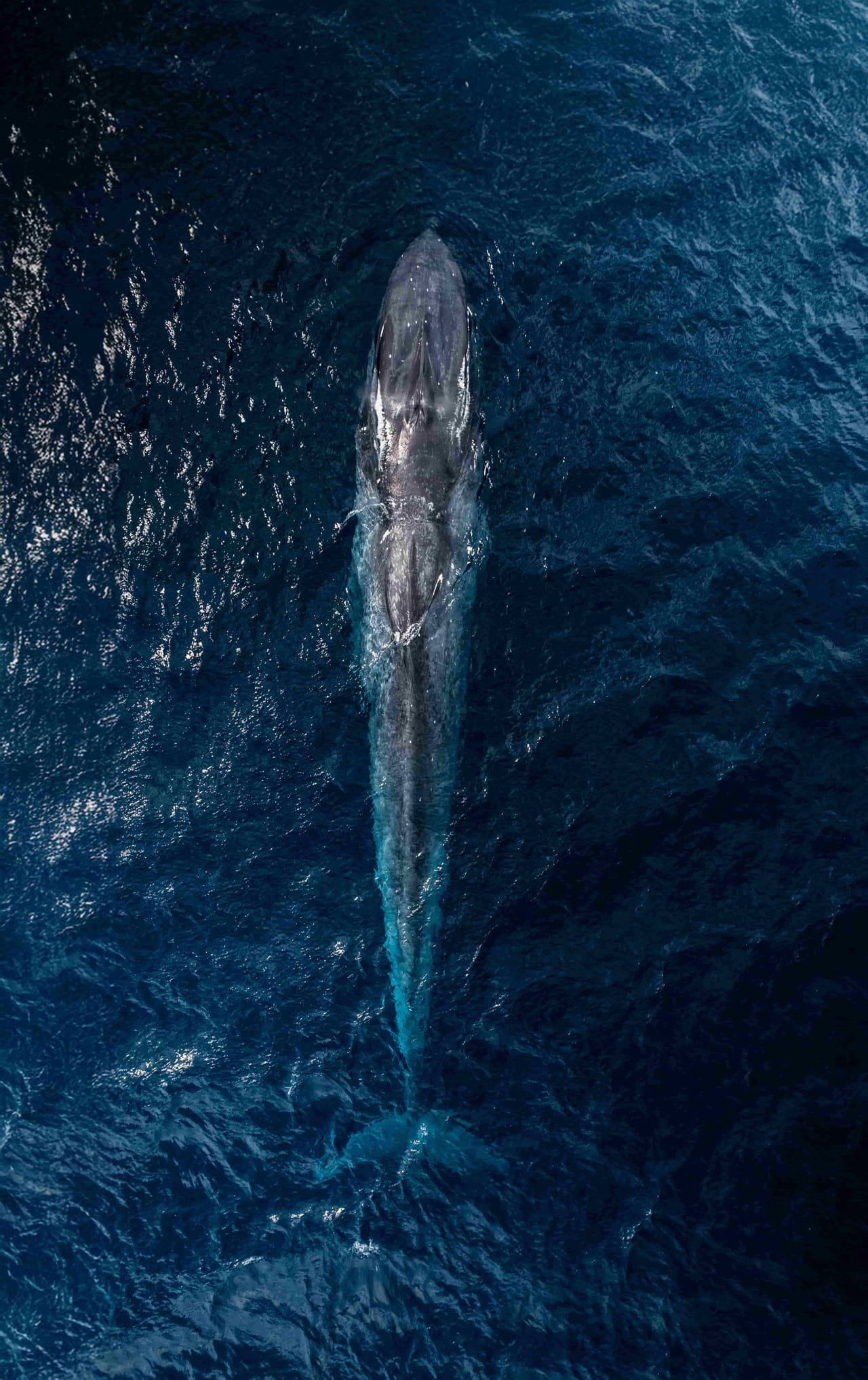
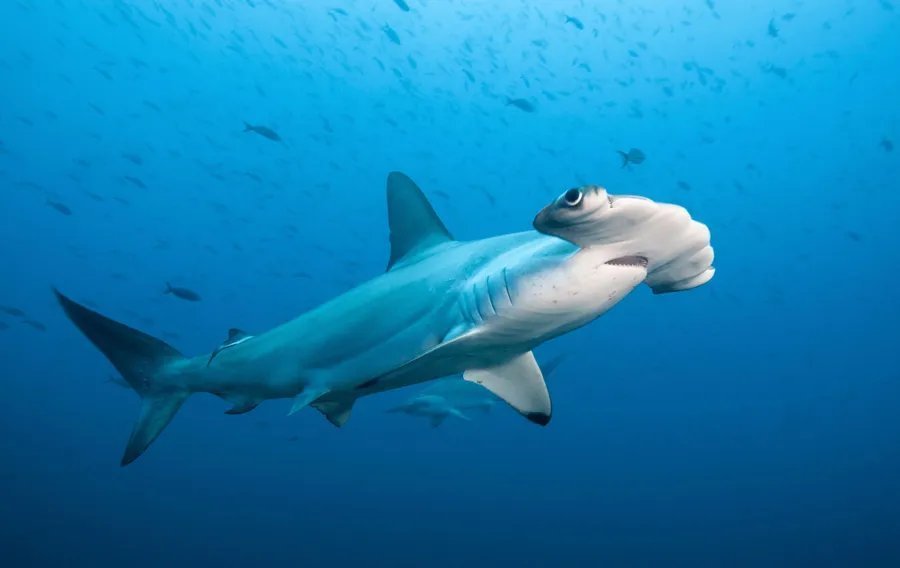
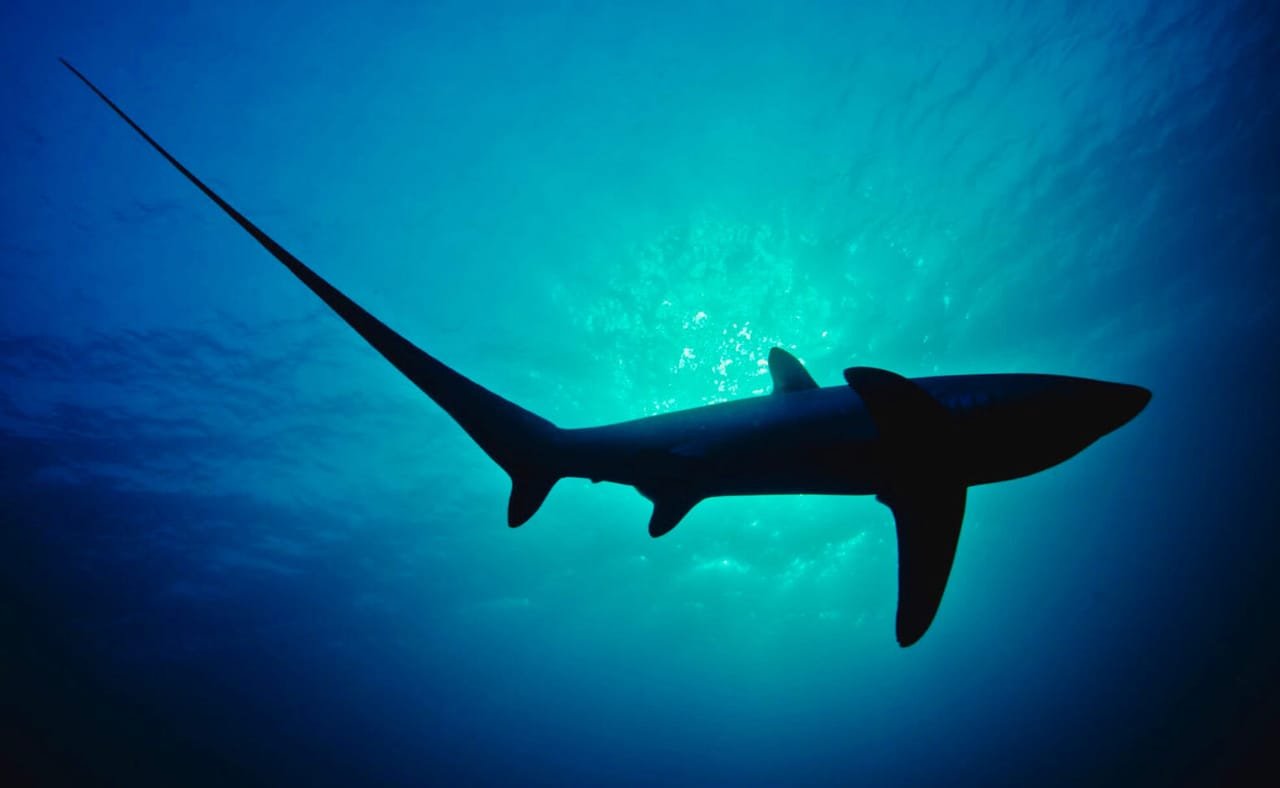
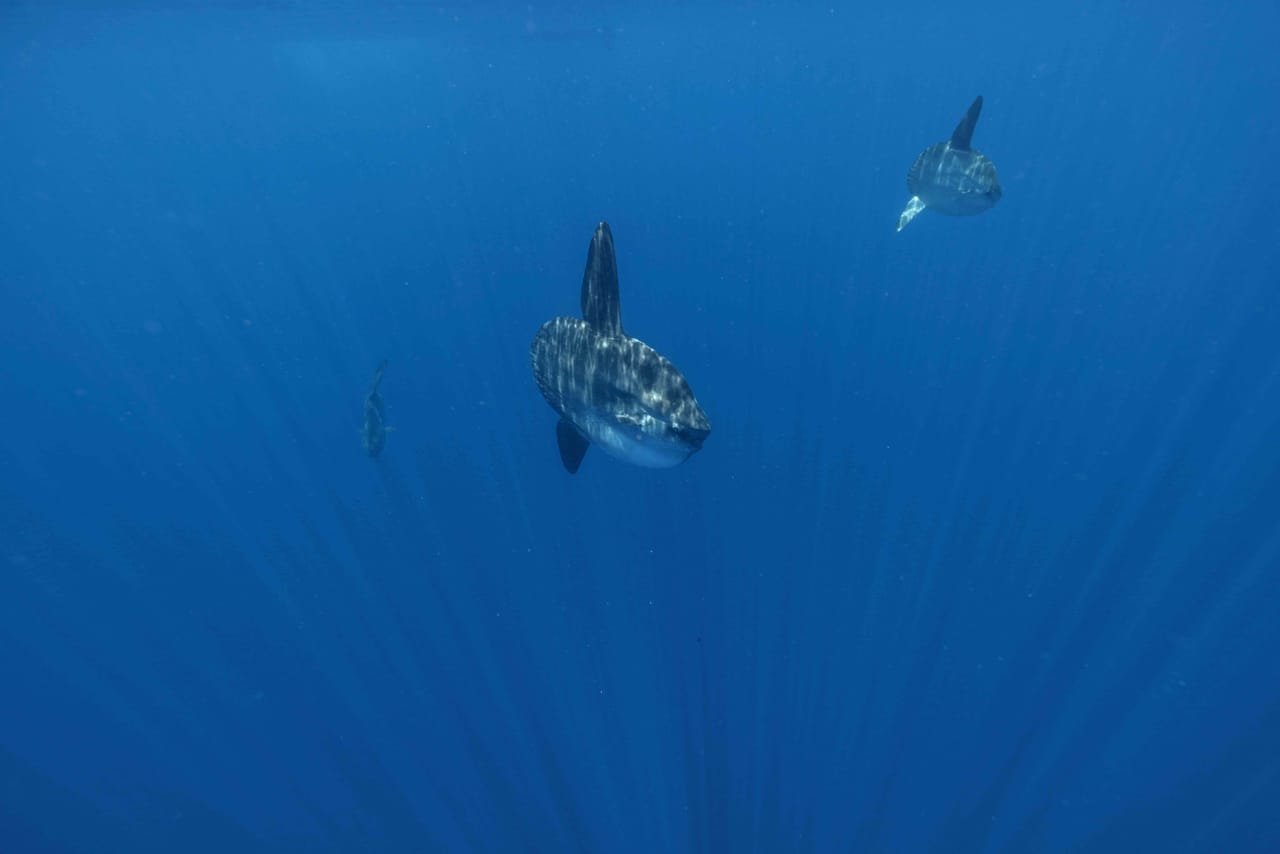
Blue whales on migration, hammerheads on the full moon, threshers in cold upwellings, mola mola in winter, and one of the densest macro scenes on Earth — all in a single strait of water.

Why Alor

A Convergence of Deep Ocean and Reef

Alor sits in the heart of the Coral Triangle, the most biodiverse marine region on the planet — a stretch of ocean shared between Indonesia, the Philippines, Malaysia, Papua New Guinea, the Solomon Islands, and Timor-Leste. Within the Coral Triangle, Alor occupies a specific and unusual position: the Pantar Strait funnels deep-ocean water between the islands of Alor and Pantar, mixing it with shallow reef habitat.

That mixing is the reason Alor punches so far above its weight. Cold upwellings draw pelagic species — mola mola, thresher sharks, dogtooth tuna — toward the walls. Migration corridors bring blue and sperm whales twice a year. Strong currents feed the reefs and keep them empty of mass tourism. And the sheltered, sandy edges of the same strait quietly produce some of the densest macro habitat in Southeast Asia.

The species below are what people come for. Some are reliable. Some are seasonal. Some are rare enough that one sighting in a week of diving makes the trip. All of them are here.

The Headliners

Eight Species, One Strait

The species below define Alor's reputation underwater. Some are seasonal, some year-round, all are reasons people come. See the full seasonal calendar

Field Guide

Everything Else You'll See Underwater

A reference of the species you'll regularly meet on Alor's reefs, walls, muck sites, and open water. Not exhaustive — but a fair guide to what shows up week to week.

Whales & Cetaceans

Two migration windows per year bring blue and sperm whales through the strait. Dolphins and pilot whales turn up on most boat trips outside those windows.

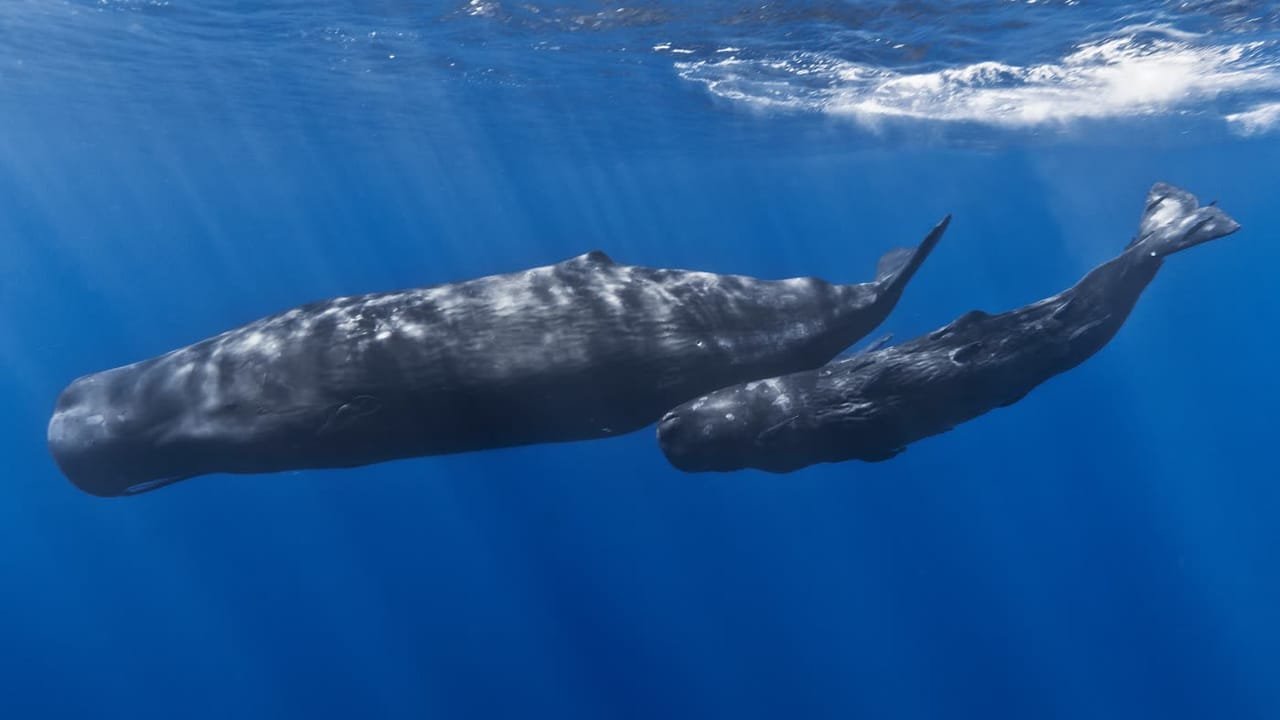
Sperm Whales — Physeter macrocephalus

Sperm Whales

Physeter macrocephalus

Year-round residents in the deep strait — deep divers, often seen logging at the surface.

Year-round
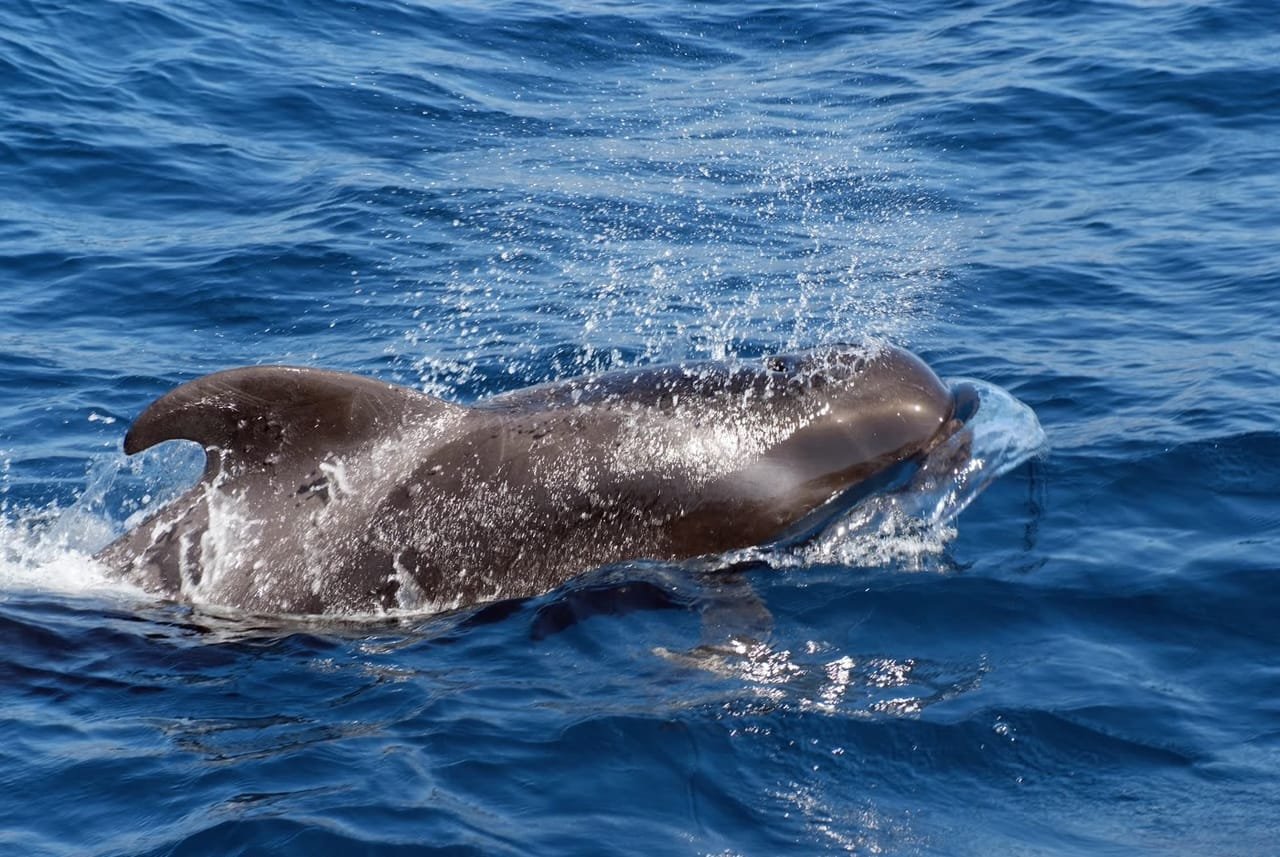
Short-finned Pilot Whales — Globicephala macrorhynchus

Short-finned Pilot Whales

Globicephala macrorhynchus

Family pods of 10–30, frequent boat trips. Curious but cautious.

Year-round
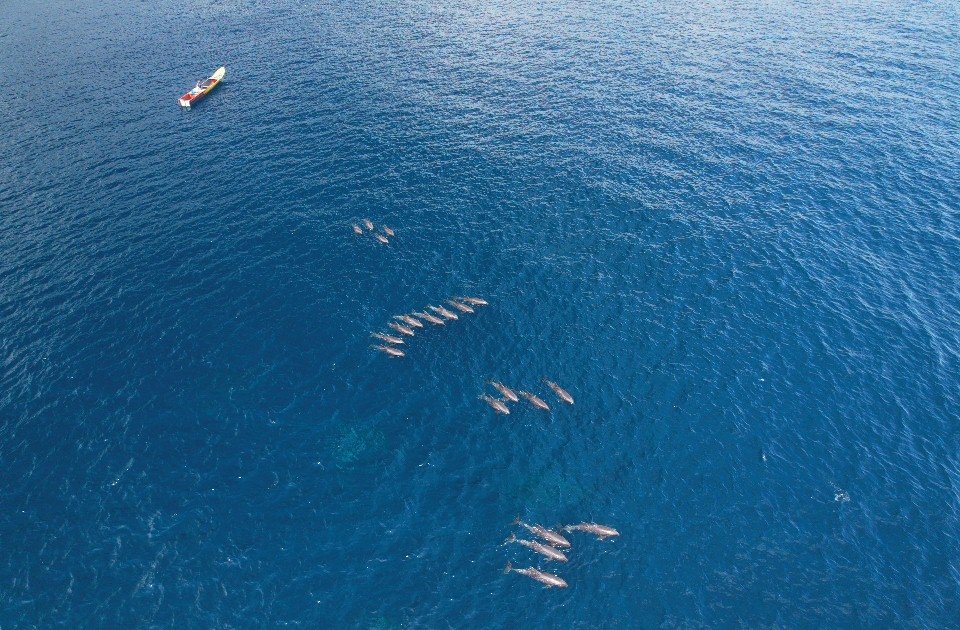
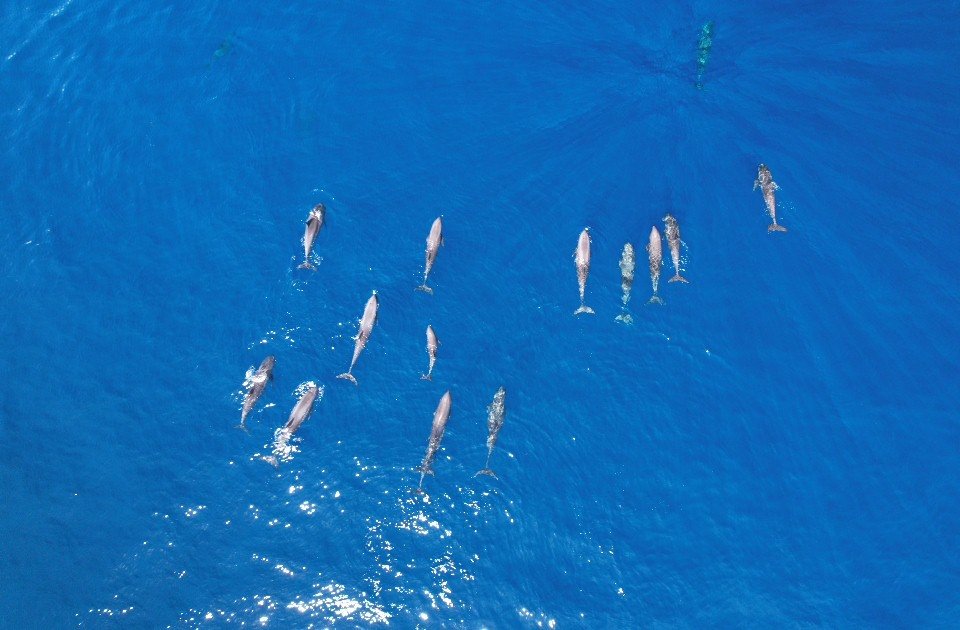
Melon-headed Whales — Peponocephala electra

Melon-headed Whales

Peponocephala electra

Oceanic dolphins in the blackfish family — dark grey-black bodies, blunt heads, no beak. Travel in tight pods of a hundred or more, often porpoising in unison. More frequent encounter than the name suggests.

Year-round
Spinner Dolphins — Stenella longirostris

Spinner Dolphins

Stenella longirostris

Acrobatic pods that ride the bow wave and leap clear of the water in tight spins.

Year-round
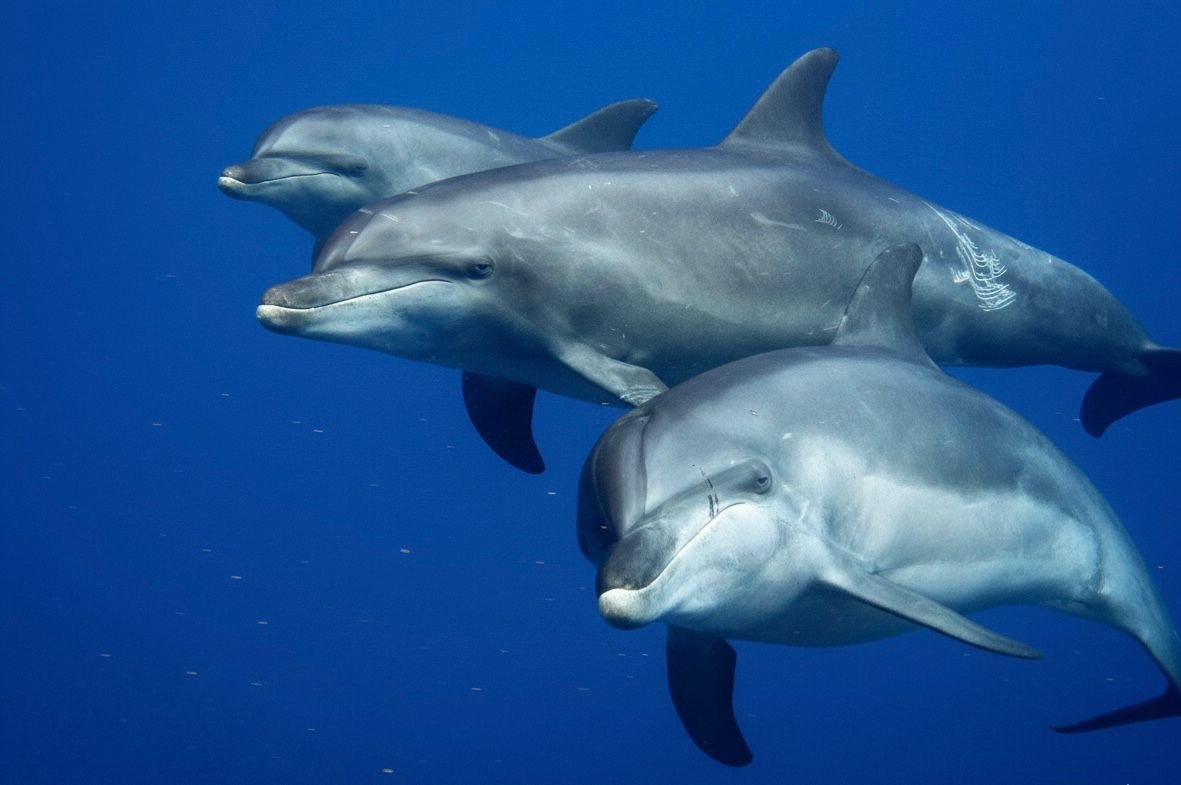
Bottlenose Dolphins — Tursiops aduncus

Bottlenose Dolphins

Tursiops aduncus

Smaller pods, often mixed with spinners. Will sometimes hang around the dive boats.

Year-round

Pelagics & Open Water

Strong currents from the deep ocean meet shallow reefs along the strait — the conditions that pull pelagics in close enough to see.

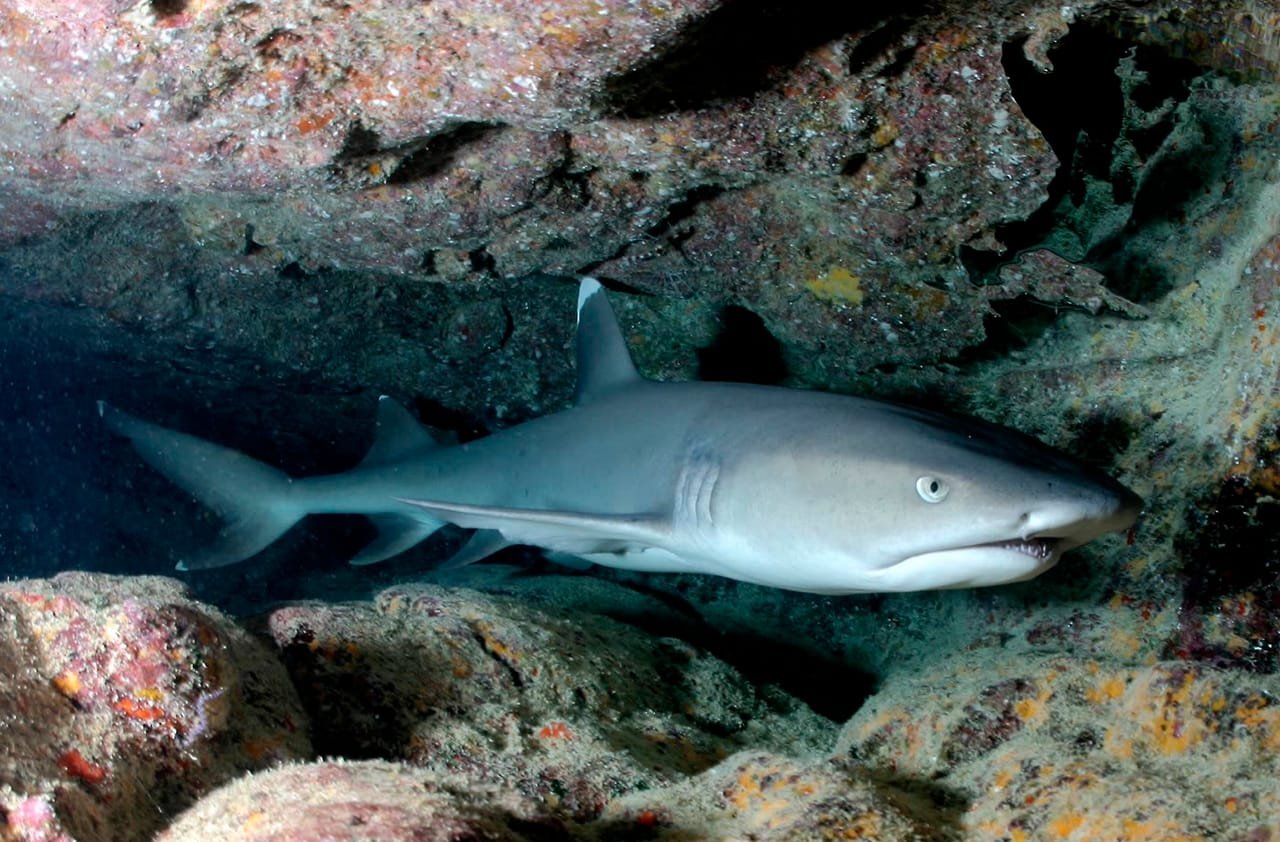
White-tip Reef Sharks — Triaenodon obesus

White-tip Reef Sharks

Triaenodon obesus

Resting on the sand under ledges by day, cruising in loose groups by night.

Regular
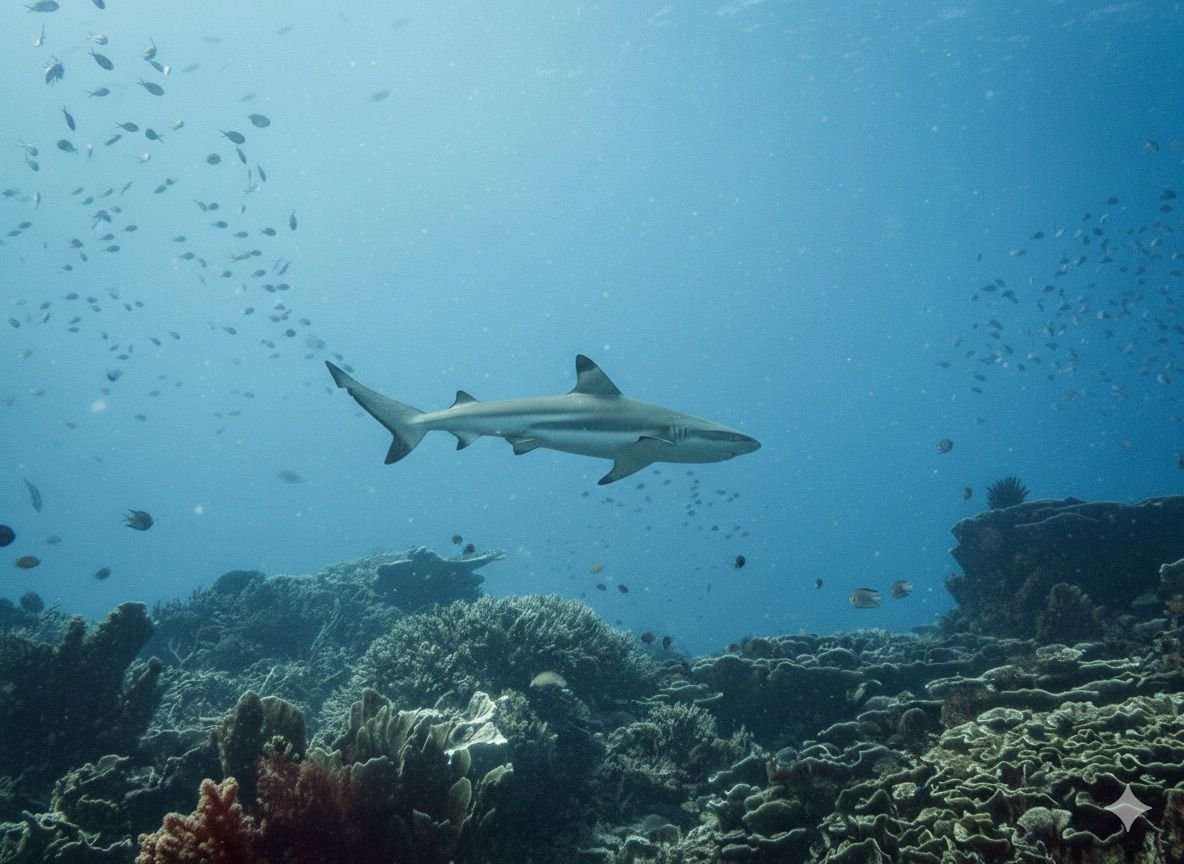
Black-tip Reef Sharks — Carcharhinus melanopterus

Black-tip Reef Sharks

Carcharhinus melanopterus

Patrolling the shallow reef edges and lagoon entrances at dawn and dusk.

Regular
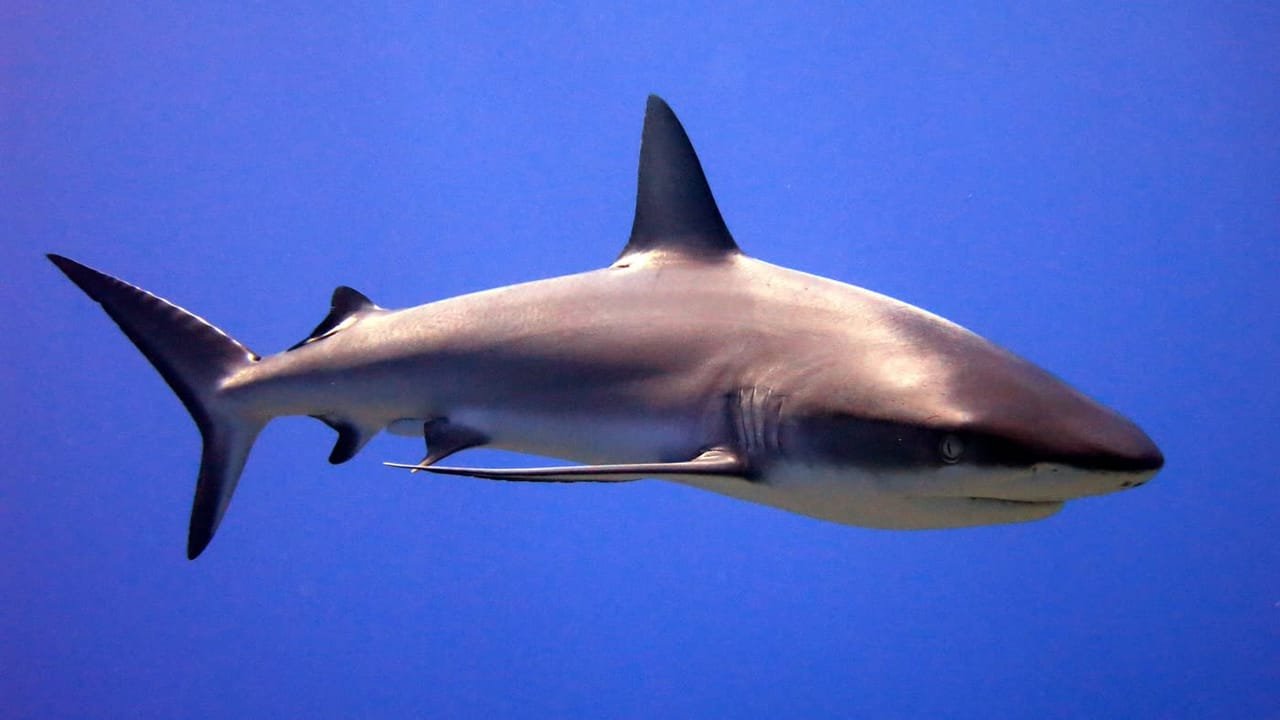
Grey Reef Sharks — Carcharhinus amblyrhynchos

Grey Reef Sharks

Carcharhinus amblyrhynchos

On the deeper drop-offs, often in current. Confident, predictable, beautiful in motion.

Regular
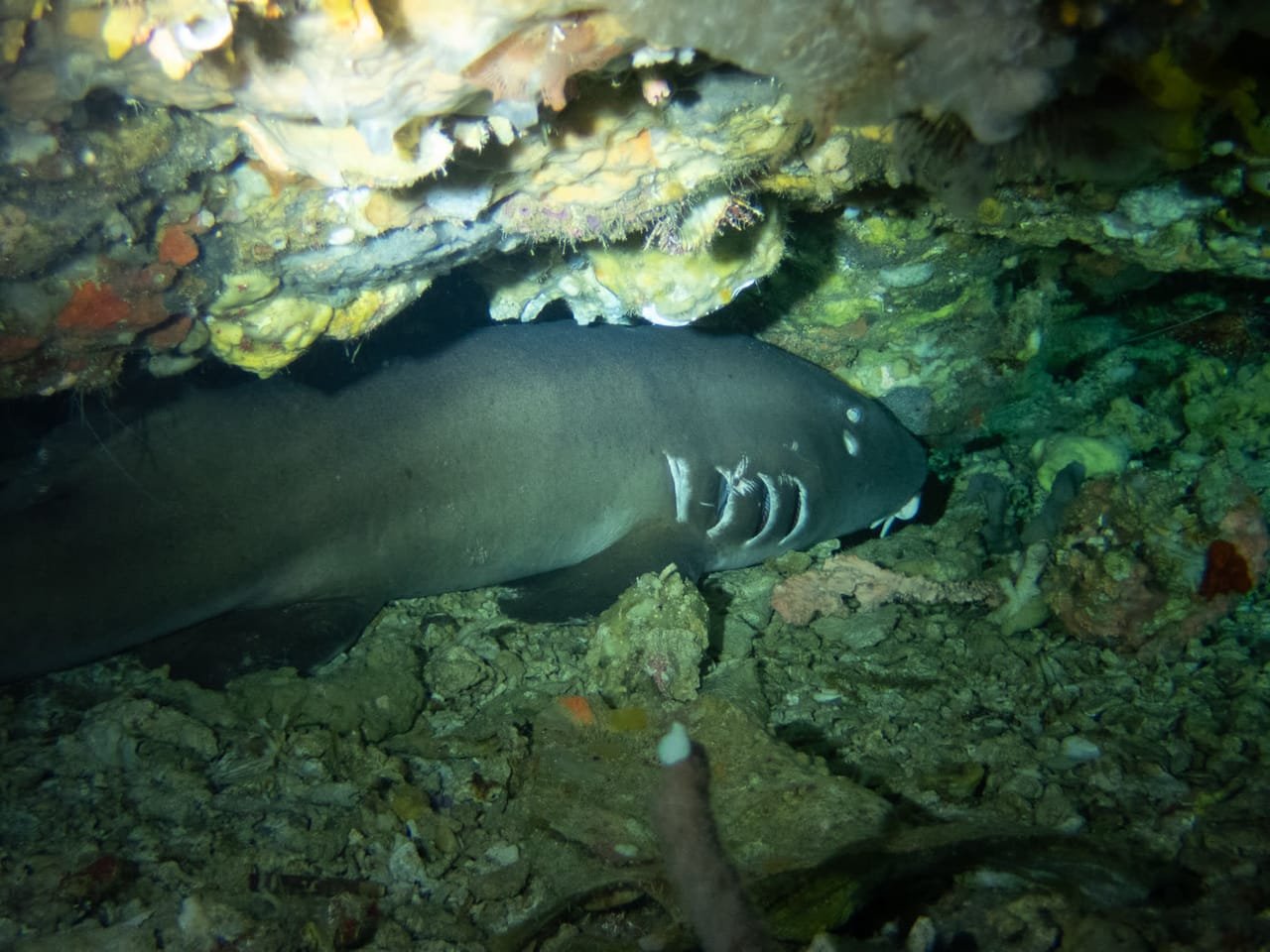
Bamboo Shark — Chiloscyllium punctatum

Bamboo Shark

Chiloscyllium punctatum

Slender, sand-coloured nocturnal sharks that tuck under ledges and inside coral overhangs by day. Glide along the bottom rather than swimming in open water. Most encounters come on night dives.

Year-round · night
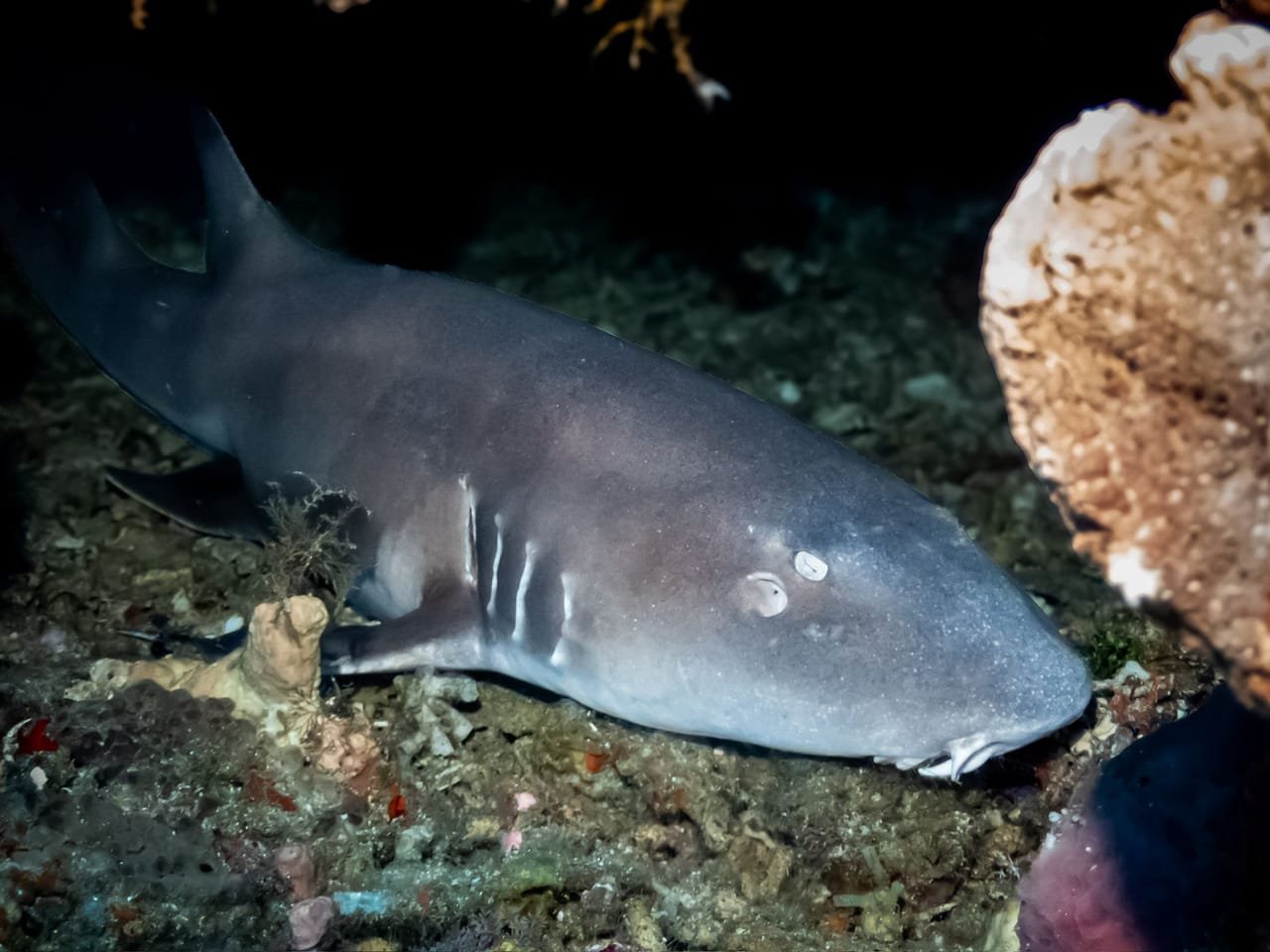
Nurse Sharks — Nebrius ferrugineus

Nurse Sharks

Nebrius ferrugineus

The tawny nurse shark — bottom-dwelling, often piled together in groups inside caves and under overhangs. Slow, docile, and most active at night.

Year-round
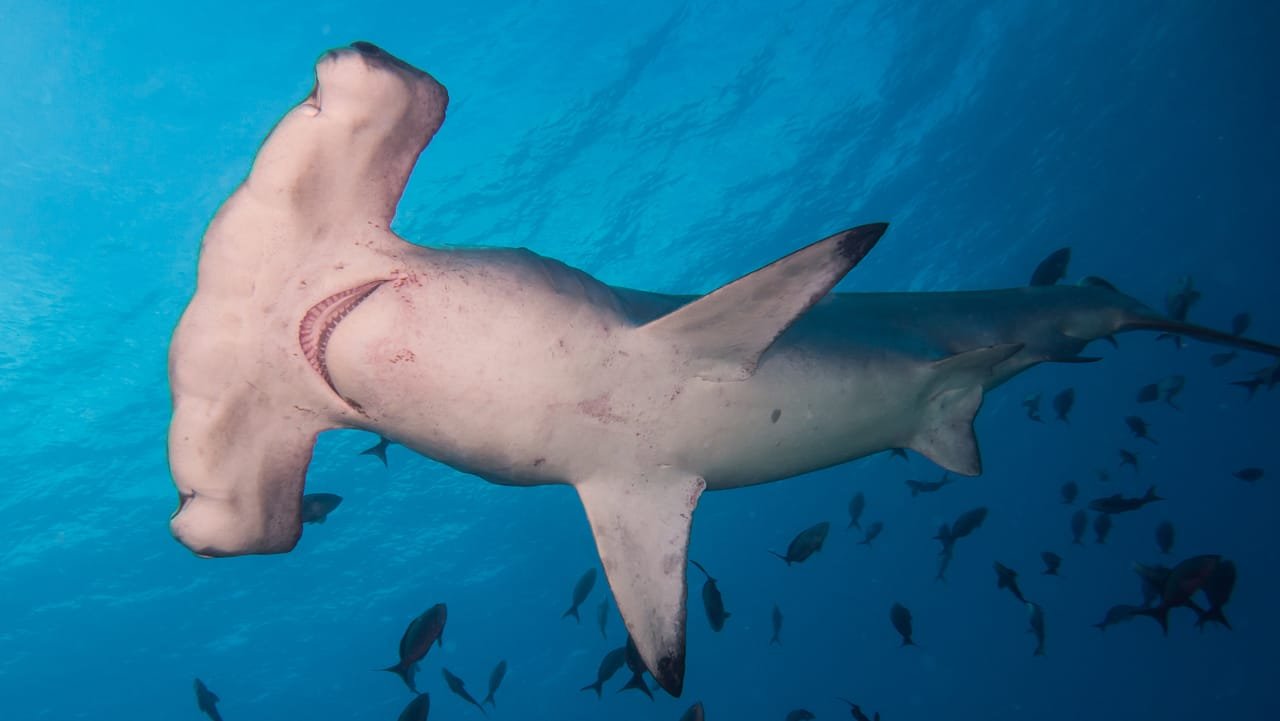
Scalloped Hammerheads — Sphyrna lewini

Scalloped Hammerheads

Sphyrna lewini

Schools form on the full and new moon when currents and upwellings are strongest. Groups range from a handful to 50–60 along the deep walls.

Year-round · lunar
Where to dive for it
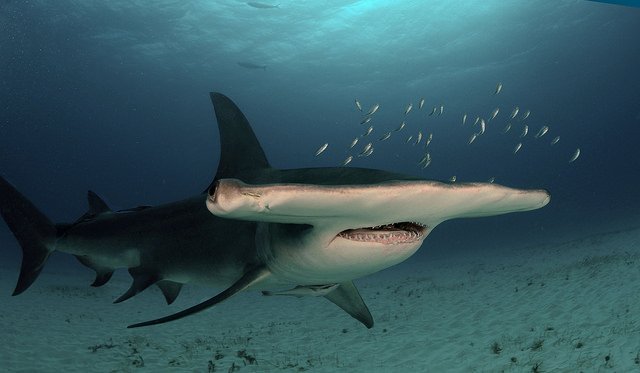
Great Hammerhead — Sphyrna mokarran

Great Hammerhead

Sphyrna mokarran

Larger and more solitary than the scalloped species. Less frequent and harder to predict — adults occasionally cruise the deeper currents at the southern walls and pinnacles.

Year-round
Mola Mola — Mola mola

Mola Mola

Mola mola

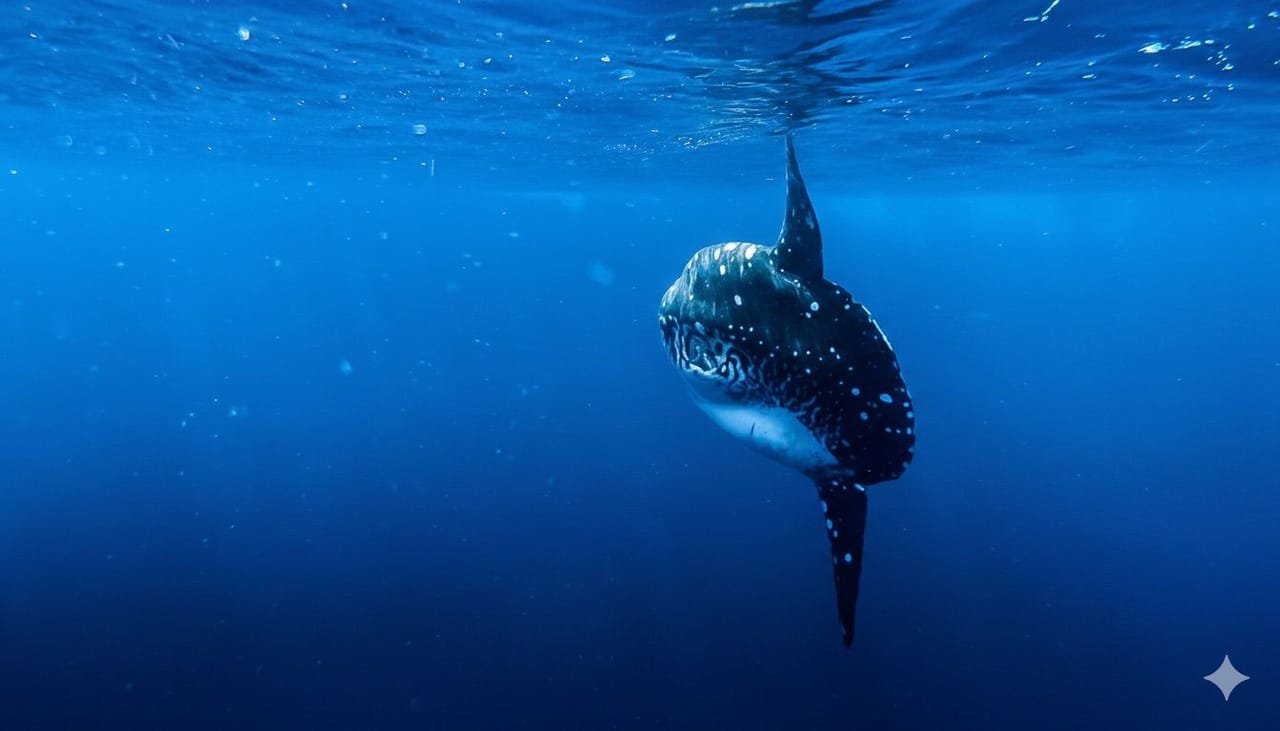
The world's heaviest bony fish. Most reliably seen at the surface year-round, where upwellings bring them up to sunbathe — we often snorkel and freedive with them during surface intervals. On the deep walls of the southern strait they're seasonal (Sep–Dec) and cold.

Surface year-round · Dives Sep–Dec
Eagle Rays — Aetobatus ocellatus

Eagle Rays

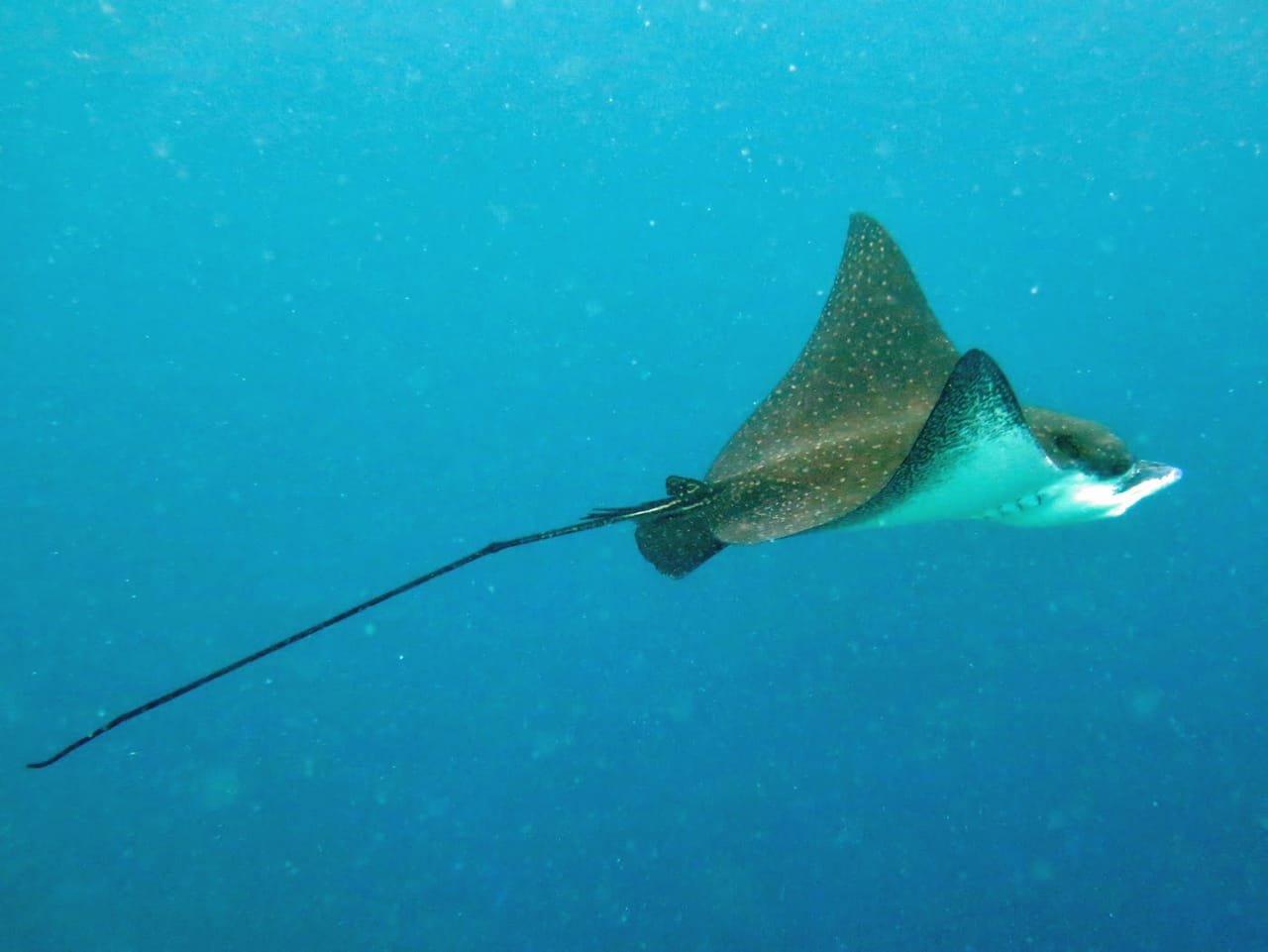
Aetobatus ocellatus

Singly or in small groups gliding past walls, sometimes stopping at cleaning stations.

Year-round
Dogtooth Tuna — Gymnosarda unicolor

Dogtooth Tuna

Gymnosarda unicolor

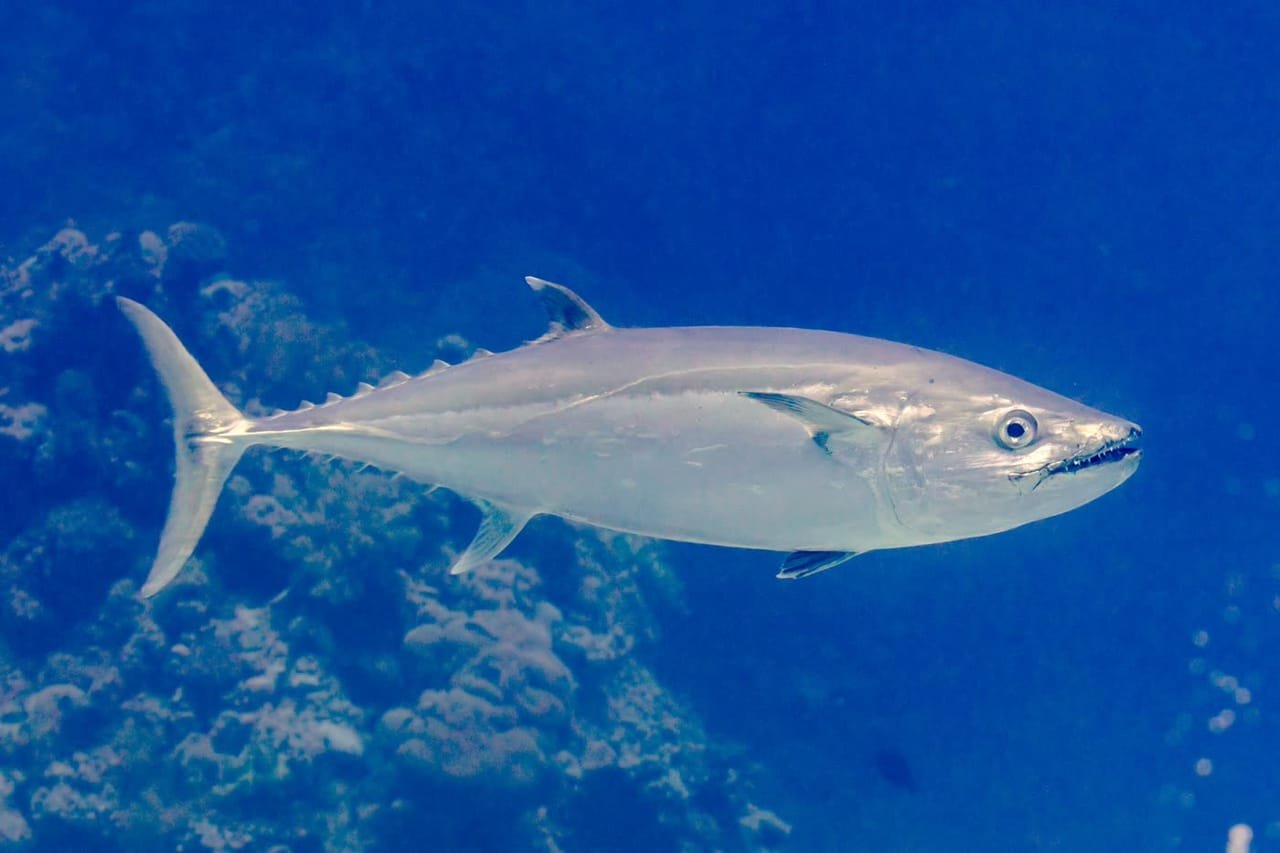
Lone hunters or small groups in current at deeper sites — fast, silvery, watchful.

Year-round
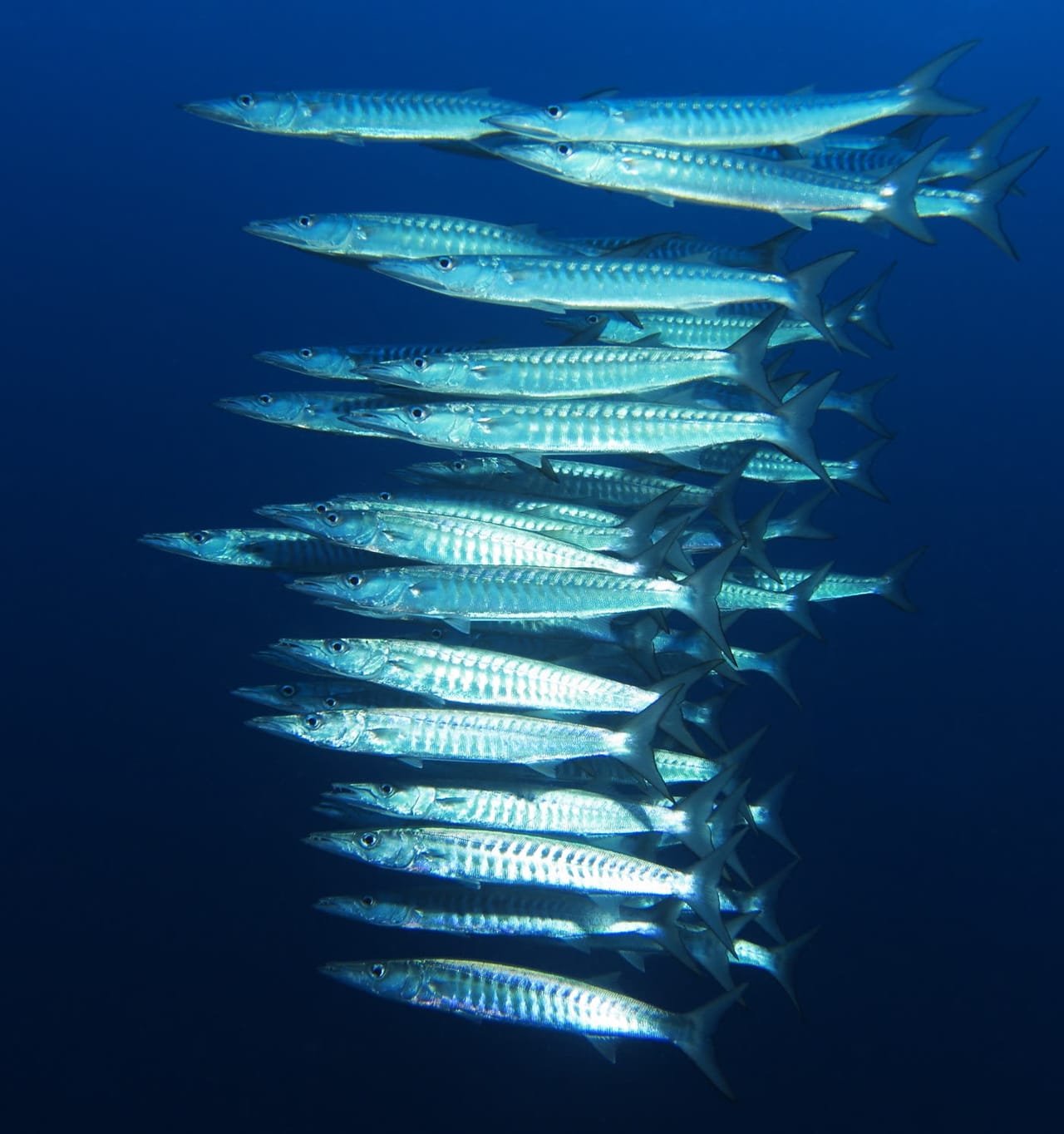
Schooling Barracuda — Sphyraena qenie

Schooling Barracuda

Sphyraena qenie

Tight cyclones of fish at the corners of pelagic sites, particularly in strong current.

Year-round
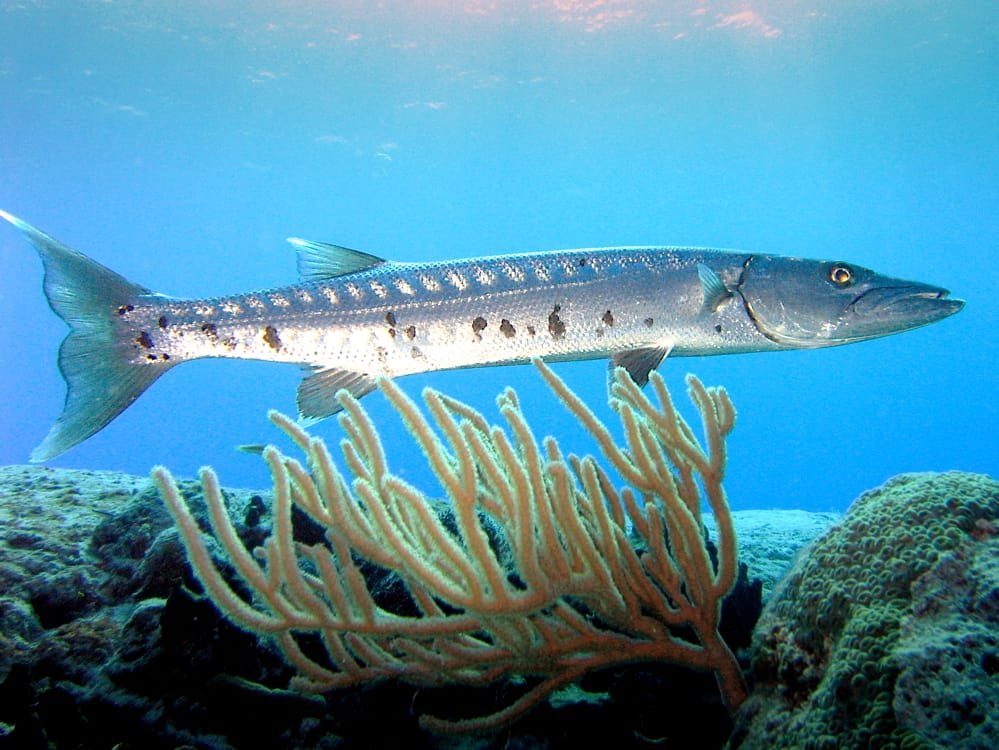
Great Barracuda — Sphyraena barracuda

Great Barracuda

Sphyraena barracuda

Larger and more solitary than the schooling Sphyraena qenie — adults are 1.5m+ ambush predators, often holding alone or in pairs along the wall.

Year-round
Where to dive for it

Reef Life

The bread and butter of every dive — turtles, schools, big resident reef fish on healthy coral.

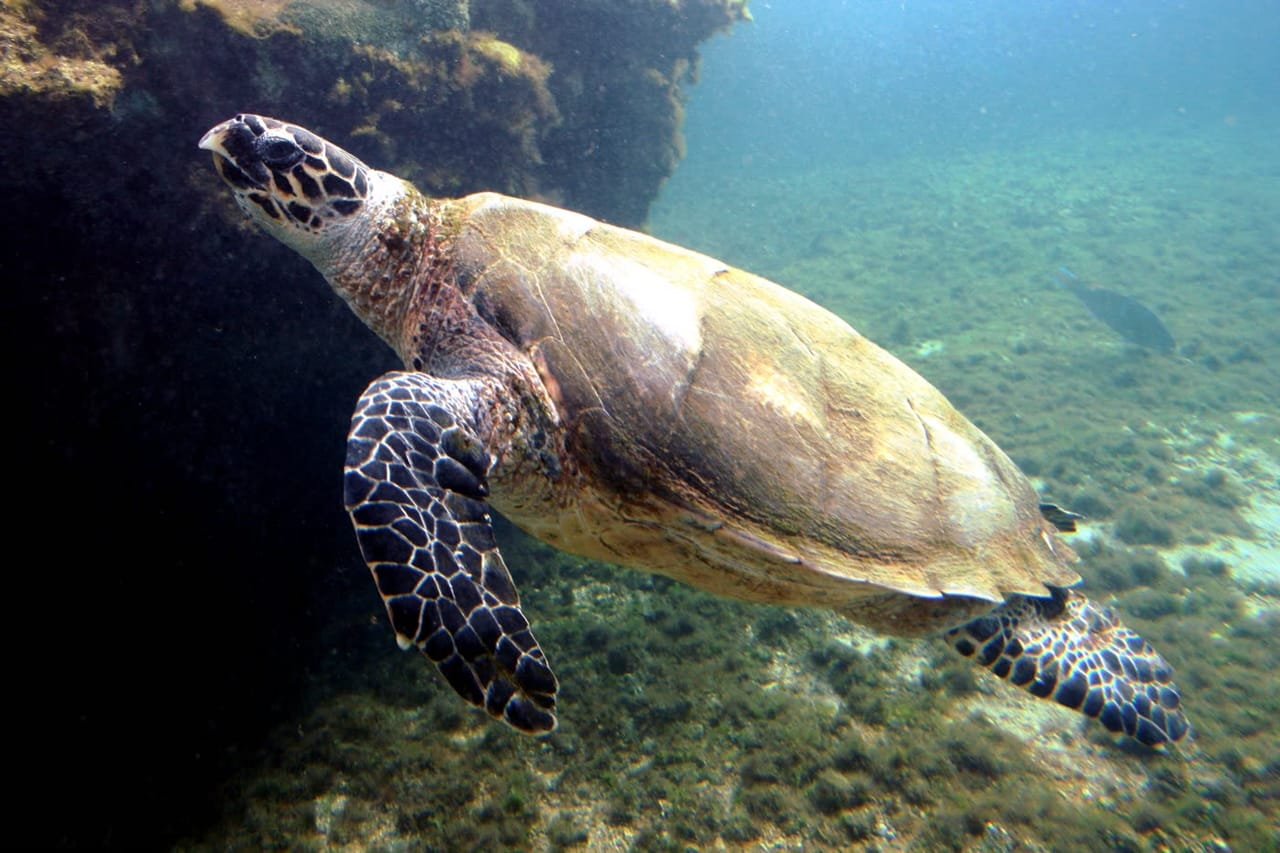
Hawksbill Turtles — Eretmochelys imbricata

Hawksbill Turtles

Eretmochelys imbricata

Common on the reefs and walls, often resting under ledges. Critically endangered globally.

Year-round
Where to dive for it
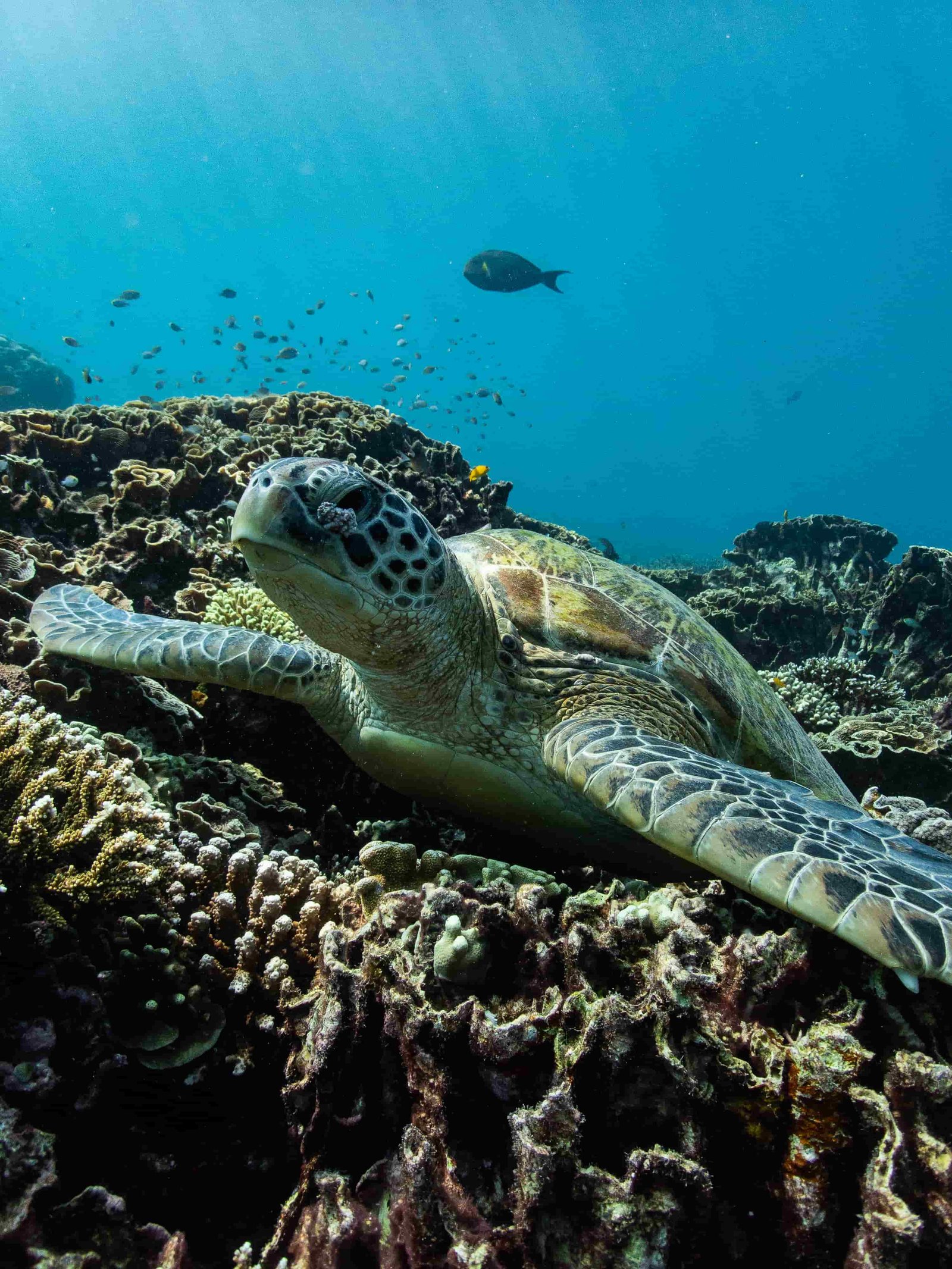
Green Turtles — Chelonia mydas

Green Turtles

Chelonia mydas

Larger and rounder than hawksbills, often grazing on algae in shallow areas.

Year-round
Where to dive for it
Dugong — Dugong dugon

Dugong

Dugong dugon

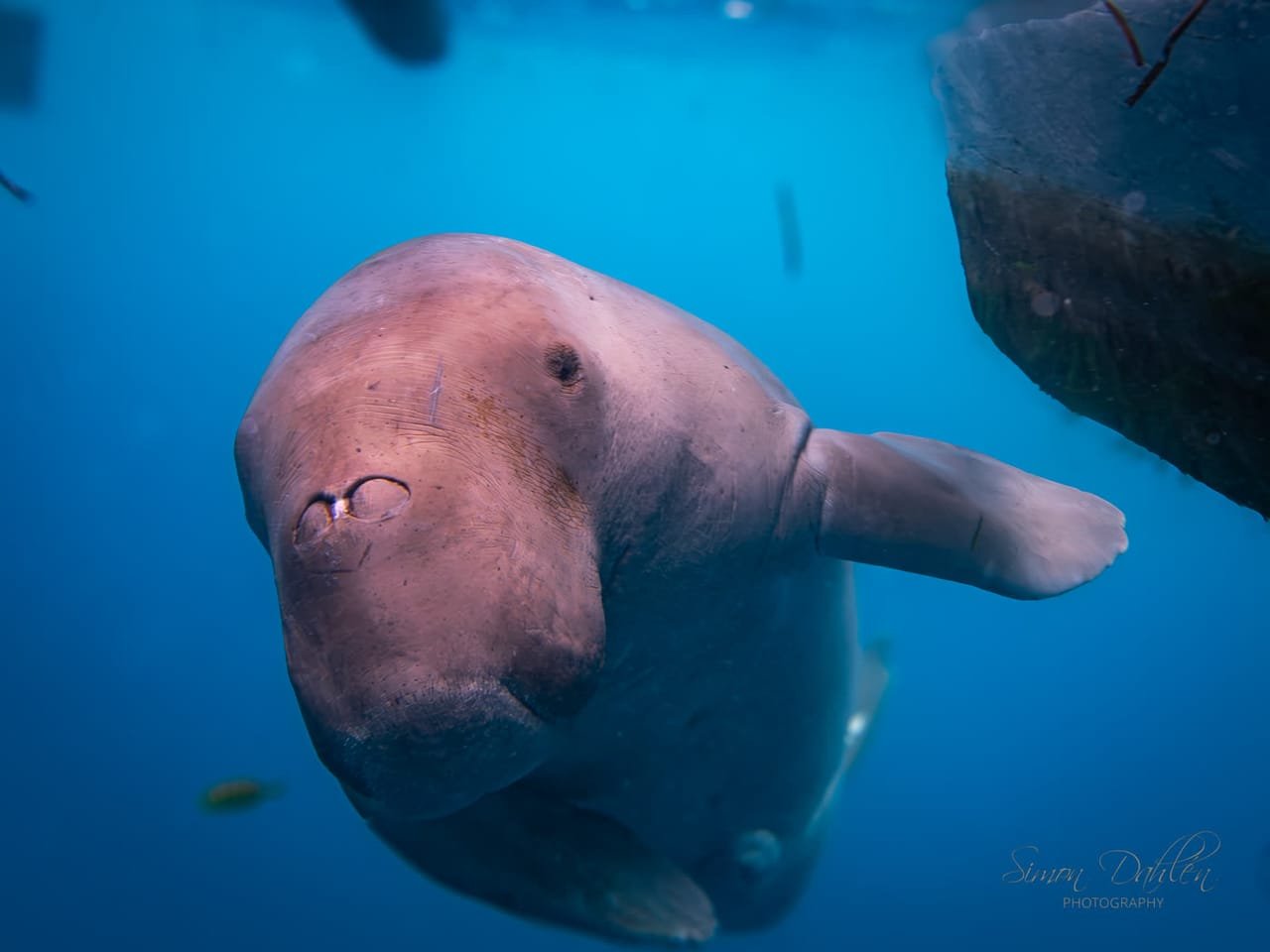
Alor has a resident dugong named Mawar — a solitary male who patrols a stretch of seagrass and reef. Sightings are never guaranteed but more reliable here than almost anywhere else in Indonesia. Slow, curious, often willing to come close.

Resident · Mawar
Bumphead Parrotfish — Bolbometopon muricatum

Bumphead Parrotfish

Bolbometopon muricatum

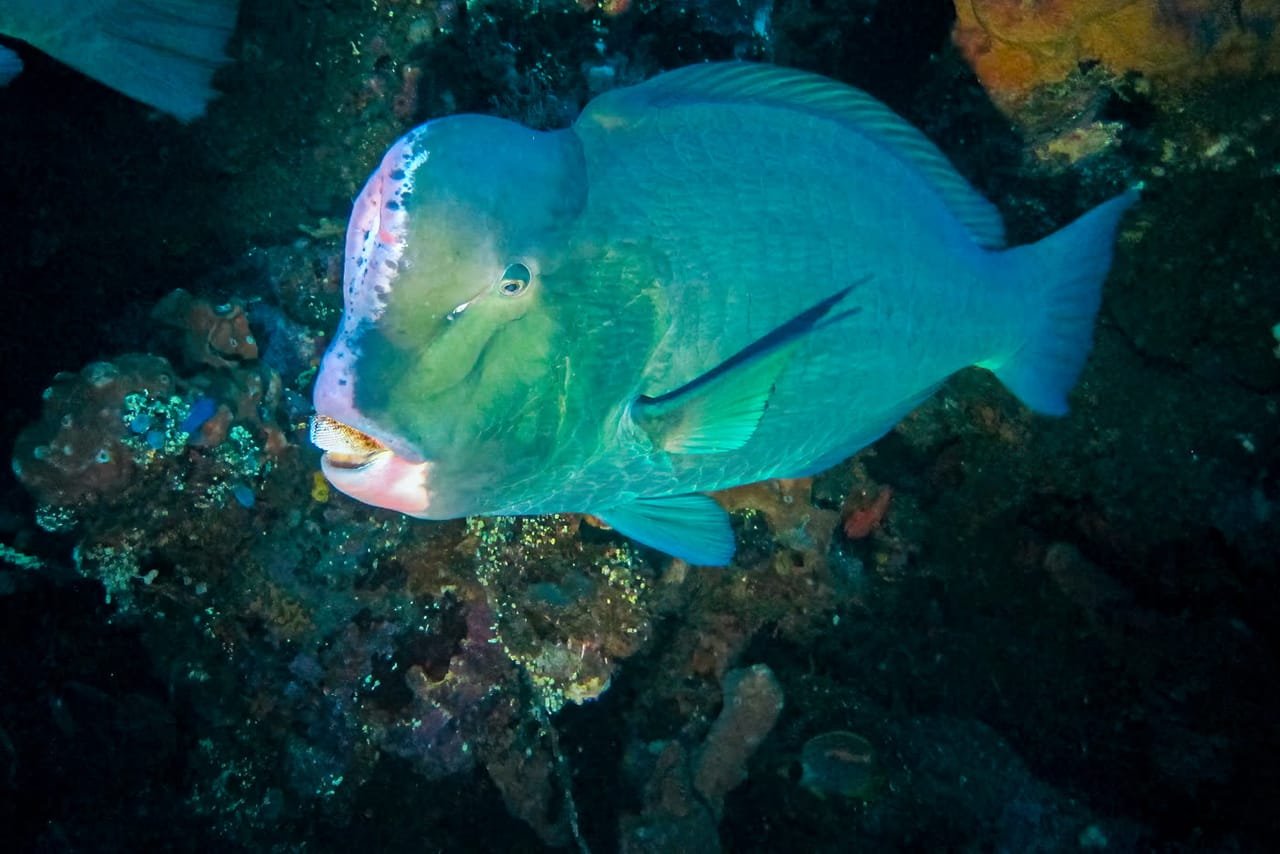
Schools of fifty-plus crashing through coral at dawn — a once-in-a-trip encounter.

Year-round
Napoleon Wrasse — Cheilinus undulatus

Napoleon Wrasse

Cheilinus undulatus

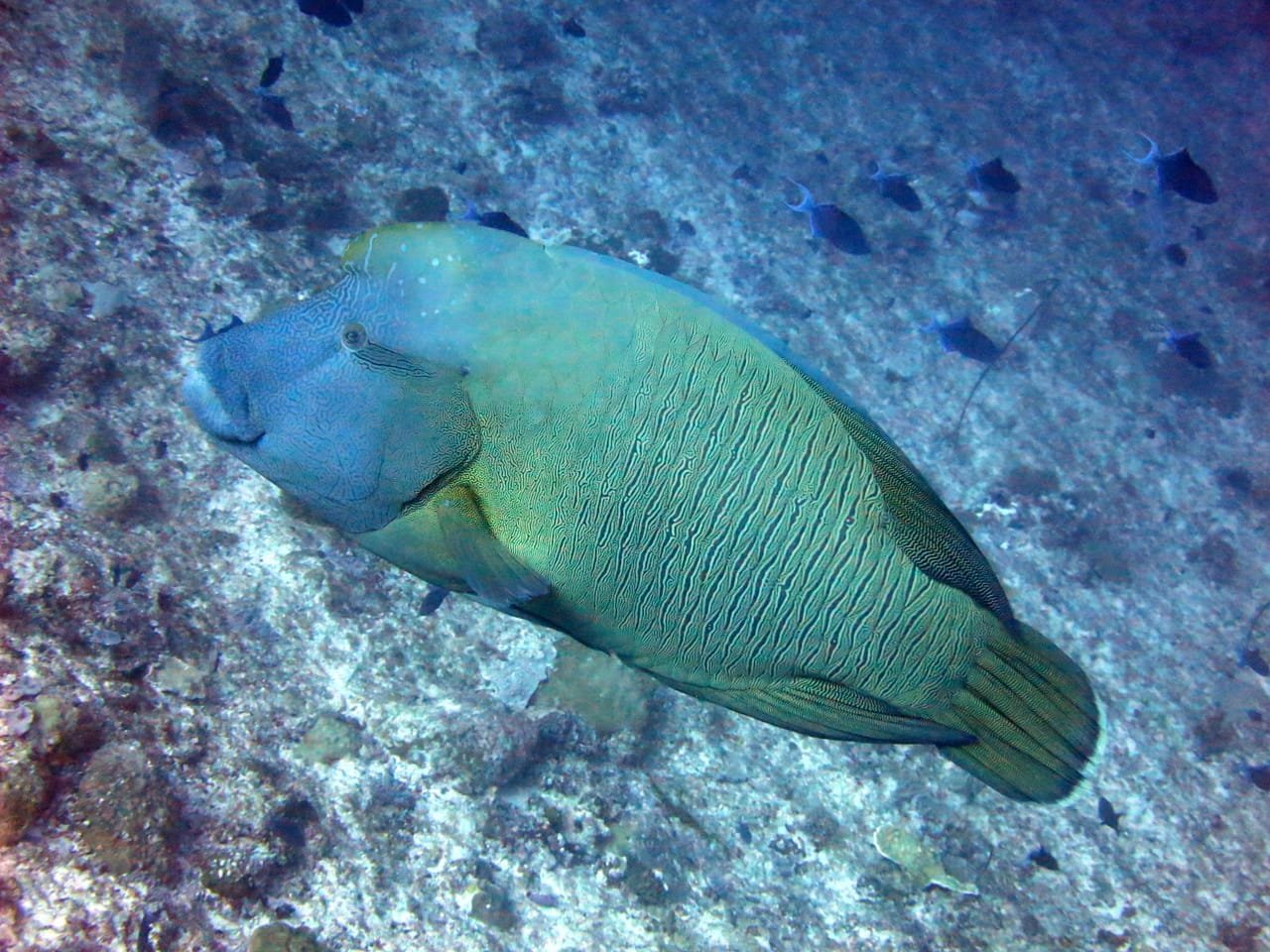
Adults reach over a metre — gentle giants that often follow divers along the reef.

Year-round
Redtooth Triggerfish — Odonus niger

Redtooth Triggerfish

Odonus niger

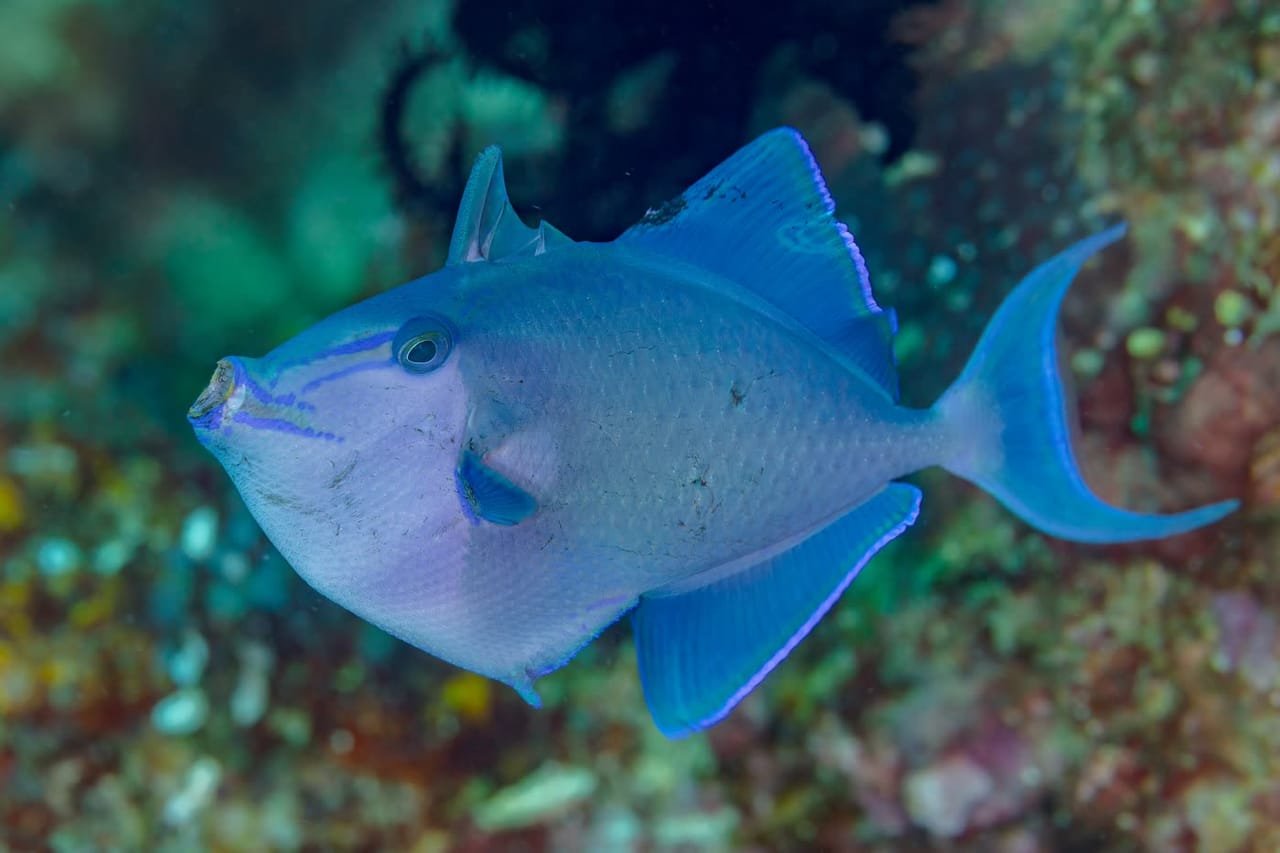
Slate-blue schooling triggerfish with sharp red teeth and trailing tail filaments. Hover in tight clouds above the wall where the current rips through.

Year-round
Where to dive for it
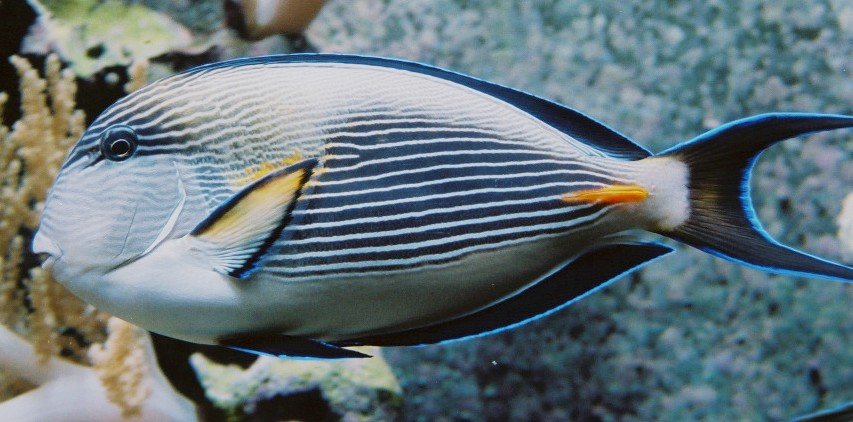
Surgeonfish — Acanthuridae

Surgeonfish

Acanthuridae

Many species across the family. Schools of yellowtail and powder-blue tangs sweep along the reef edge, working the algae in a moving wall of fish.

Year-round
Where to dive for it
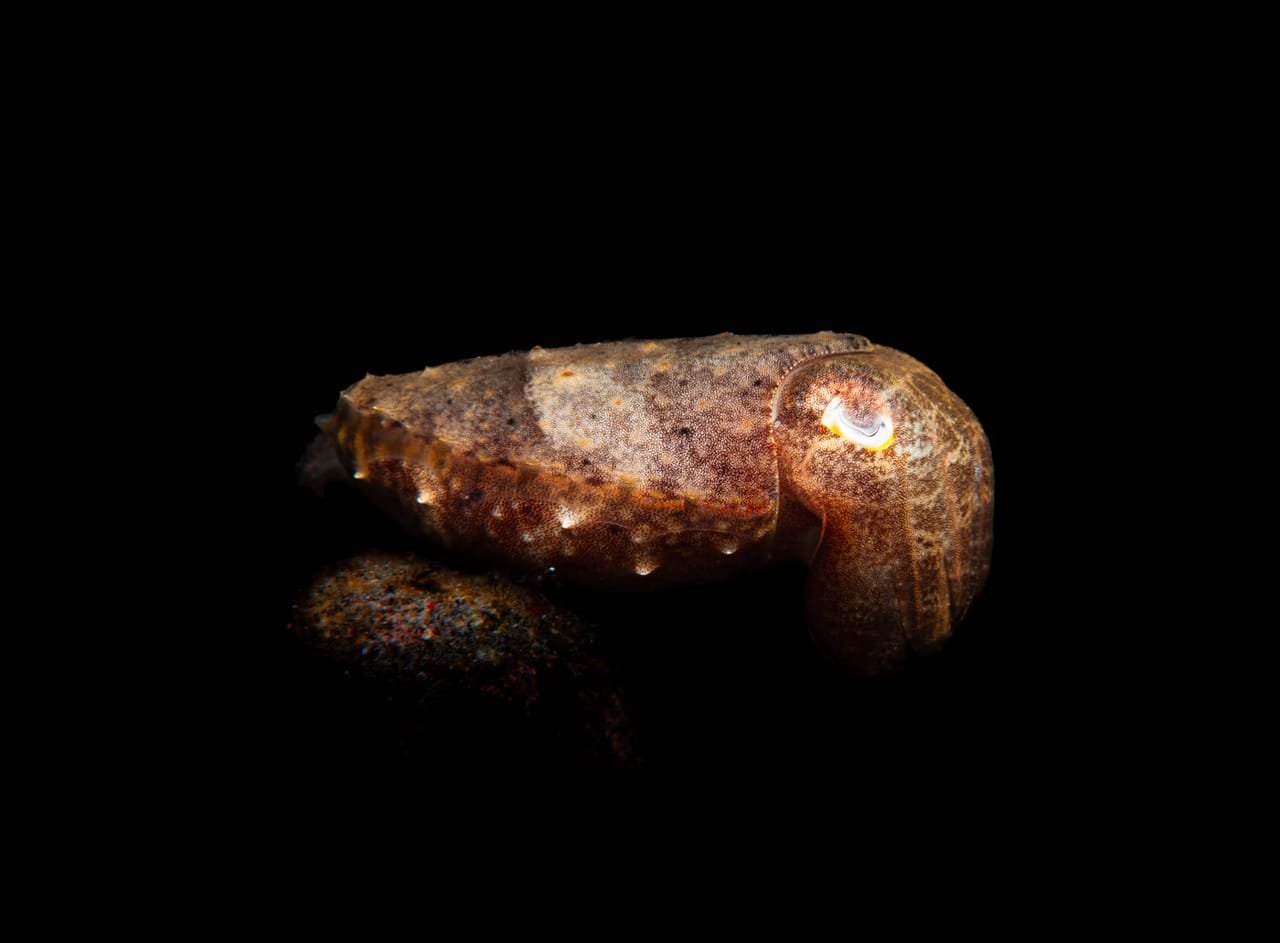
Cuttlefish — Sepia latimanus & others

Cuttlefish

Sepia latimanus & others

Hovering, colour-shifting, endlessly curious. Frequent on the reef and house reef.

Year-round
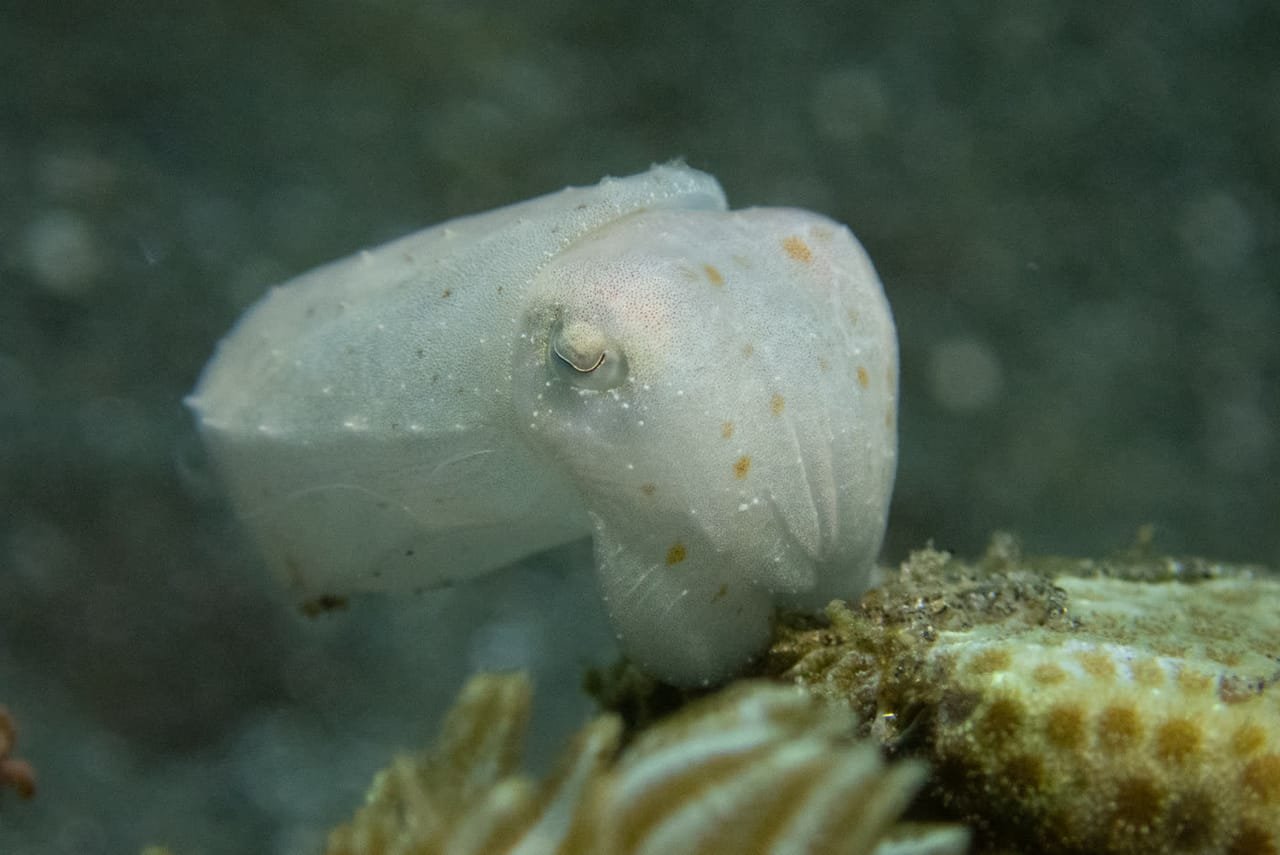
Dwarf Cuttlefish — Sepia bandensis

Dwarf Cuttlefish

Sepia bandensis

A small cuttlefish — rarely over 7 cm — that hovers above sand and rubble. Pale body with golden spots, big expressive eyes. Often seen on muck dives in pairs or small groups, and a favourite for macro photography.

Year-round
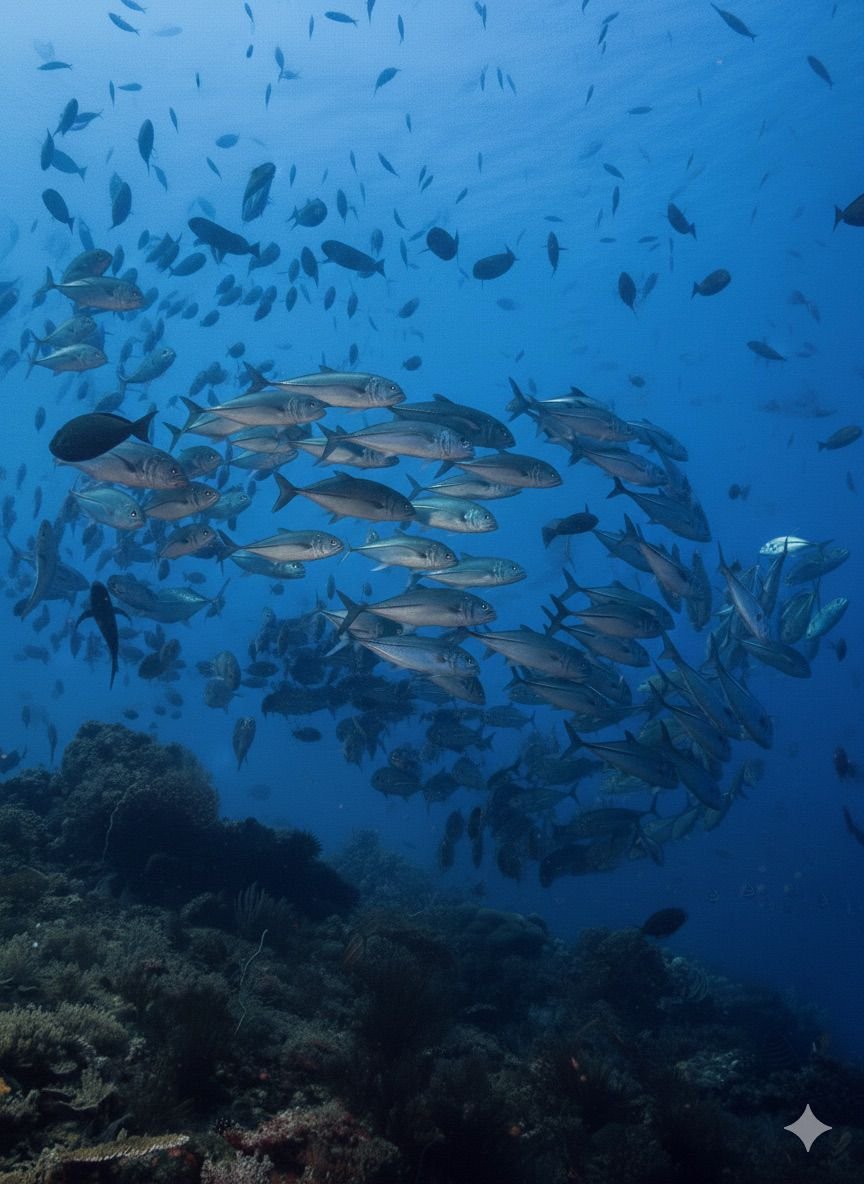
Schooling Jacks — Caranx sexfasciatus

Schooling Jacks

Caranx sexfasciatus

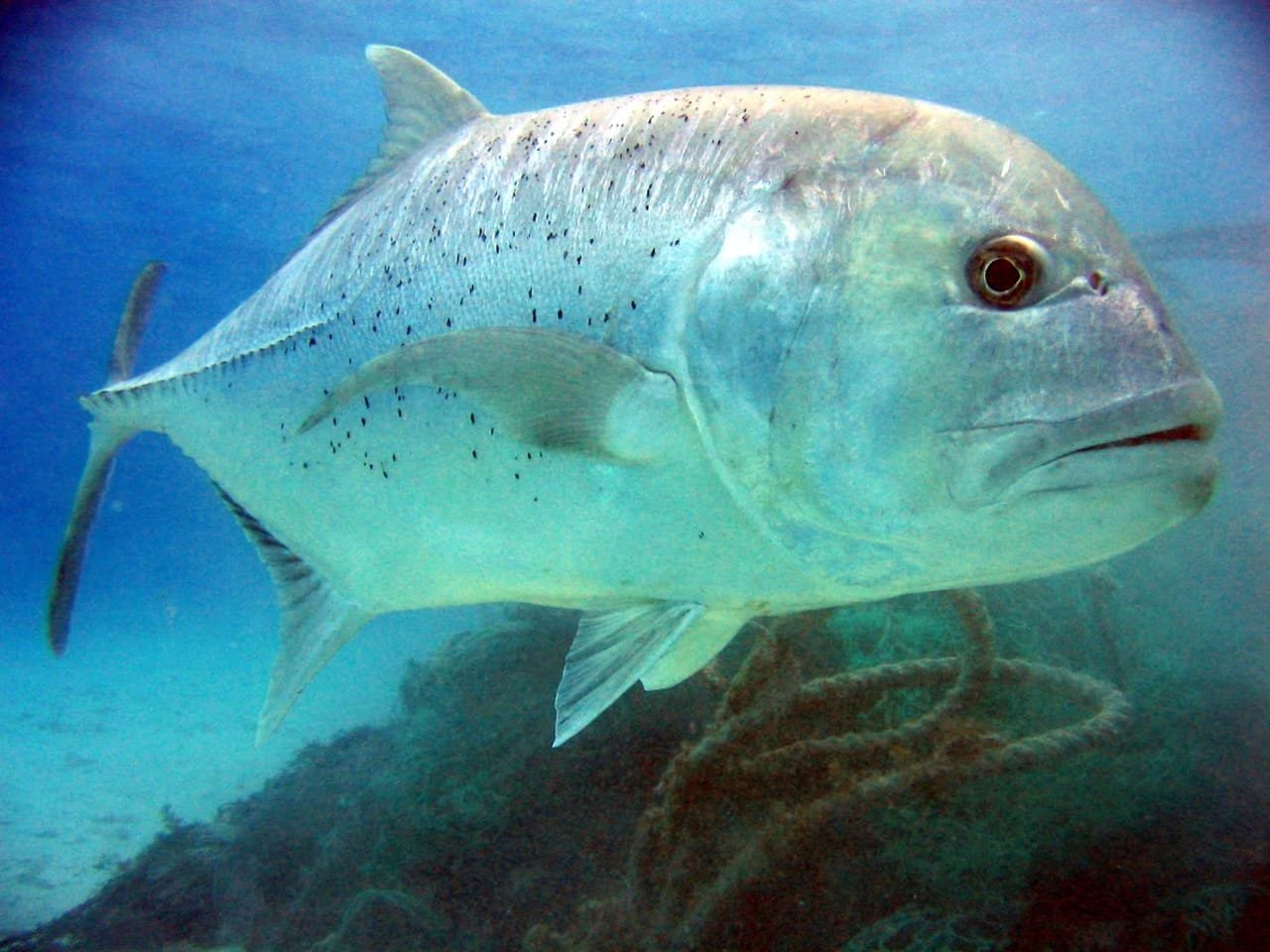
Big-eye trevally in tornado formations at the deeper pelagic sites.

Year-round
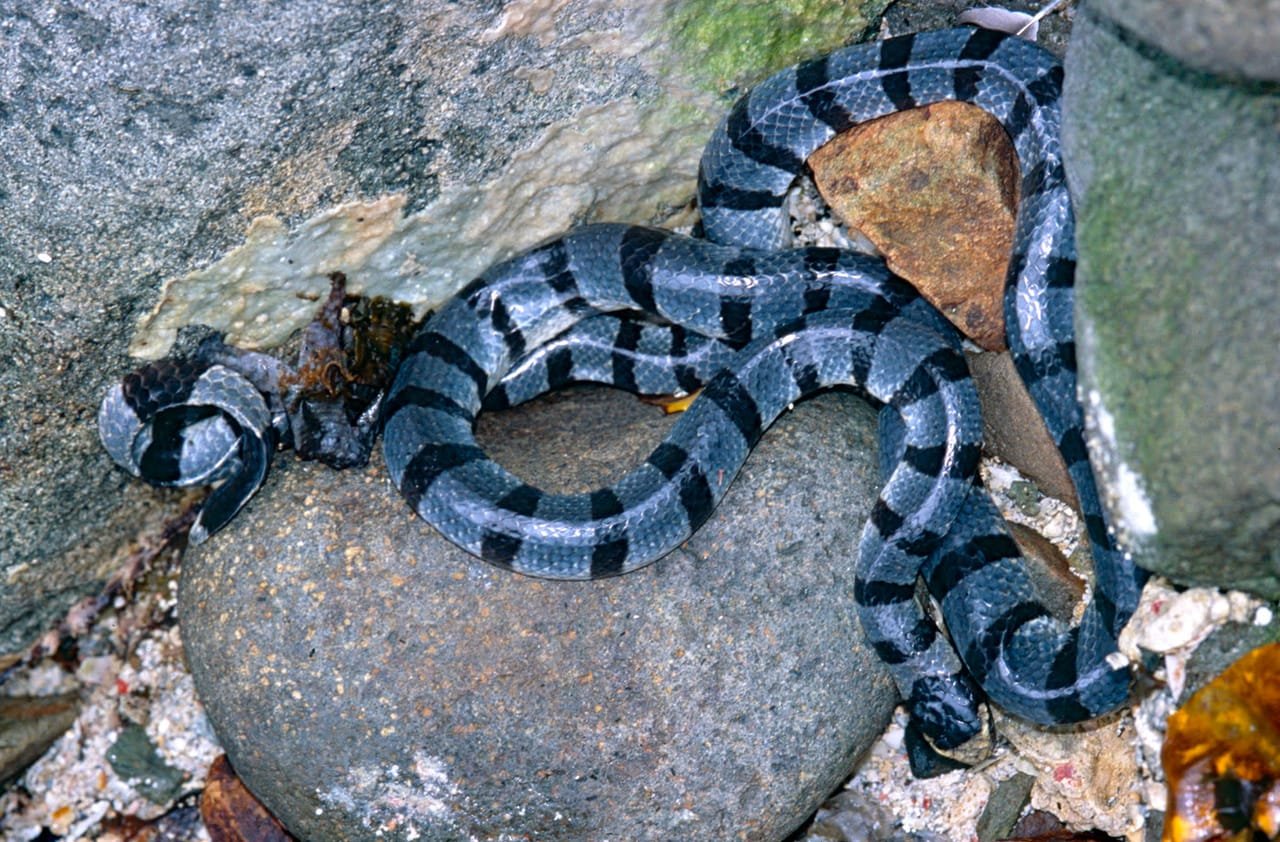
Sea Snakes — Laticauda colubrina & Hydrophis spp.

Sea Snakes

Laticauda colubrina & Hydrophis spp.

Banded sea kraits and true sea snakes both show up on the walls and deeper reefs. Slow, indifferent to divers, and venomous but very rarely defensive.

Year-round
Where to dive for it
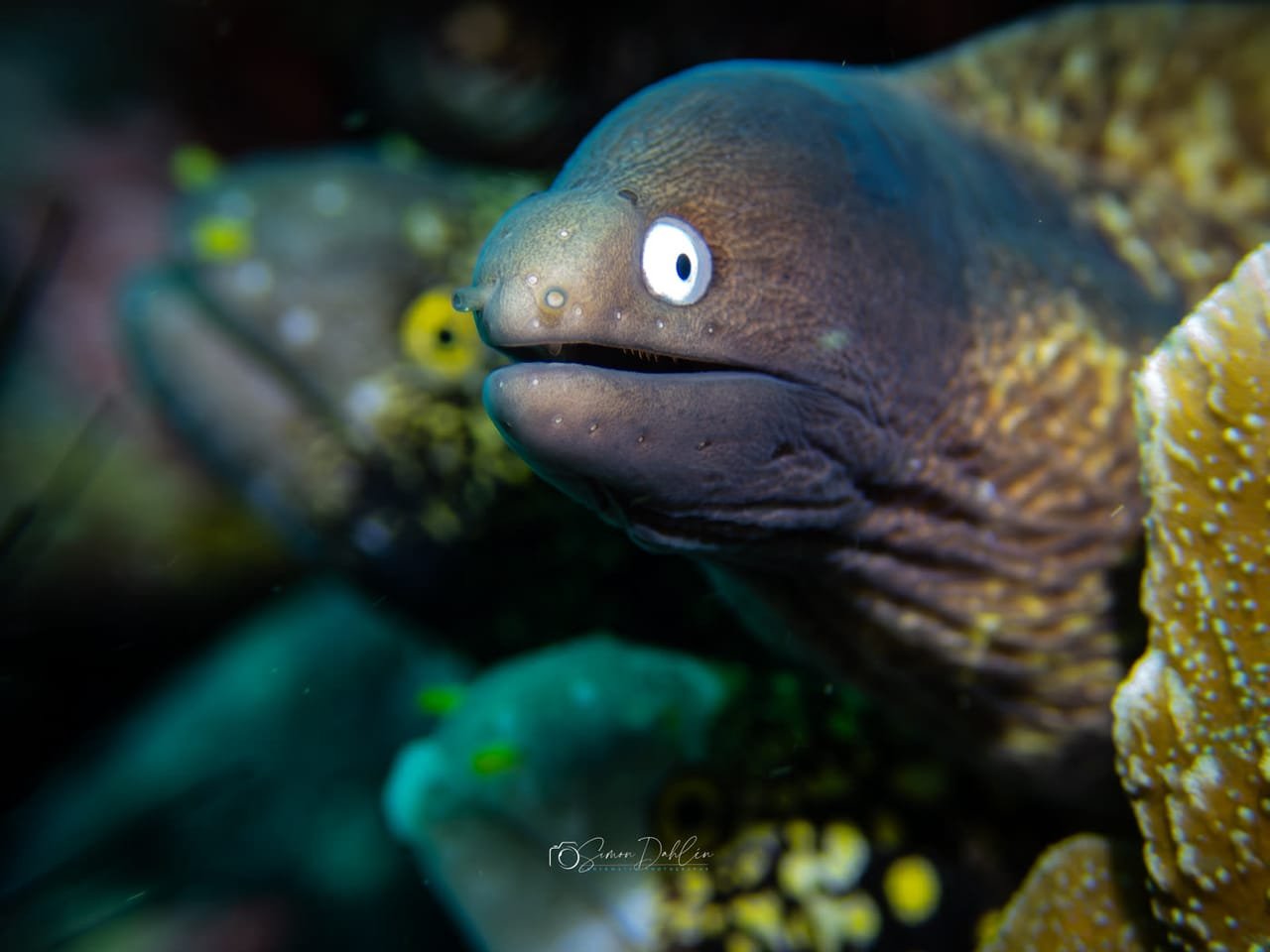
Moray Eels — Muraenidae

Moray Eels

Muraenidae

Multiple species across the family — giant, white-eyed, snowflake, and undulated all show up. Heads protrude from cracks in the reef by day; full bodies snake out into the open on night-dive hunts.

Year-round
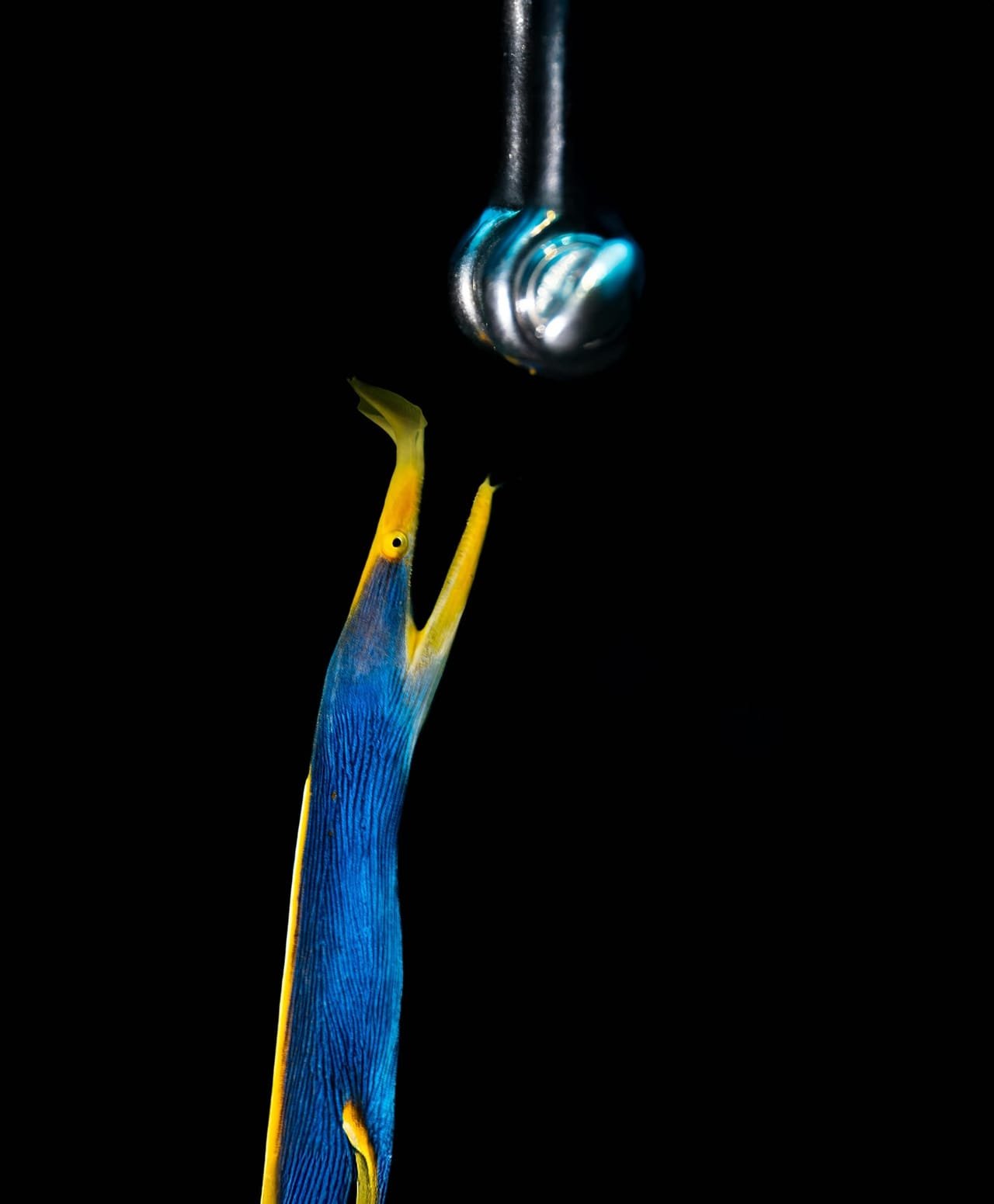
Ribbon Eels — Rhinomuraena quaesita

Ribbon Eels

Rhinomuraena quaesita

Black juveniles, electric-blue males, yellow females — all the same species shifting colour and sex through life. Heads poke from the sand at the muck and jetty sites.

Year-round
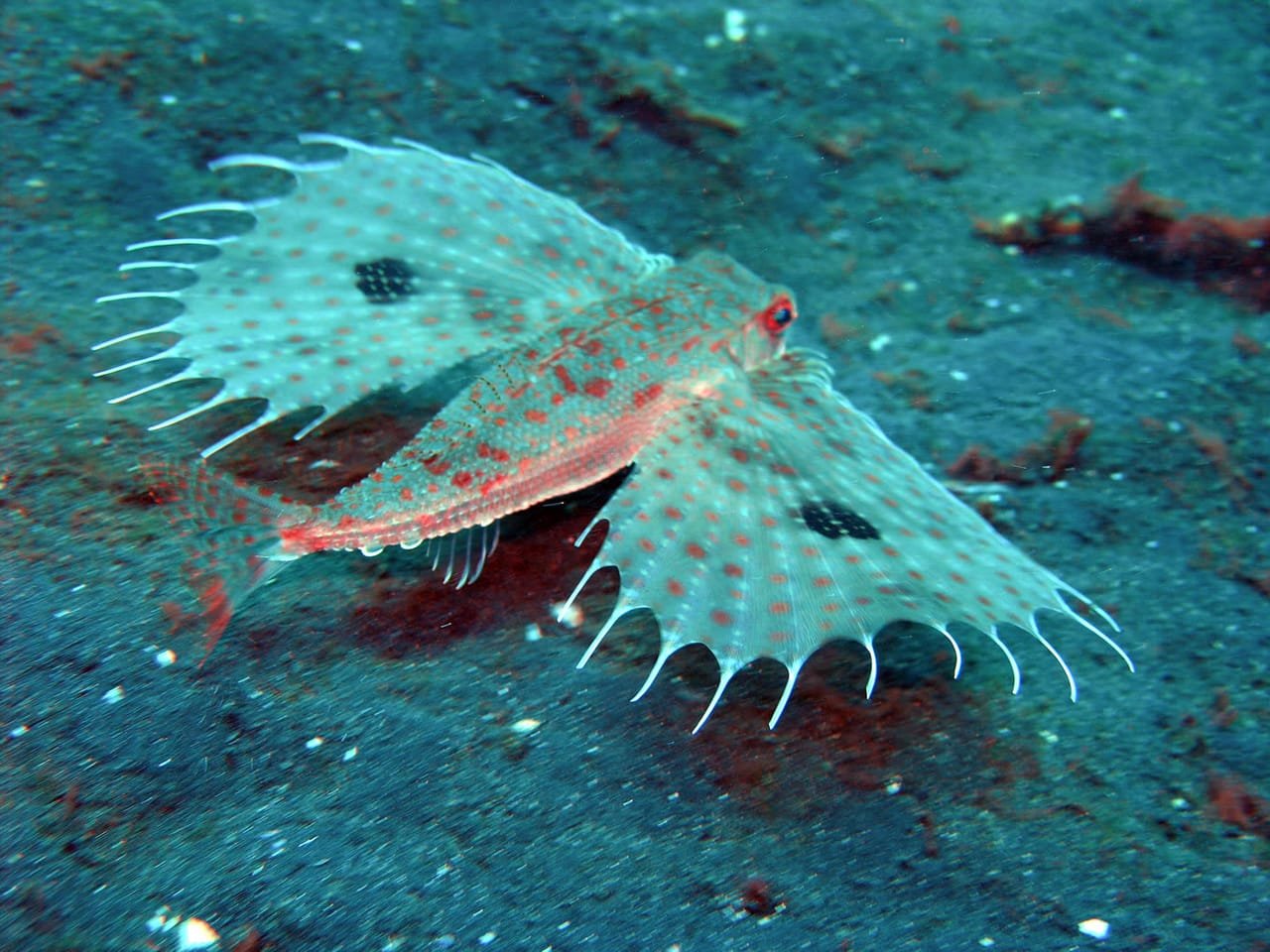
Flying Gurnards — Dactyloptena orientalis

Flying Gurnards

Dactyloptena orientalis

Walks on stiff pectoral-fin rays across the sand, then fans huge electric-blue wing-fins when threatened. A bit prehistoric, very photogenic.

Year-round

Macro & Muck

Alor's muck and rubble sites quietly compete with Lembeh. Critters layered upon critters — bring a long lens.

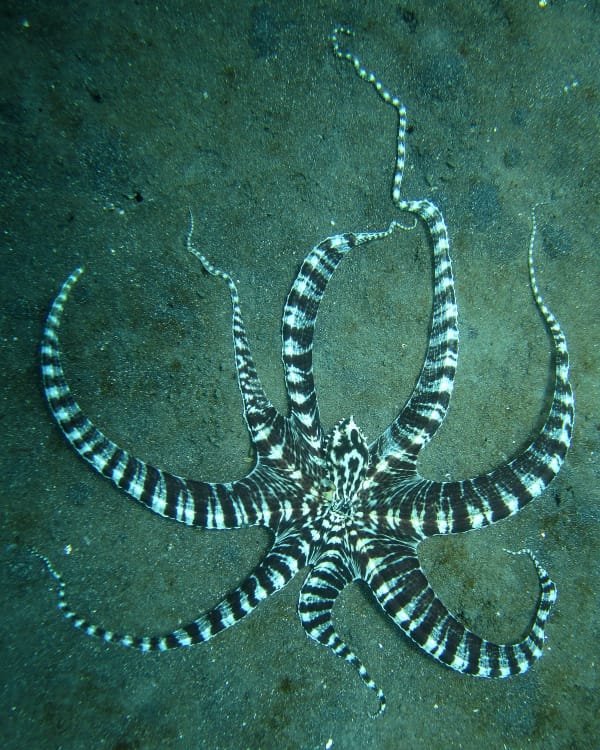
Mimic Octopus — Thaumoctopus mimicus

Mimic Octopus

Thaumoctopus mimicus

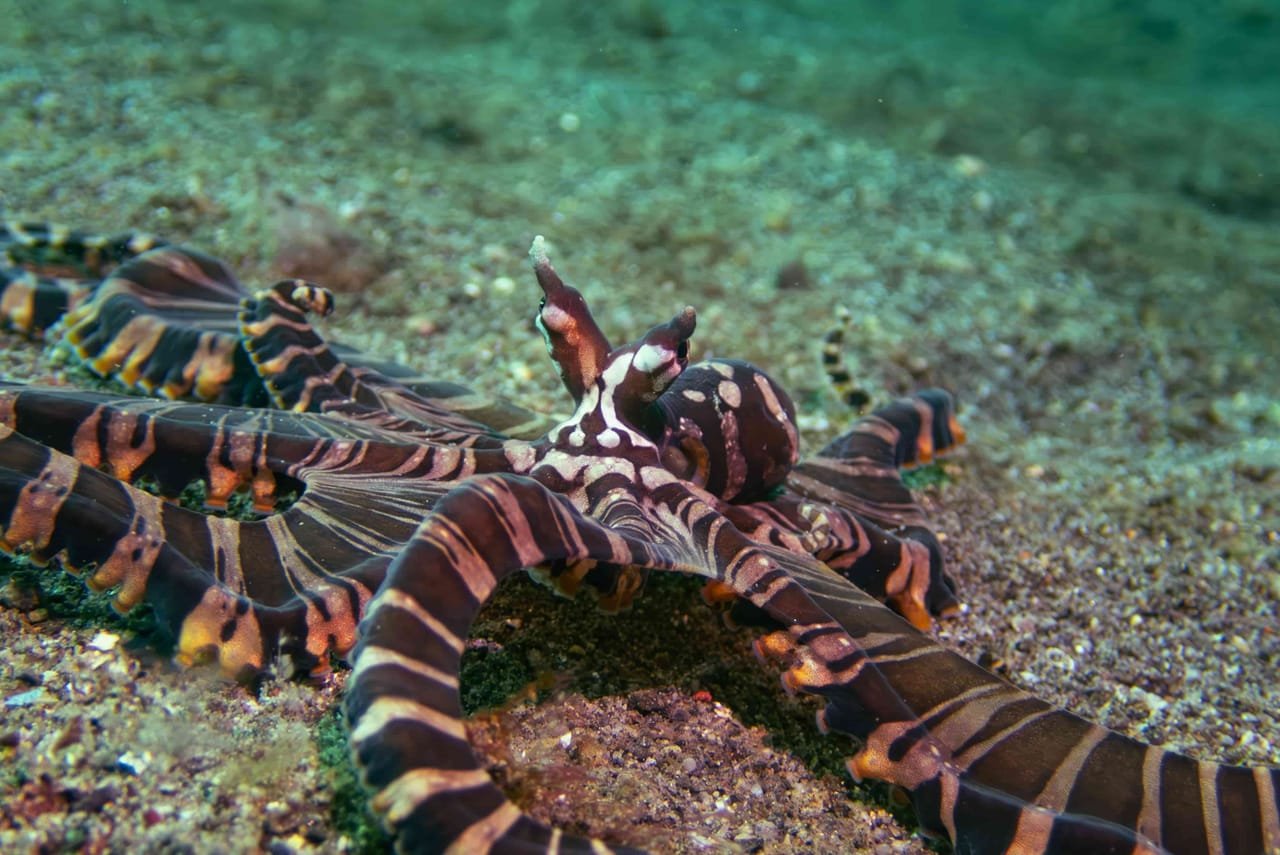
The legendary impersonator. Long banded arms, behaviour that shifts mid-dive.

Year-round
Where to dive for it
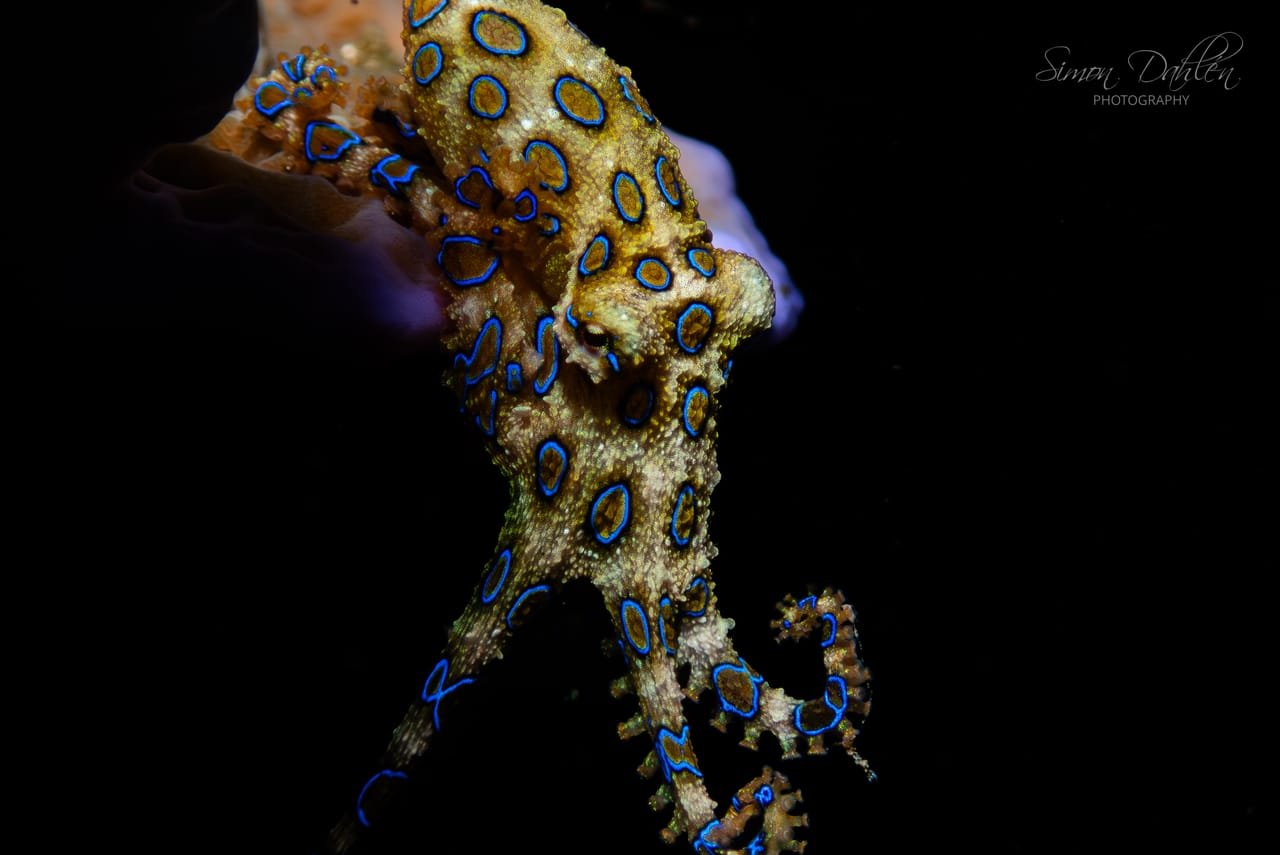
Blue-ringed Octopus — Hapalochlaena lunulata

Blue-ringed Octopus

Hapalochlaena lunulata

Tiny, lethal, photogenic. Found on rubble — never touched, always respected.

Year-round
Where to dive for it
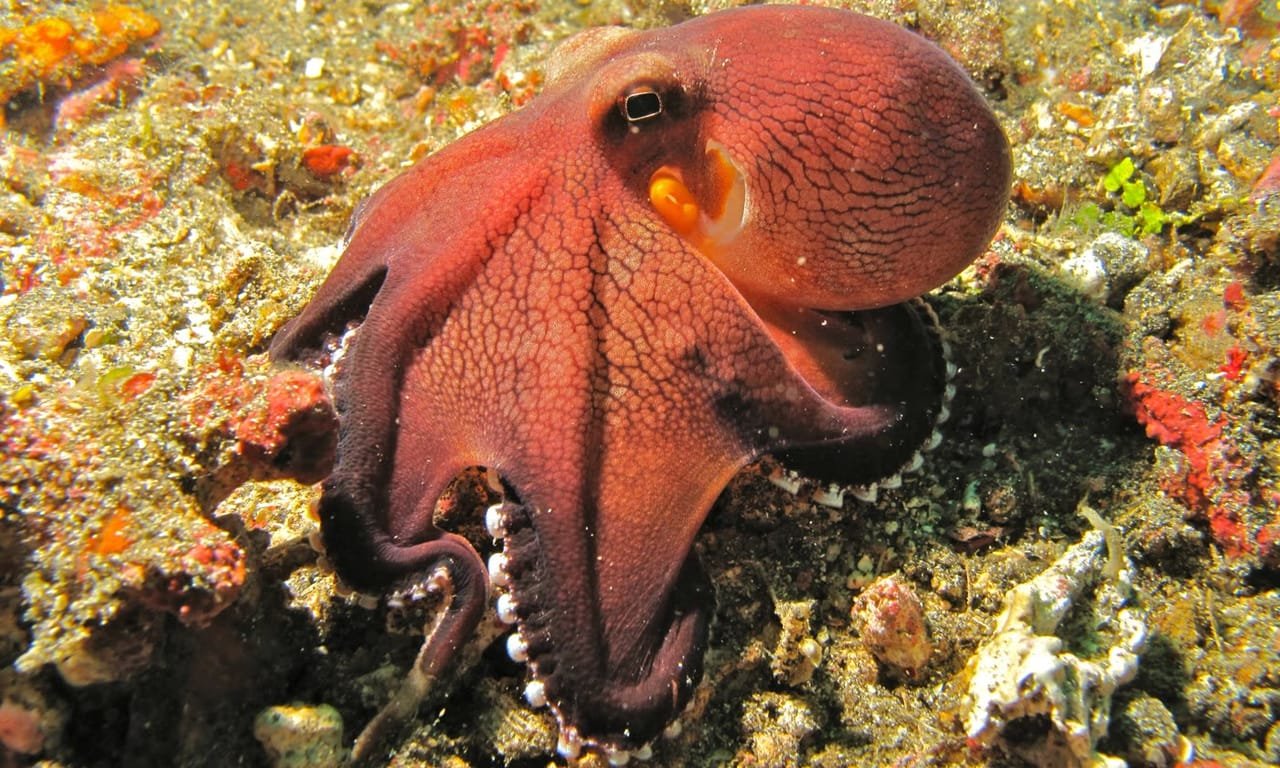
Coconut Octopus — Amphioctopus marginatus

Coconut Octopus

Amphioctopus marginatus

The one carrying coconut shells and clamshells as portable armour. Endlessly entertaining.

Year-round
Where to dive for it
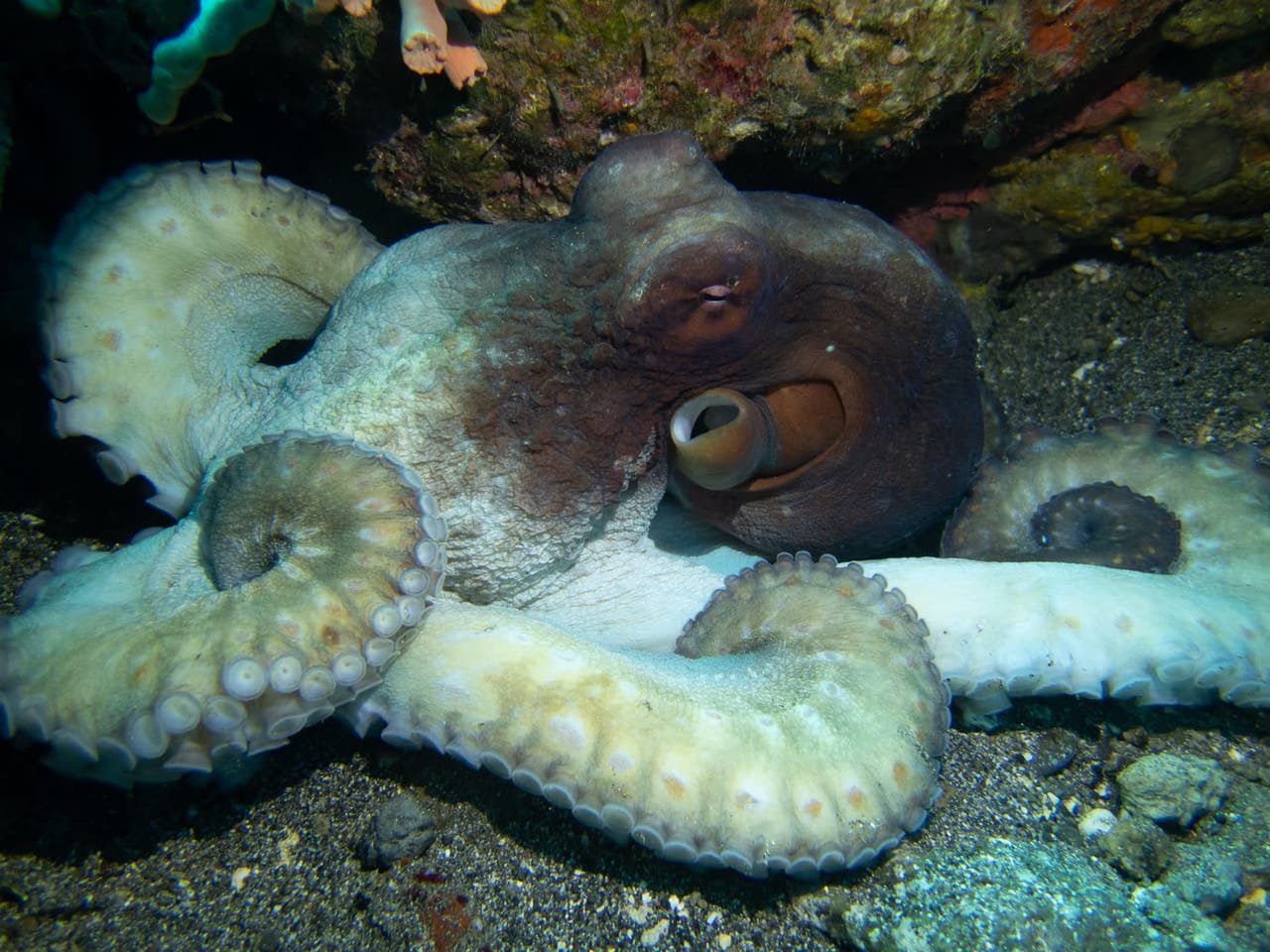
Reef Octopus — Octopus cyanea

Reef Octopus

Octopus cyanea

The "day octopus" — colour and texture-shifting in real time, often hunting openly across the rubble. Frequent on jetty dives and night dives.

Year-round
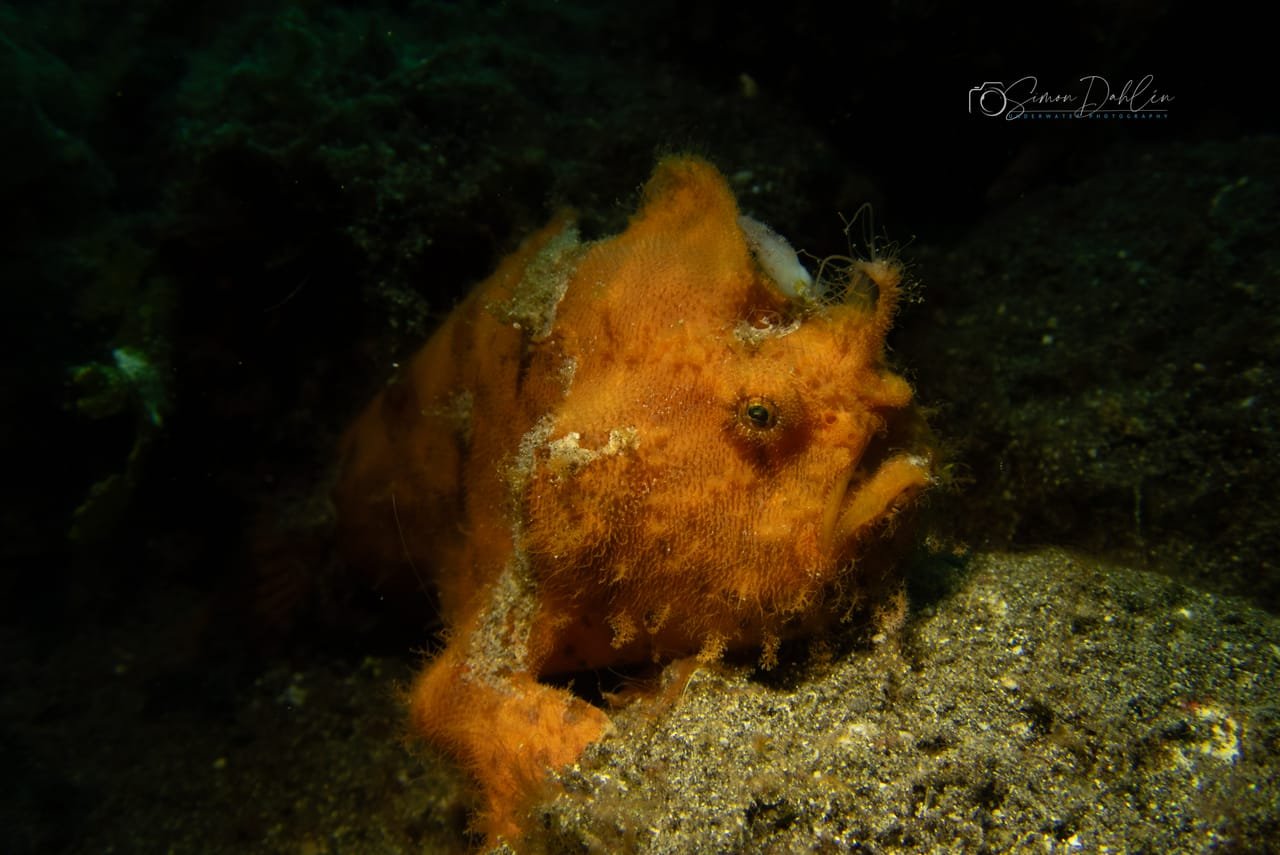
Hairy Frogfish — Antennarius striatus

Hairy Frogfish

Antennarius striatus

Walking, lure-fishing, perfectly camouflaged. The "hairy" form is iconic.

Year-round
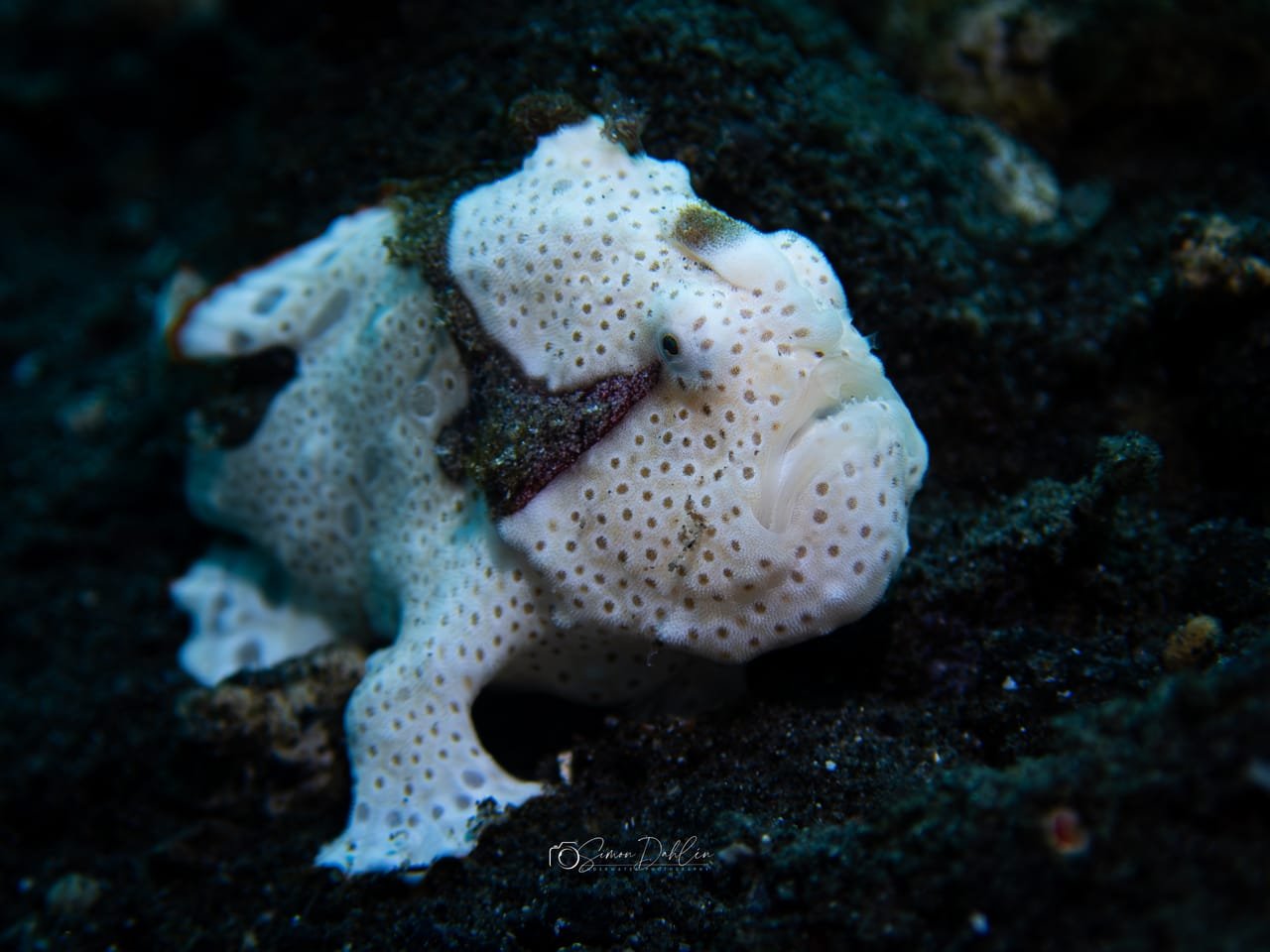
Painted Frogfish — Antennarius pictus

Painted Frogfish

Antennarius pictus

Vivid colours — orange, yellow, black, white. Sits like a rock for days.

Year-round
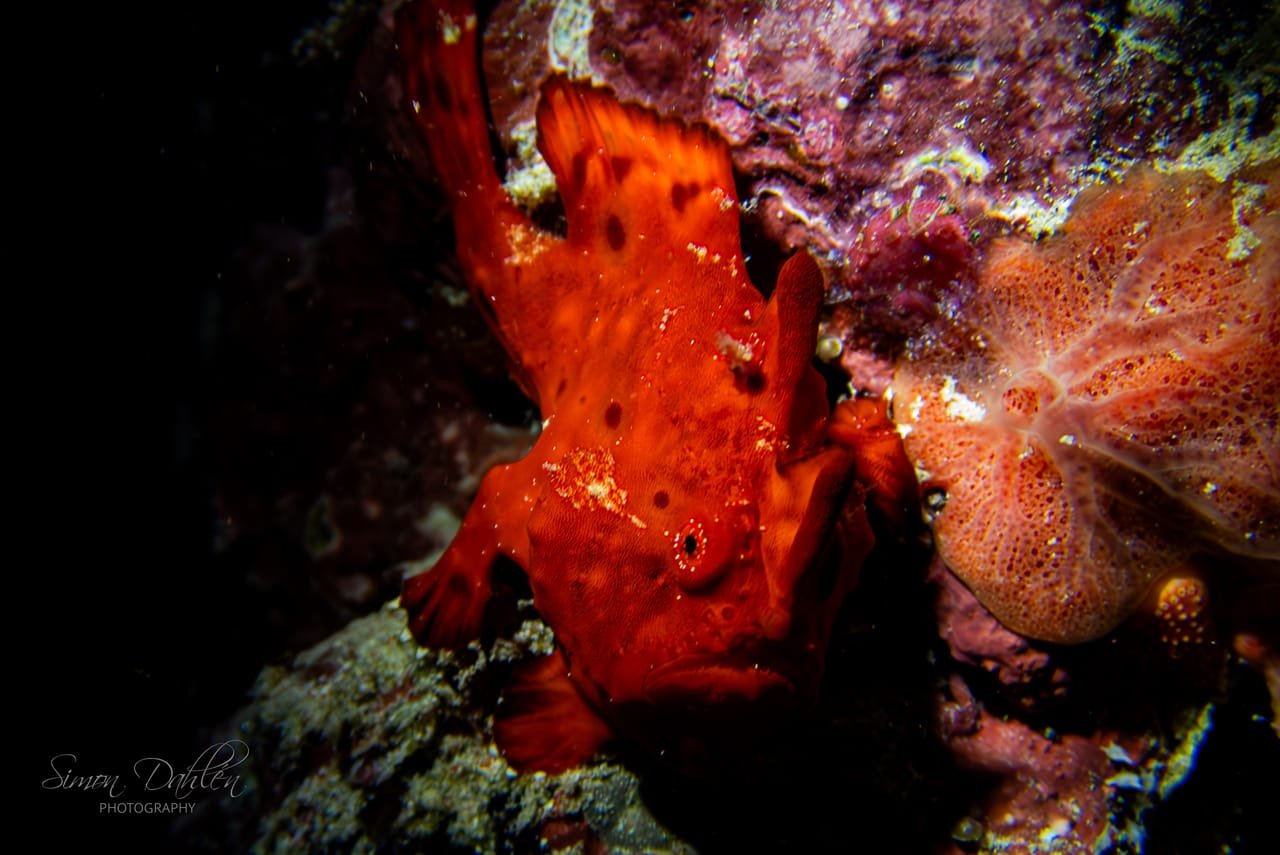
Warty Frogfish — Antennarius maculatus

Warty Frogfish

Antennarius maculatus

Also known as the Clown Frogfish. Bright orange, red, or yellow with dark wart-like spots and a distinctive worm-shaped lure. Up to 15 cm.

Year-round
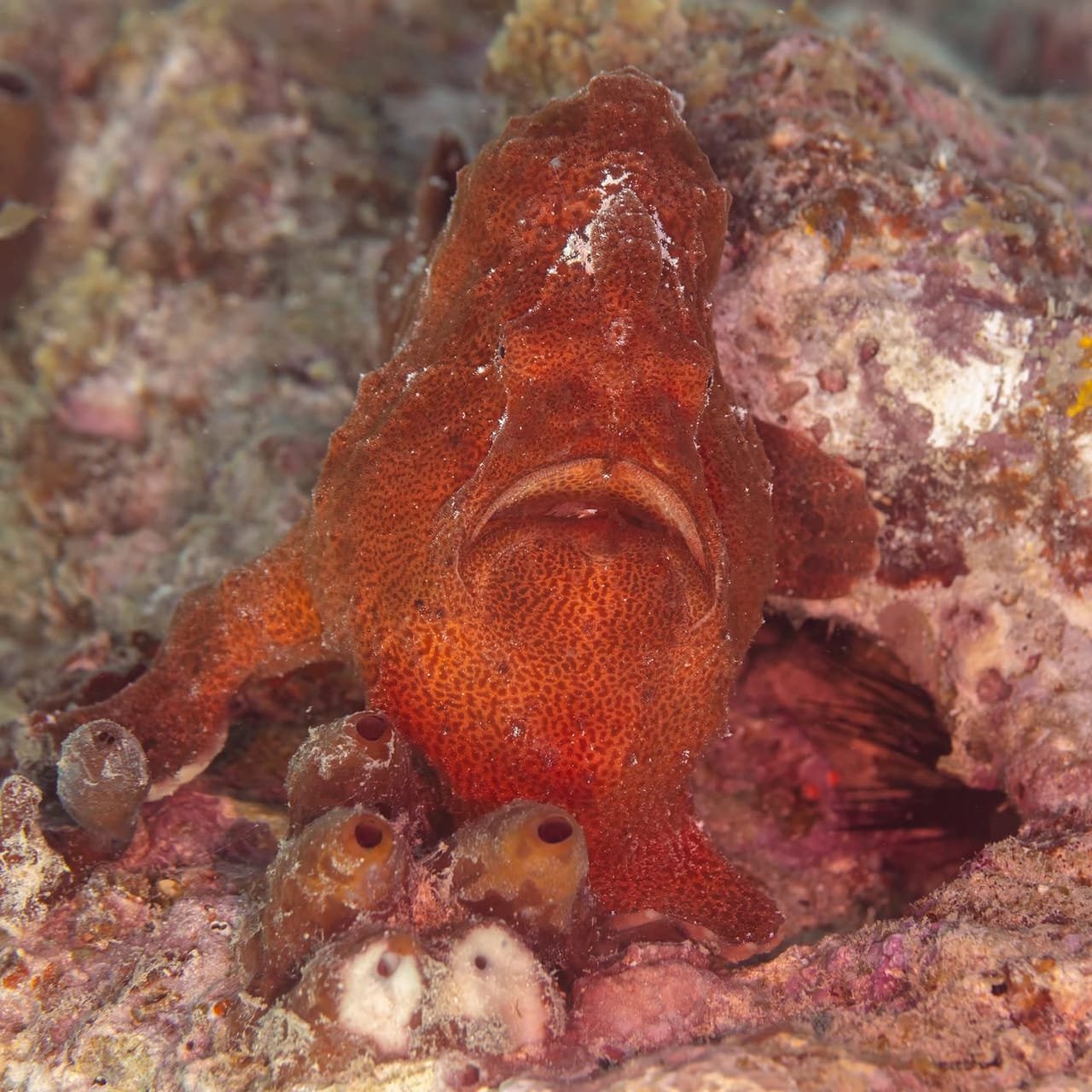
Giant Frogfish — Antennarius commerson

Giant Frogfish

Antennarius commerson

The largest of the frogfish — up to 38 cm — and a master of mimicking sponges. Highly variable in colour: black, yellow, red, brown.

Year-round
Rhinopias — Rhinopias spp.

Rhinopias

Rhinopias spp.

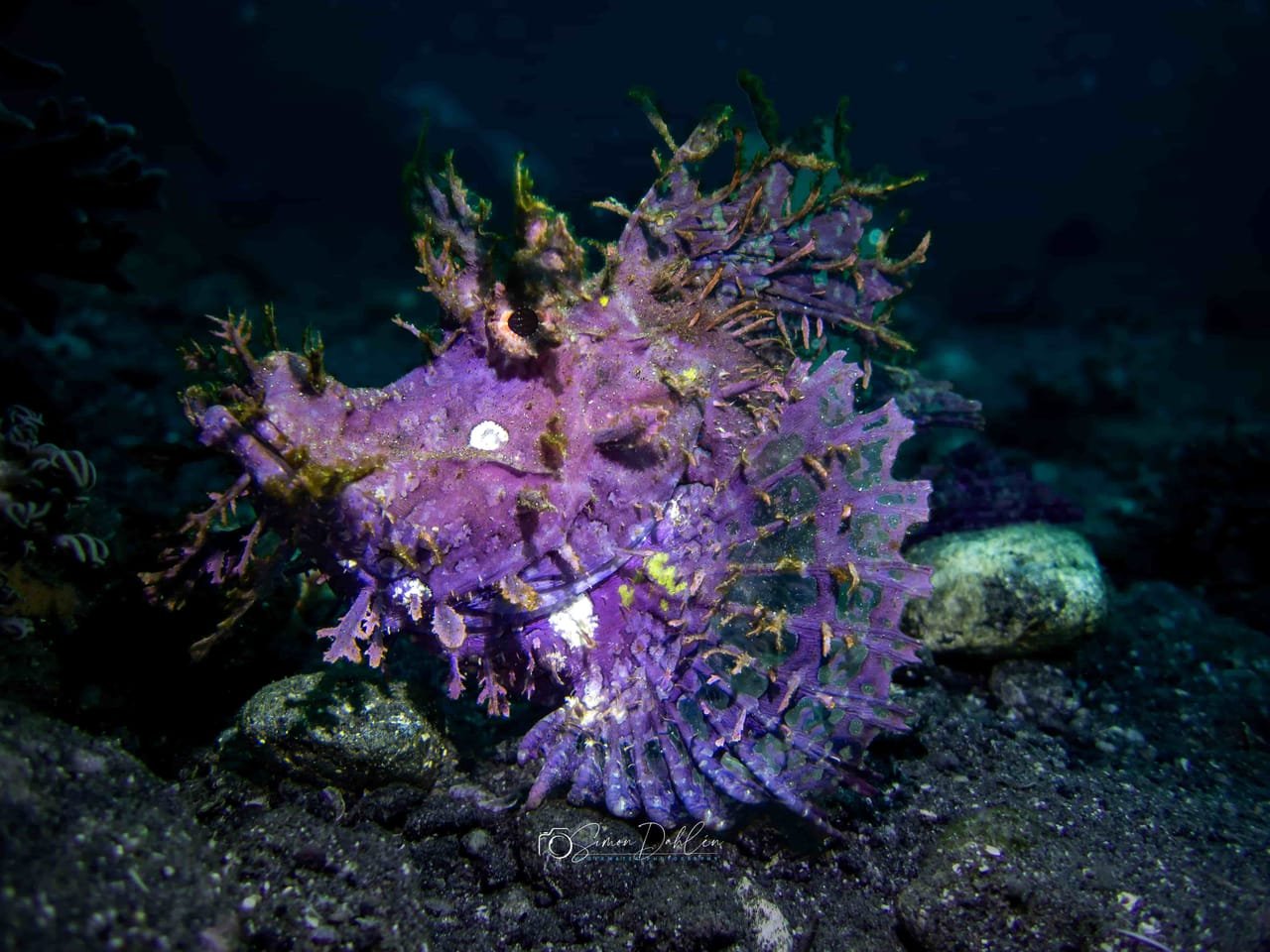
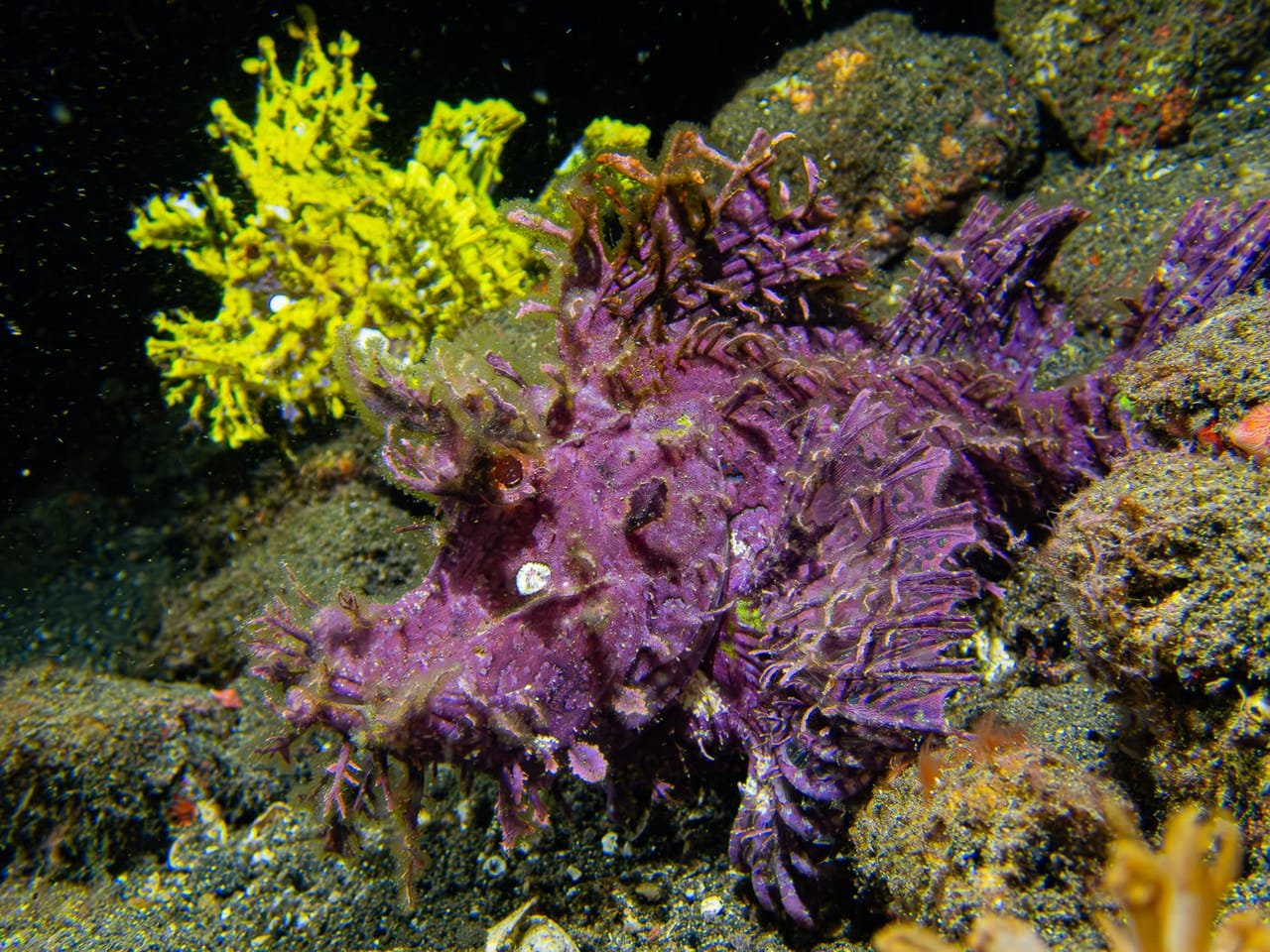
Alor's most iconic muck residents — weedy, paddle-flap, and lacy variants all show up here. Perched motionless on rubble or sponges; once spotted, they hold long enough to set up the shot.
Year-round
Leaf Scorpionfish — Taenianotus triacanthus

Leaf Scorpionfish

Taenianotus triacanthus

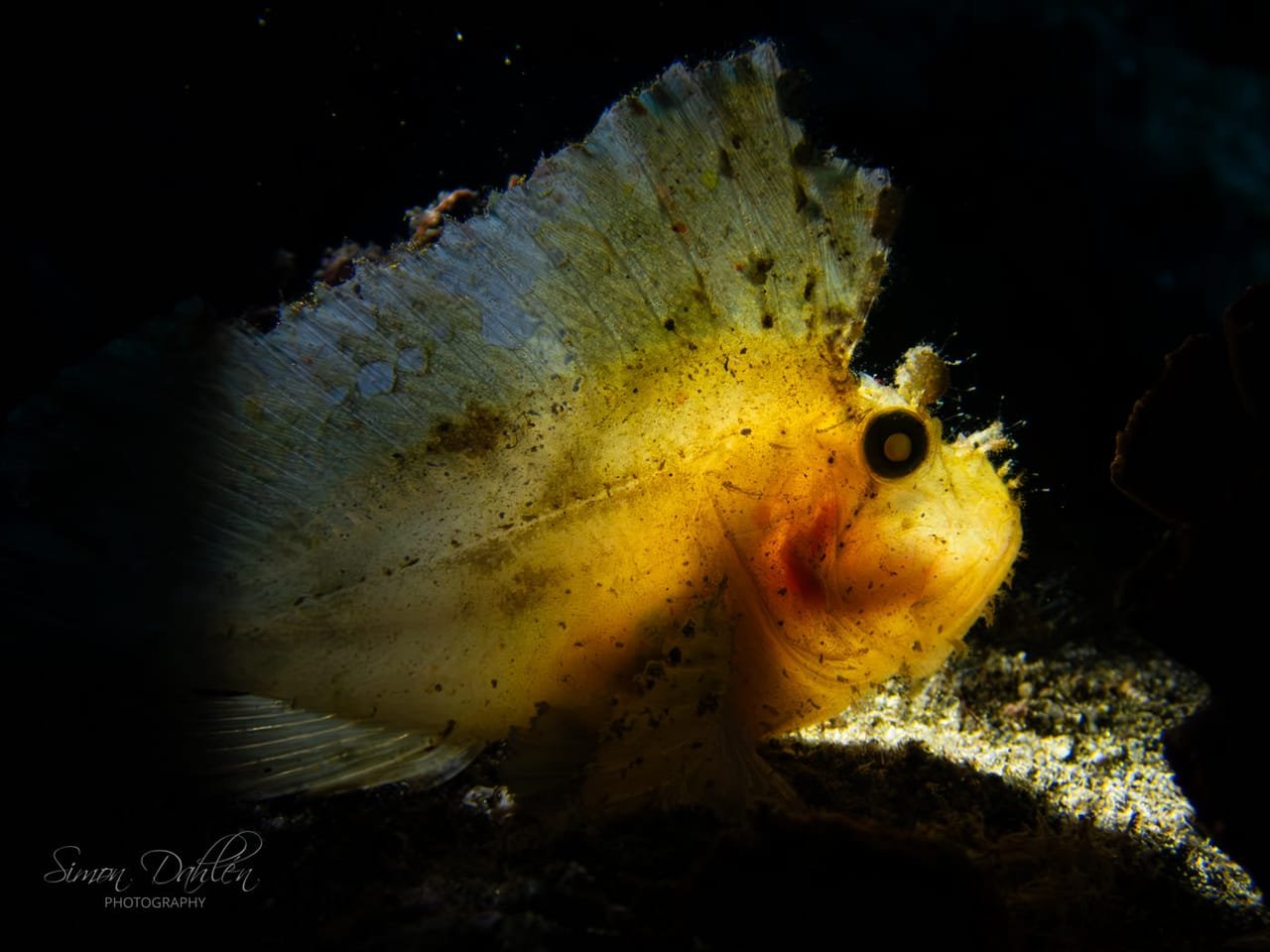
A small leaf-mimic that sways gently with the surge like a fallen leaf. Yellow, white, pink, and brown morphs all show up. Holds on a single perch for days, easy to miss without a guide.

Year-round
Cockatoo Waspfish — Ablabys taenianotus

Cockatoo Waspfish

Ablabys taenianotus

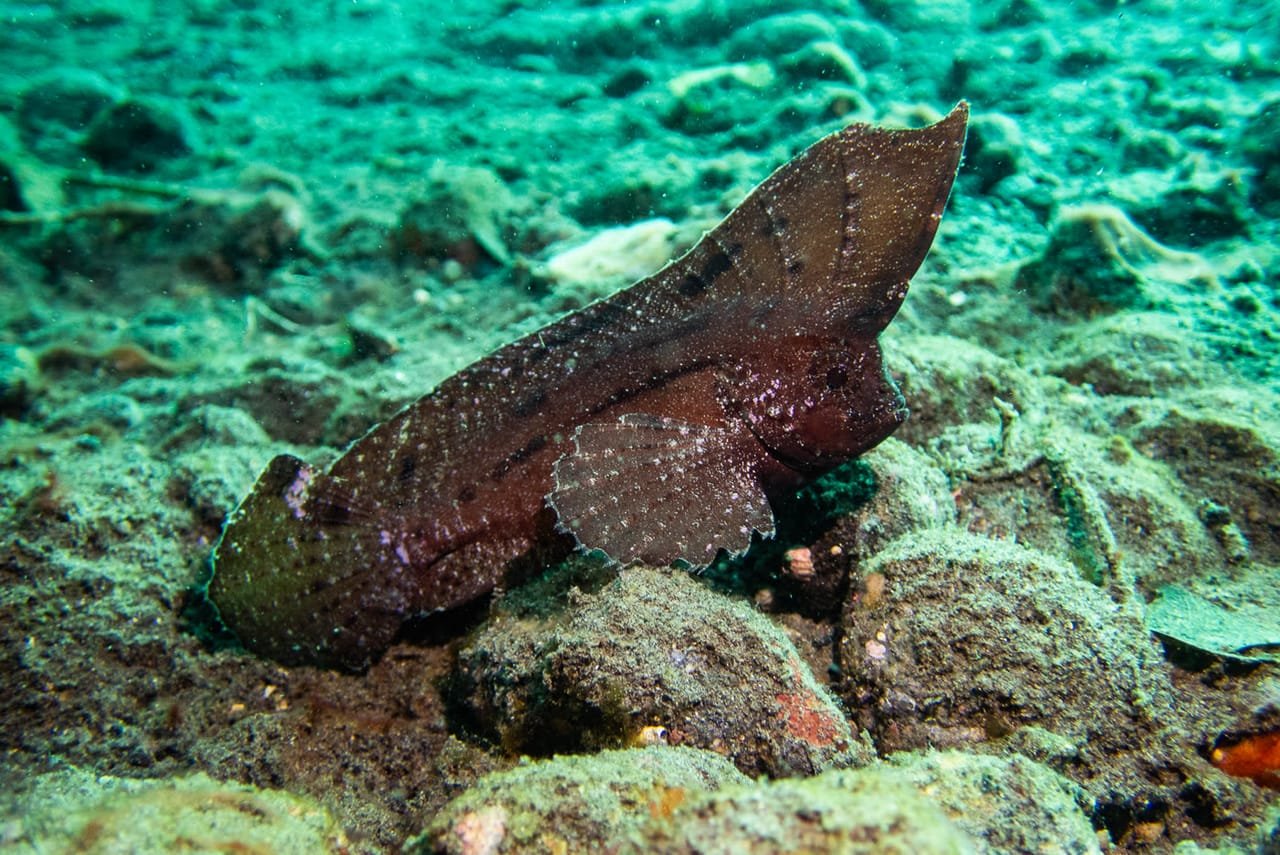
A flat, leaf-shaped venomous fish that sways with the surge to mimic a drifting leaf. Dark brown morphs are most common in Alor. Spines on the dorsal fin pack a sting — give it space.

Year-round
Brock's Pipefish — Halicampus brocki

Brock's Pipefish

Halicampus brocki

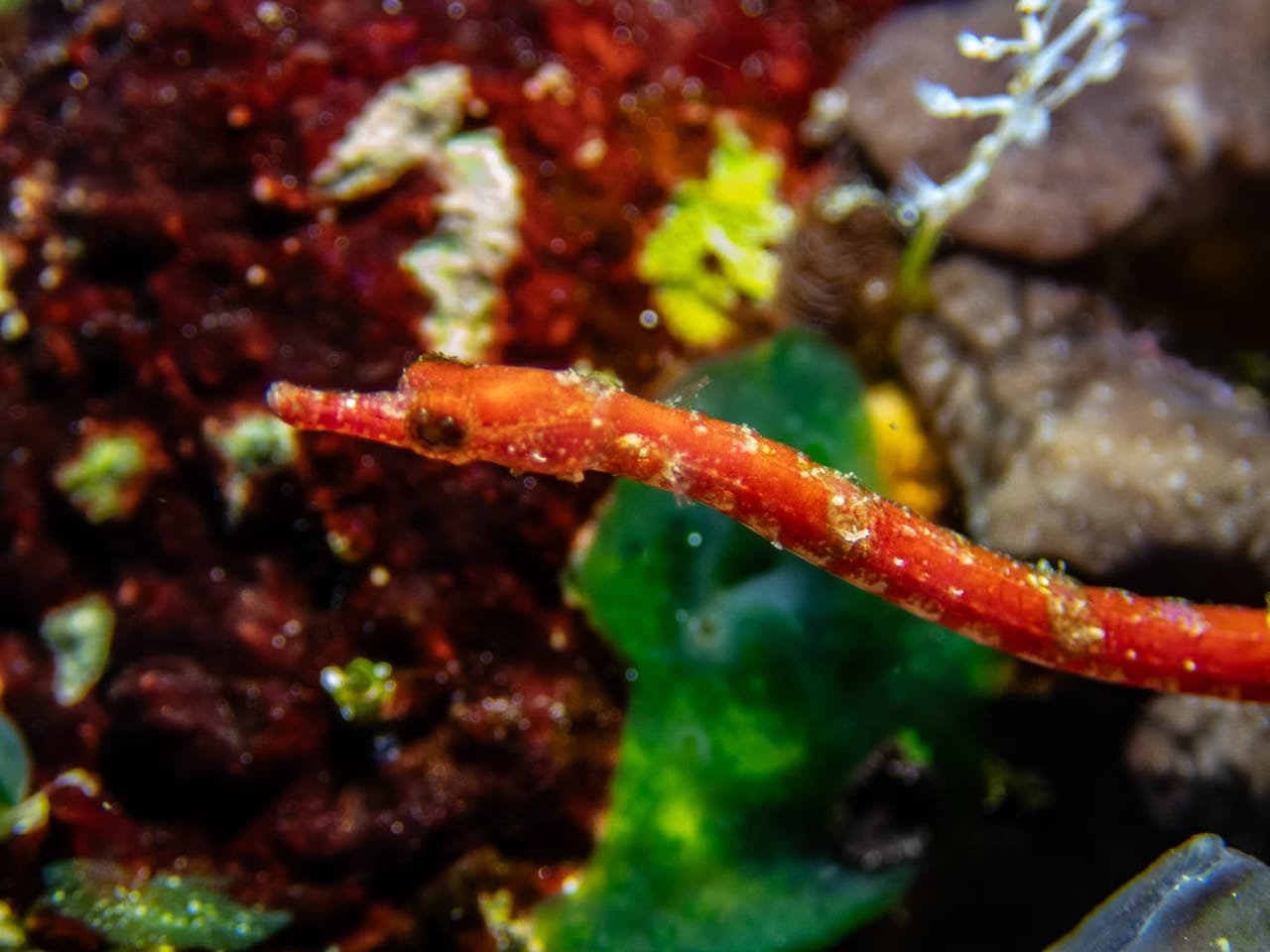
A slender pipefish a few centimetres long, often deep red or orange to match its algal surroundings. Holds still along sea whips and rubble — hard to see without a guide pointing it out.

Year-round
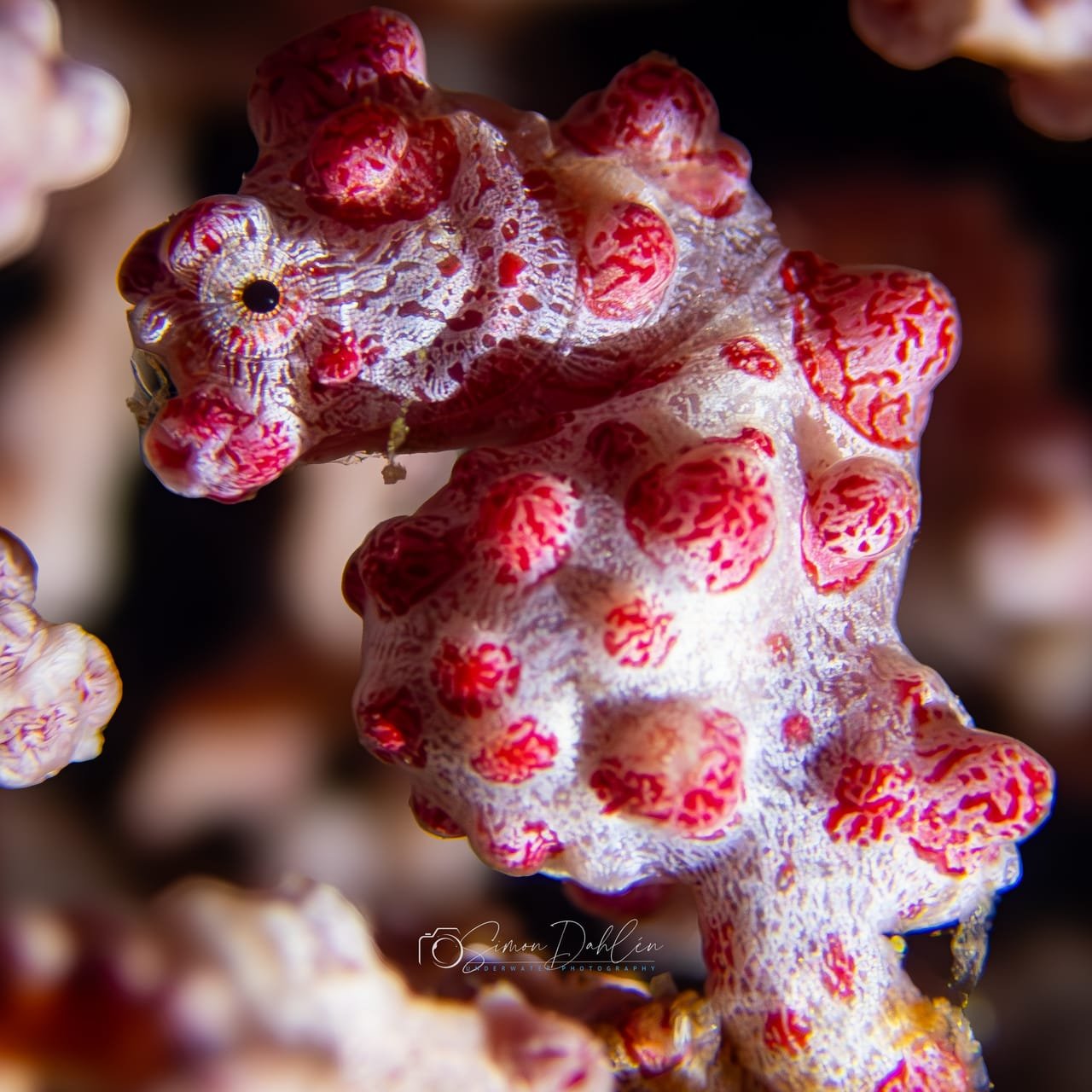
Pygmy Seahorses — Hippocampus bargibanti, H. denise

Pygmy Seahorses

Hippocampus bargibanti, H. denise

A few millimetres long, on their host gorgonian fans. Spotting them takes a guide who knows.

Year-round
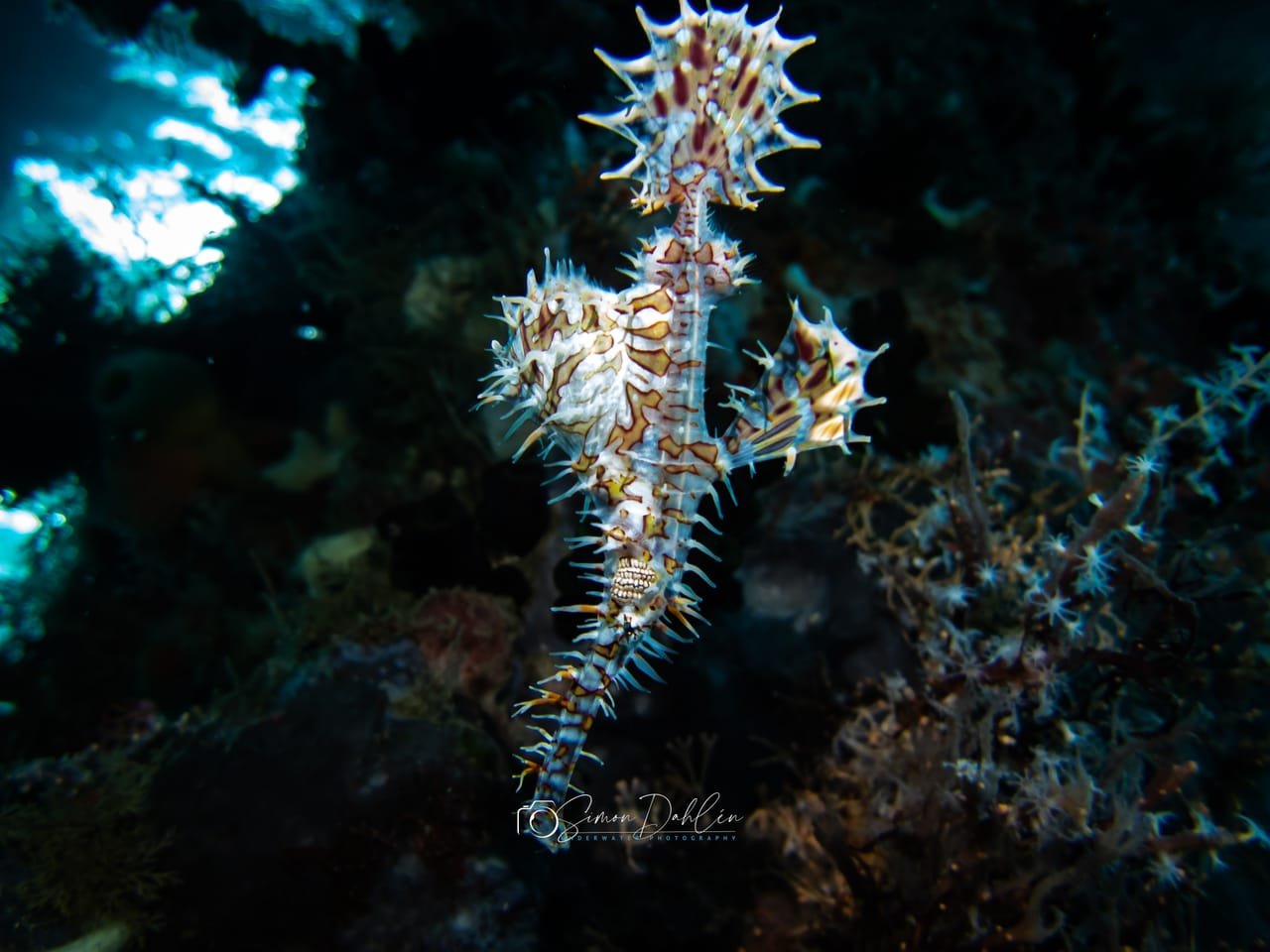
Ghost Pipefish — Solenostomus paradoxus & cyanopterus

Ghost Pipefish

Solenostomus paradoxus & cyanopterus

Ornate or robust, often in pairs, drifting near crinoids and soft corals.

Year-round
Where to dive for it
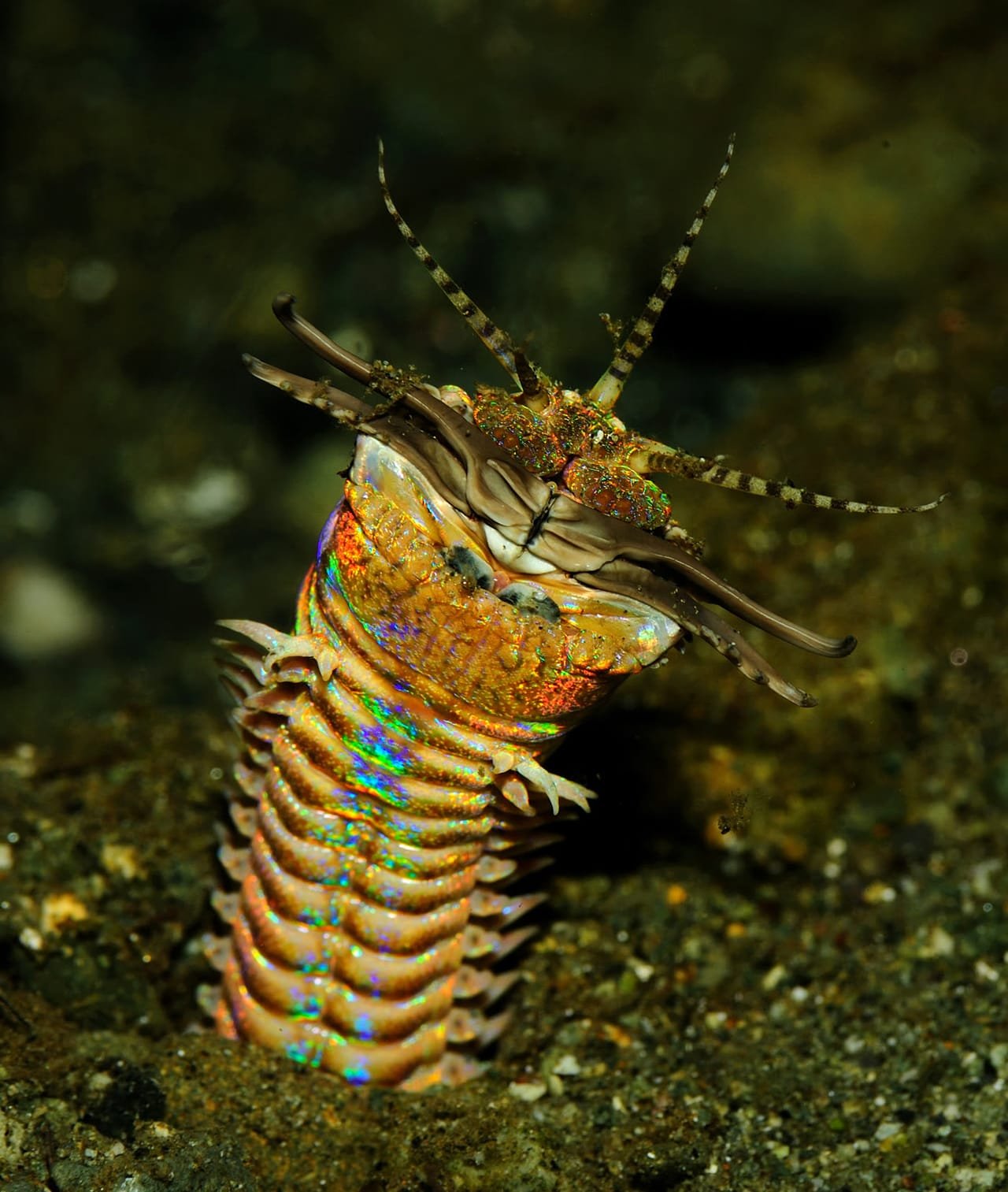
Bobbit Worm — Eunice aphroditois

Bobbit Worm

Eunice aphroditois

Two metres of segmented predator buried in the sand, striking from below. Rare to see.

Year-round
Where to dive for it

Crustaceans

The kind of detail that turns a dive into a treasure hunt. Most of these live in association with another animal — a host coral, an urchin, a sea cucumber — and most are smaller than a fingernail. Bring a long lens and a patient guide.

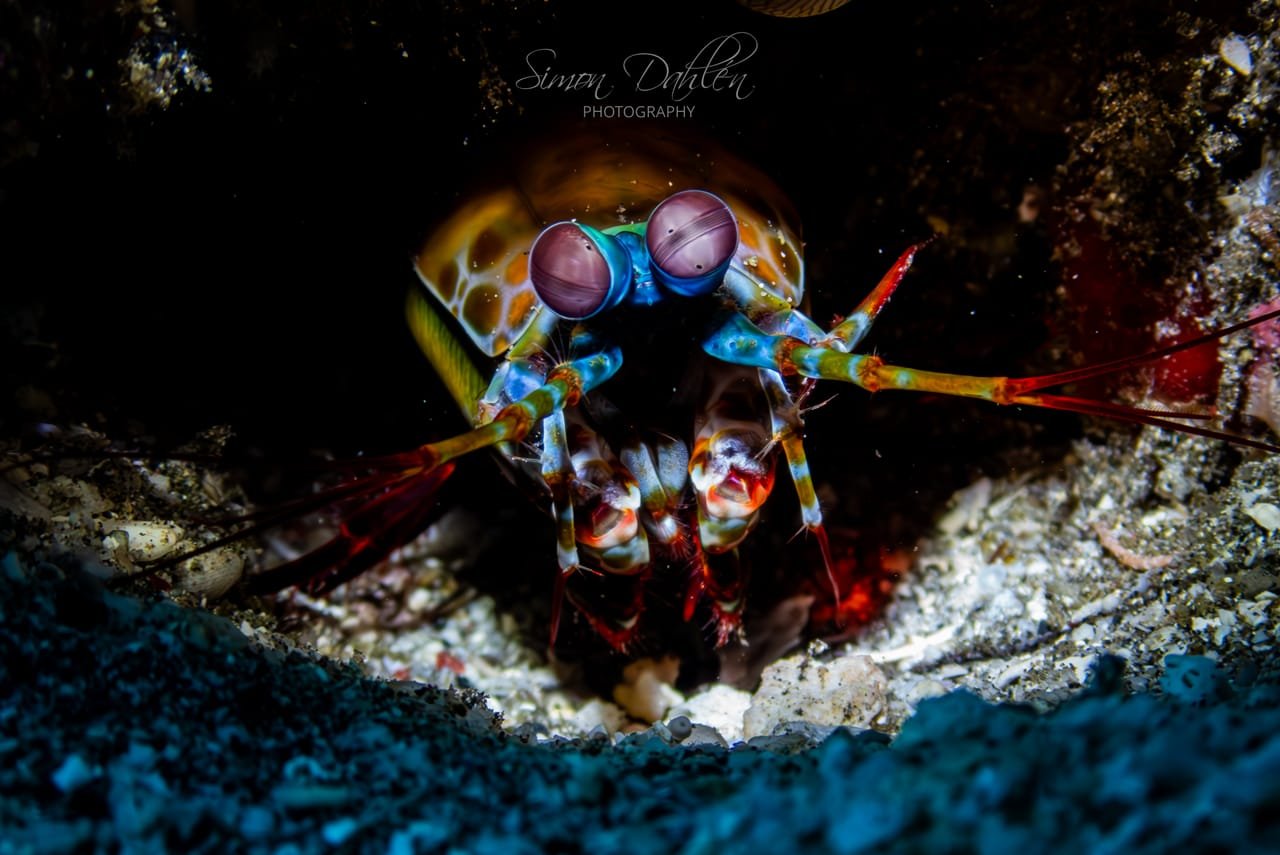
Peacock Mantis Shrimp — Odontodactylus scyllarus

Peacock Mantis Shrimp

Odontodactylus scyllarus

Brilliant colour, club-strike fast enough to boil water. Burrow openings give them away.

Year-round
Boxer Crab — Lybia tessellata

Boxer Crab

Lybia tessellata

Carries a small anemone in each claw like pom-poms, waving them in defence.

Year-round
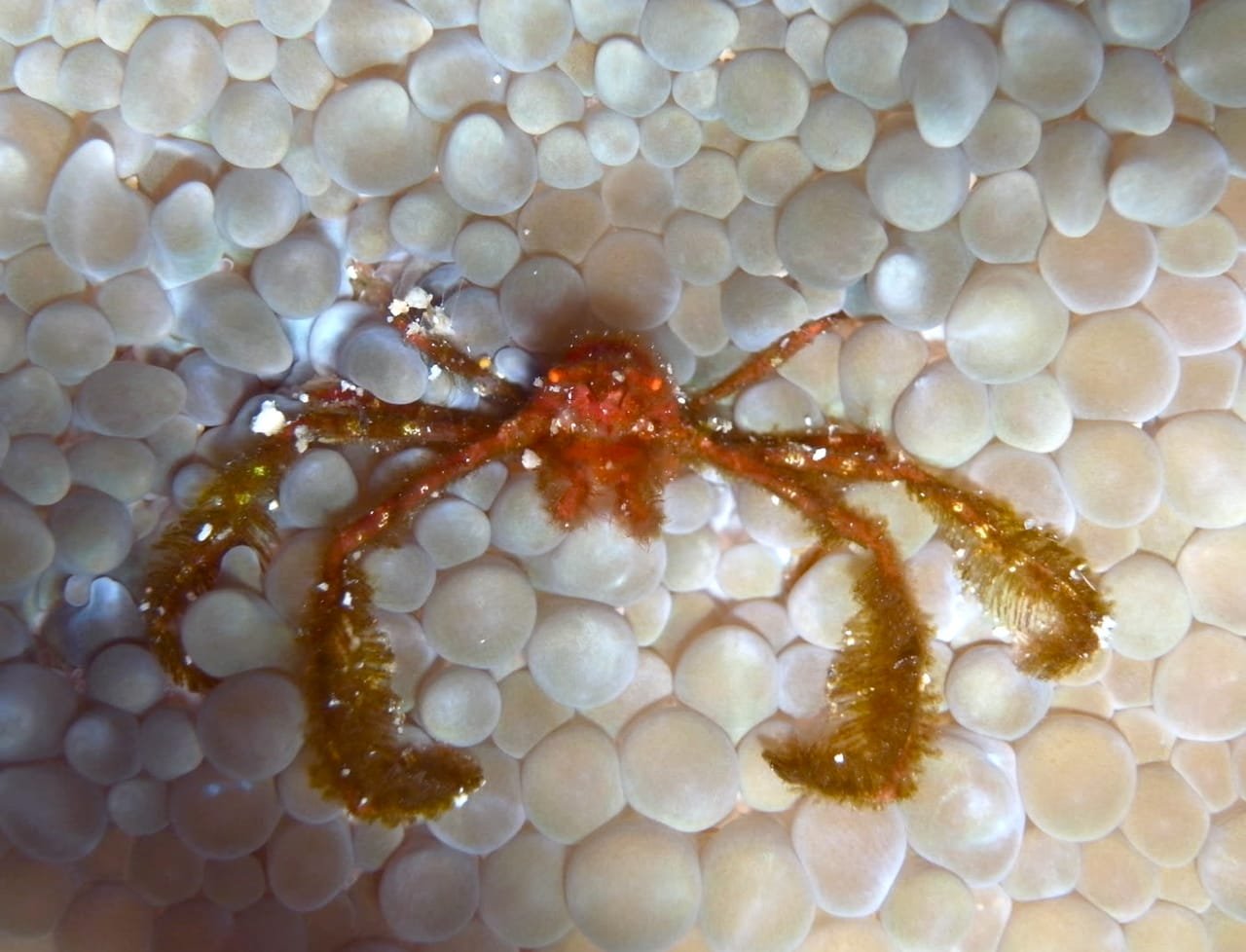
Orangutan Crab — Achaeus japonicus

Orangutan Crab

Achaeus japonicus

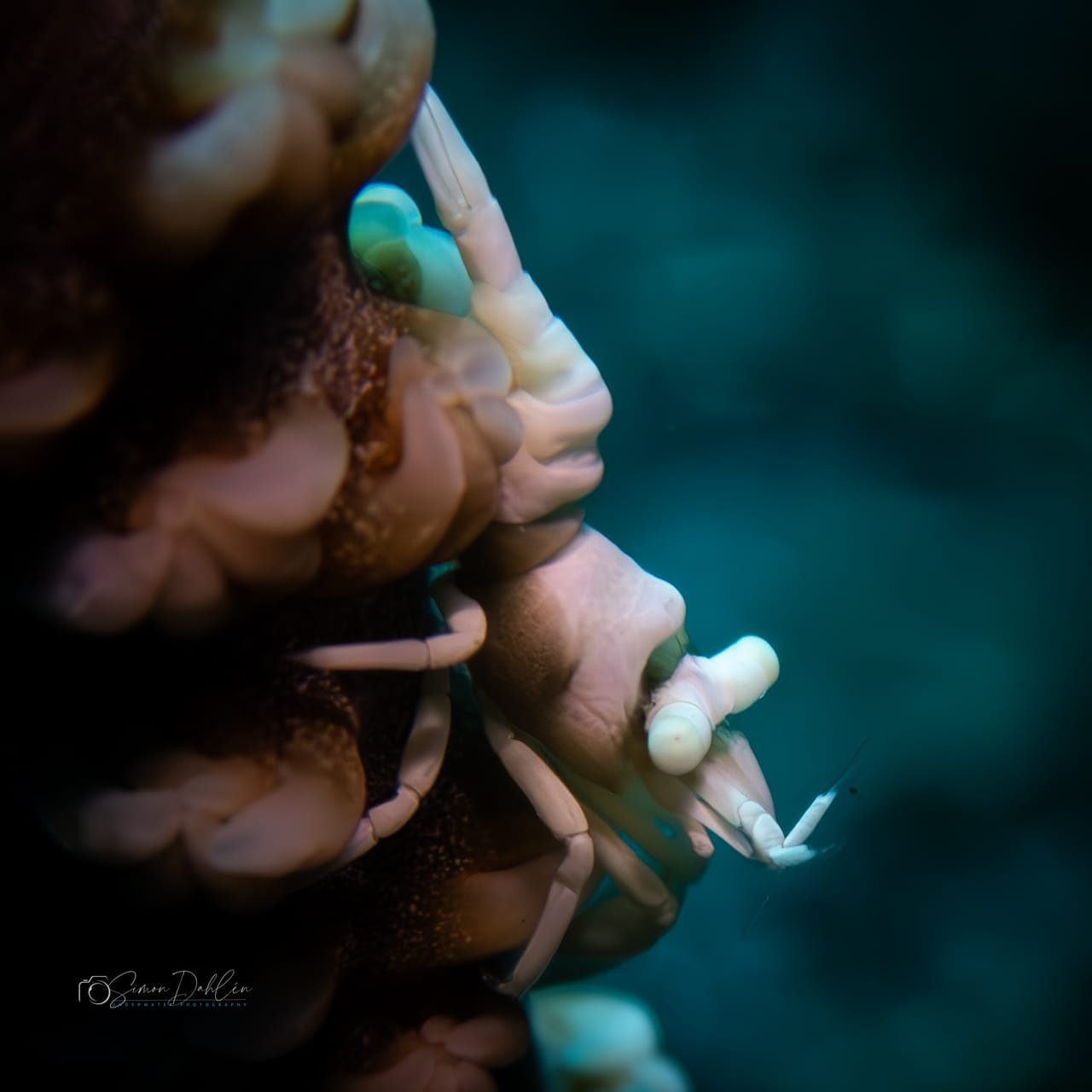
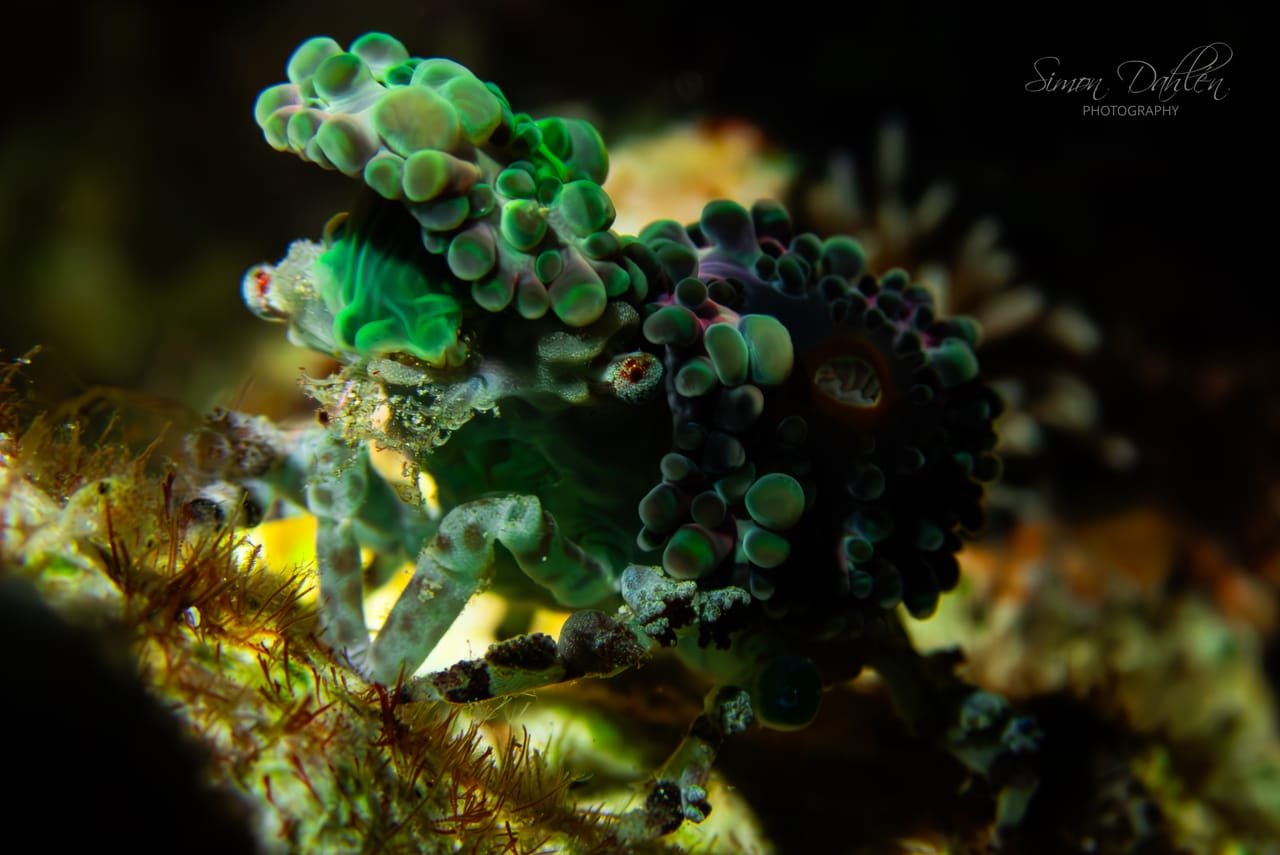
Long ginger-red hair, lives on bubble corals and anemones. Slow, photogenic, charming.

Year-round
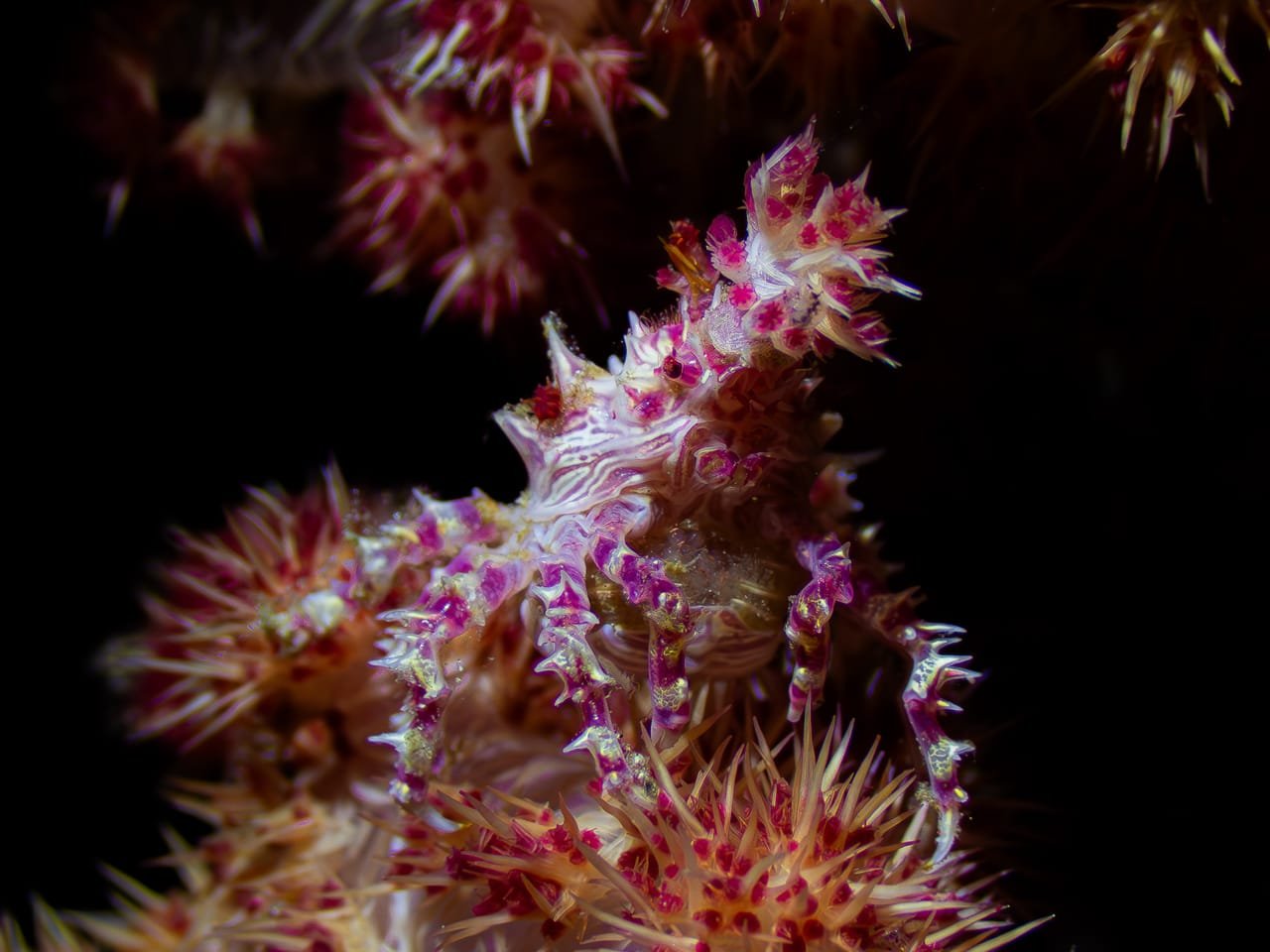
Candy Crab — Hoplophrys oatesi

Candy Crab

Hoplophrys oatesi

Lives exclusively on soft corals (Dendronephthya), matching their pink, white, and red tones perfectly. A few millimetres long and almost invisible until pointed out.

Year-round
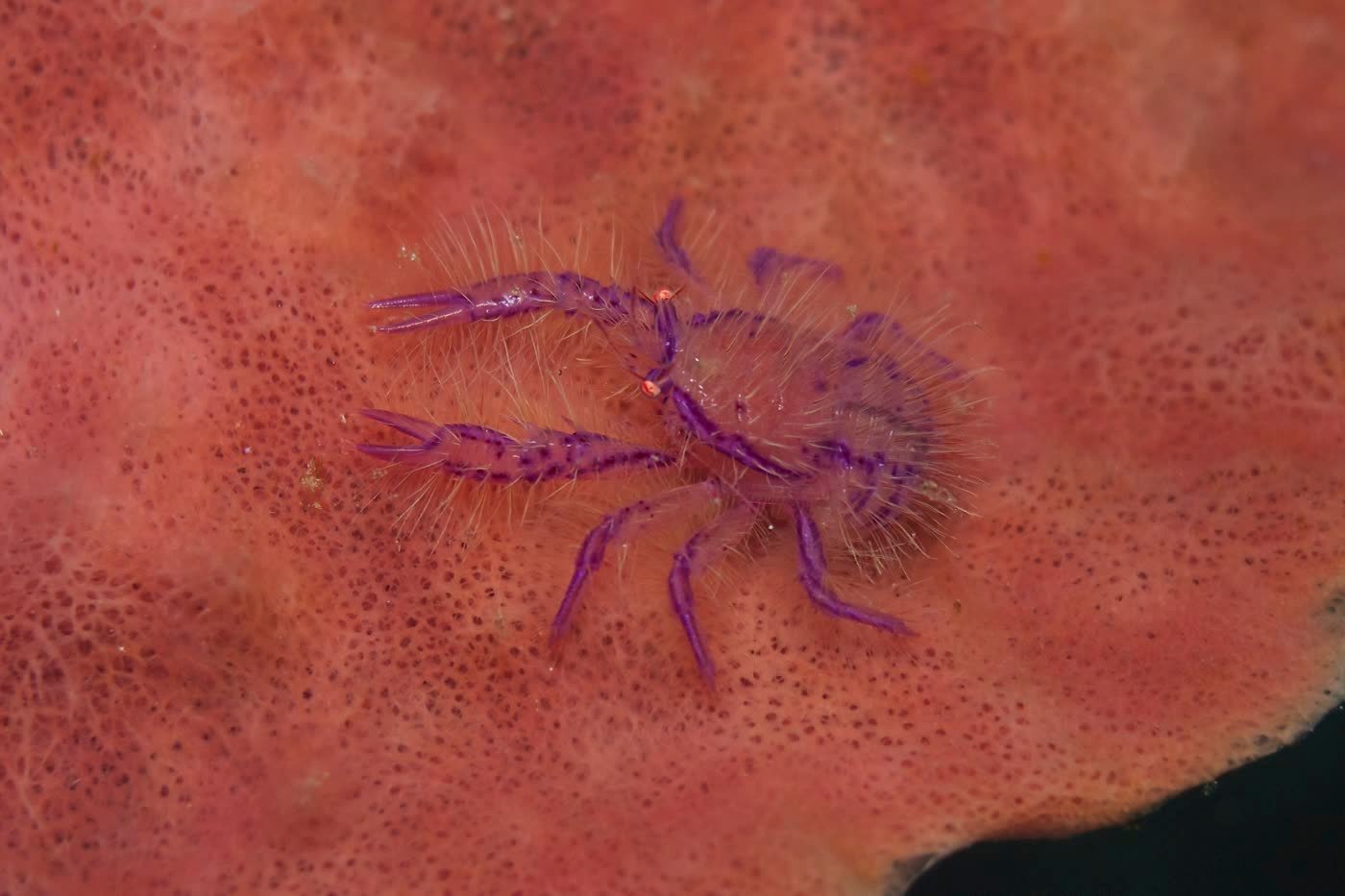
Hairy Squat Lobster — Lauriea siagiani

Hairy Squat Lobster

Lauriea siagiani

Pink and white, fingernail-sized, lives almost exclusively on giant barrel sponges.

Year-round
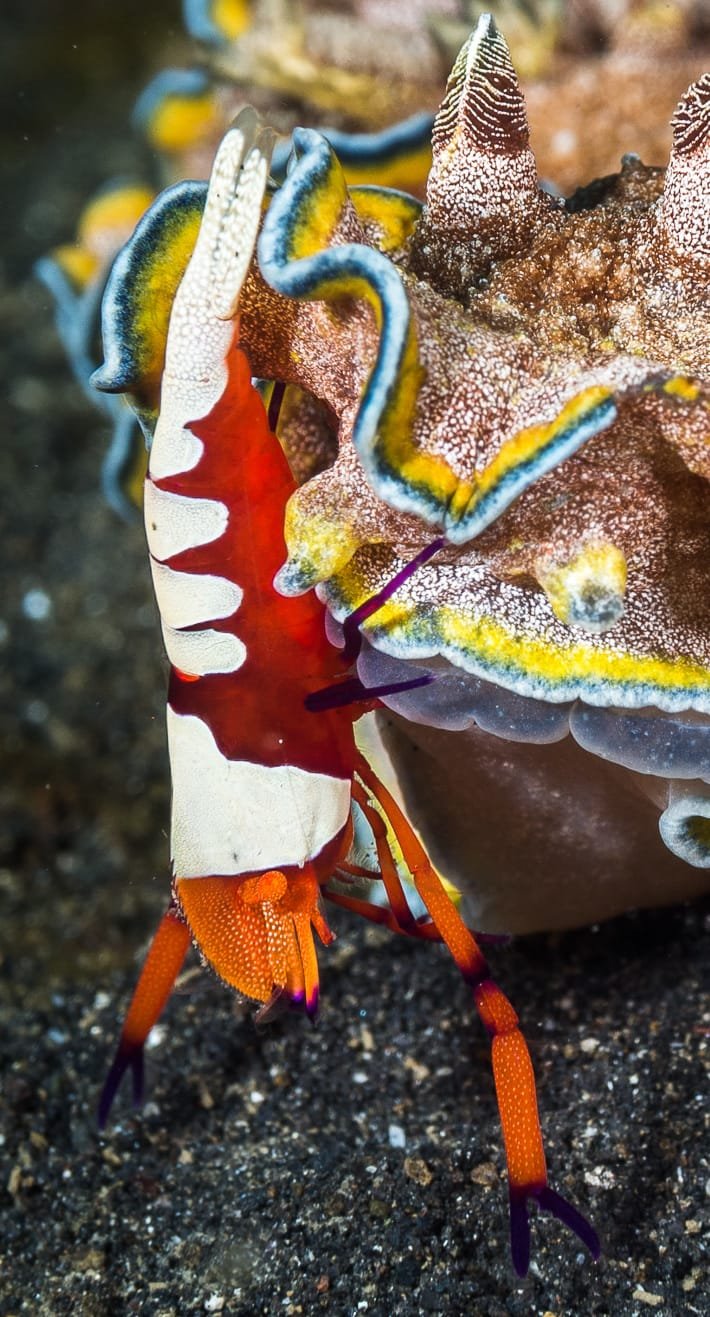
Imperial Shrimp — Periclimenes imperator

Imperial Shrimp

Periclimenes imperator

Lives on the back of sea cucumbers, nudibranchs, and Spanish dancers. Free taxi service.

Year-round
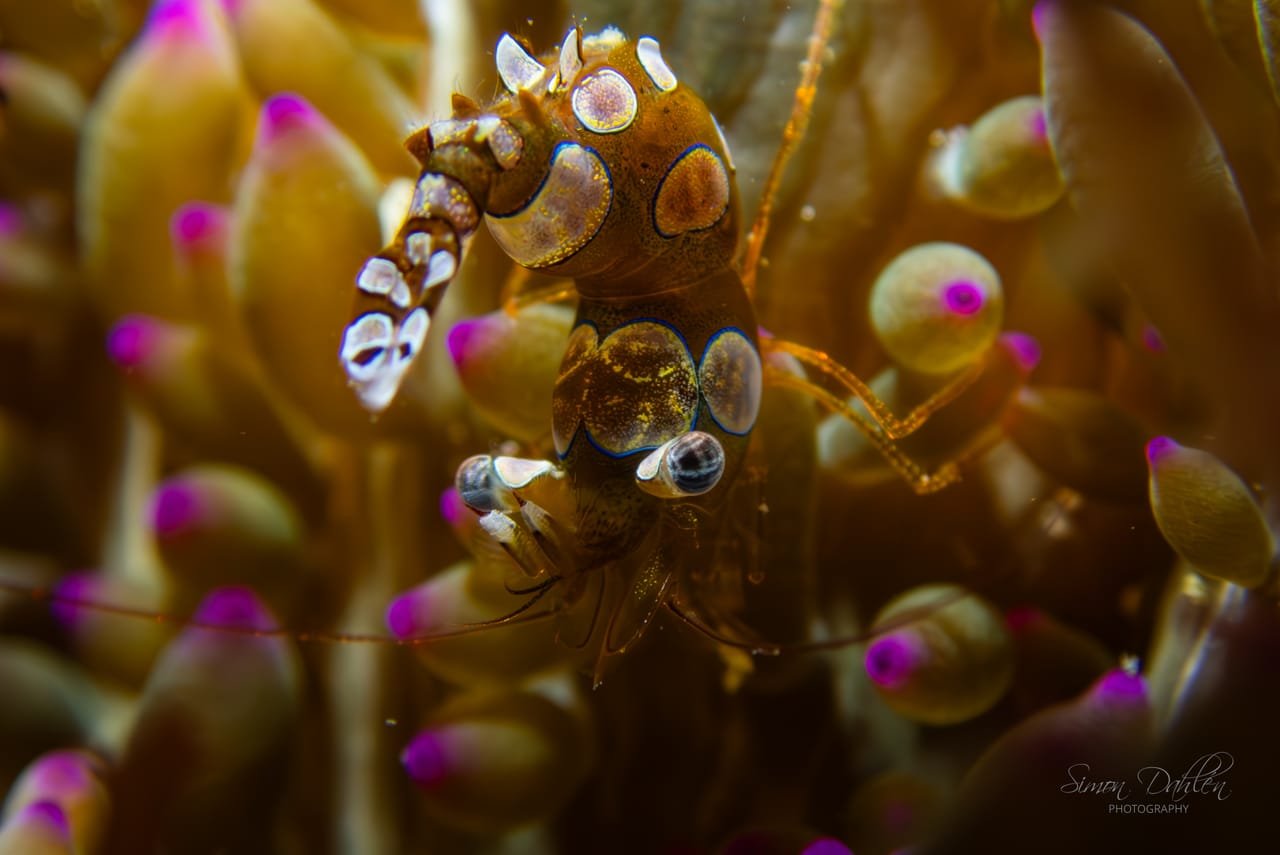
Sexy Shrimp — Thor amboinensis

Sexy Shrimp

Thor amboinensis

Tiny, wiggles its abdomen high in the air constantly. Lives in anemones and coral.

Year-round
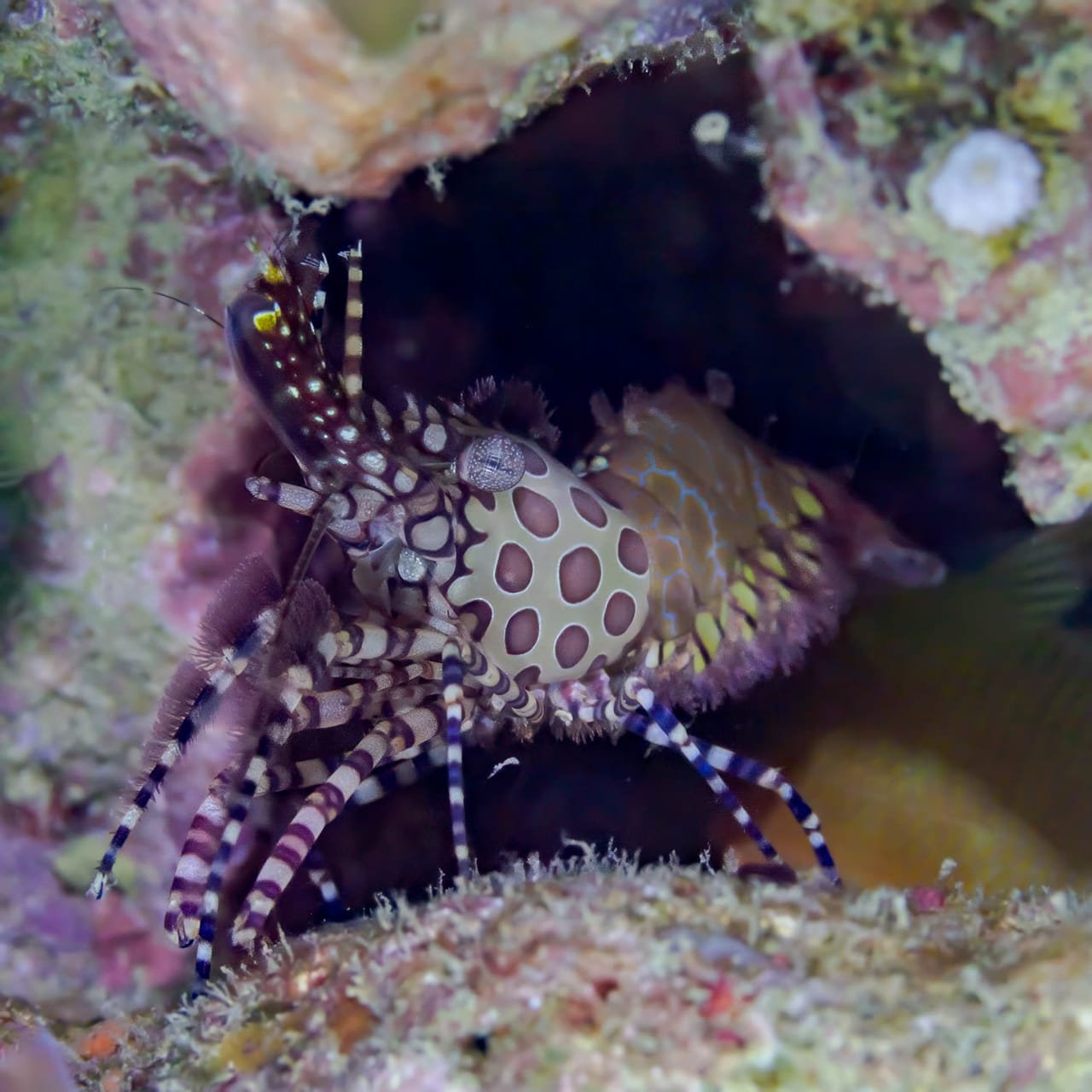
Saron Shrimp — Saron marmoratus

Saron Shrimp

Saron marmoratus

Marbled green, brown, red. Nocturnal — often photographed on night dives.

Year-round
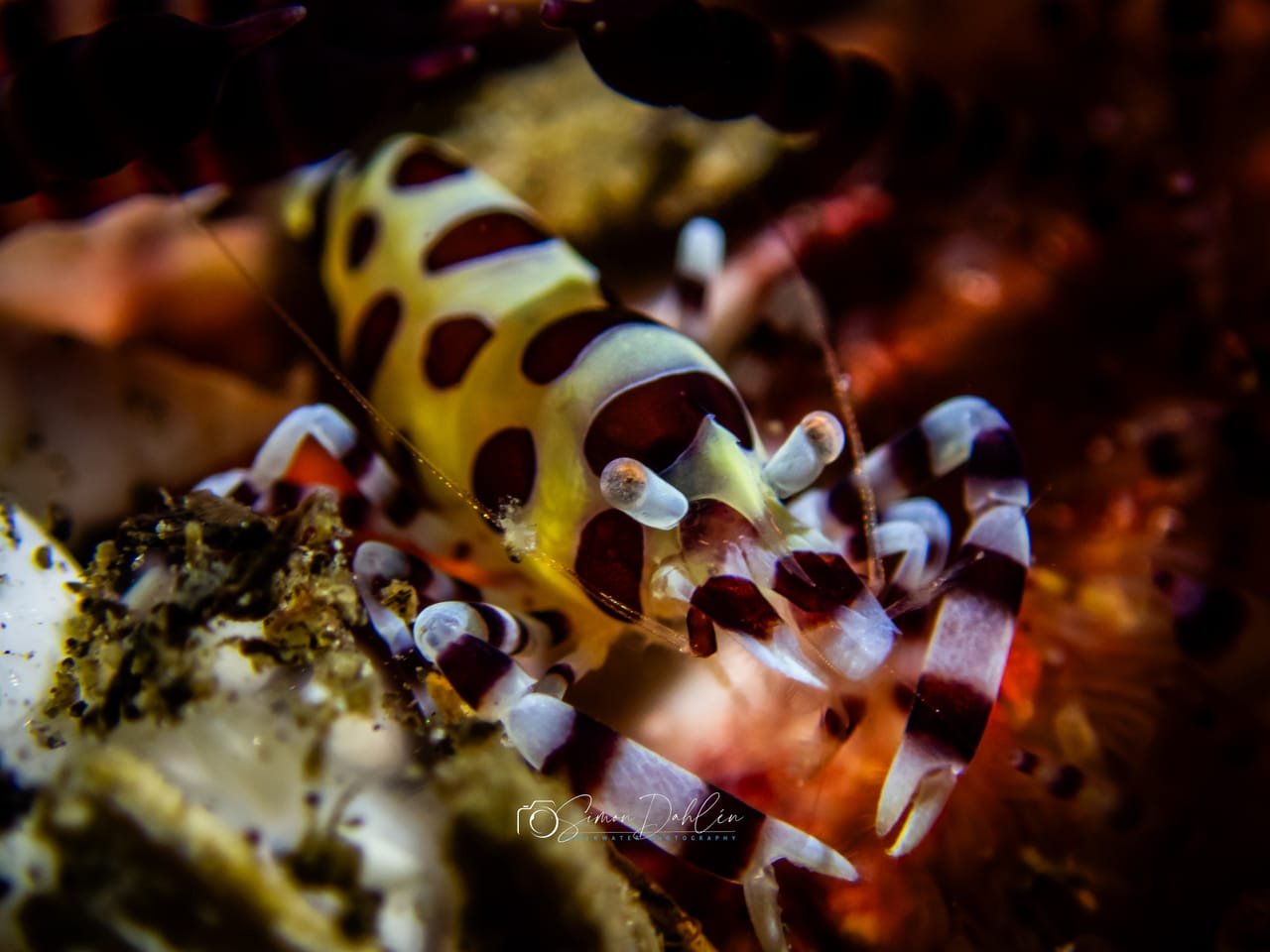
Coleman's Shrimp — Periclimenes colemani

Coleman's Shrimp

Periclimenes colemani

Lives in pairs on the venomous fire urchin, in a small clearing they keep groomed.

Year-round
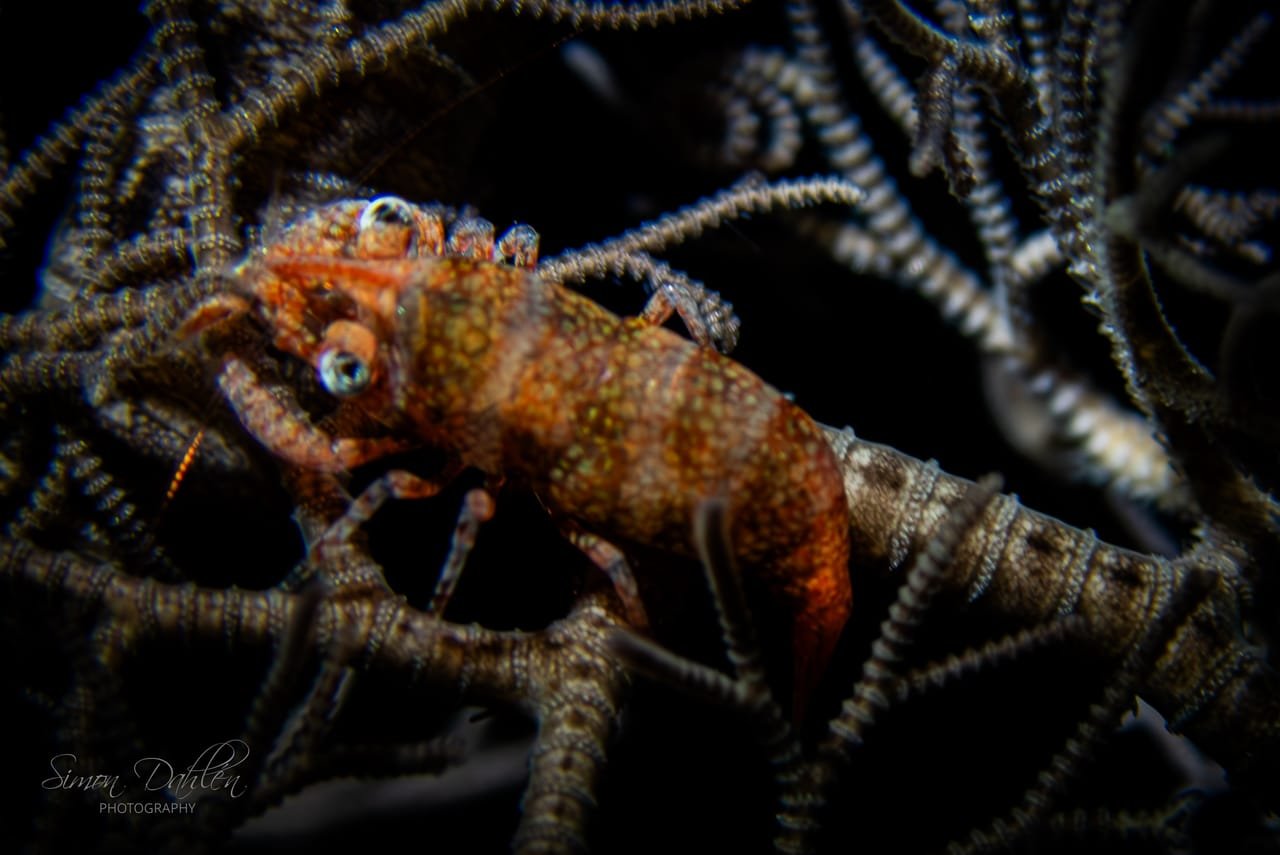
Basket Star Shrimp — Periclimenes lanipes

Basket Star Shrimp

Periclimenes lanipes

A tiny commensal shrimp that lives on basket stars, emerging at night when the host extends its arms to feed. Often paired.

Year-round · night
Where to dive for it
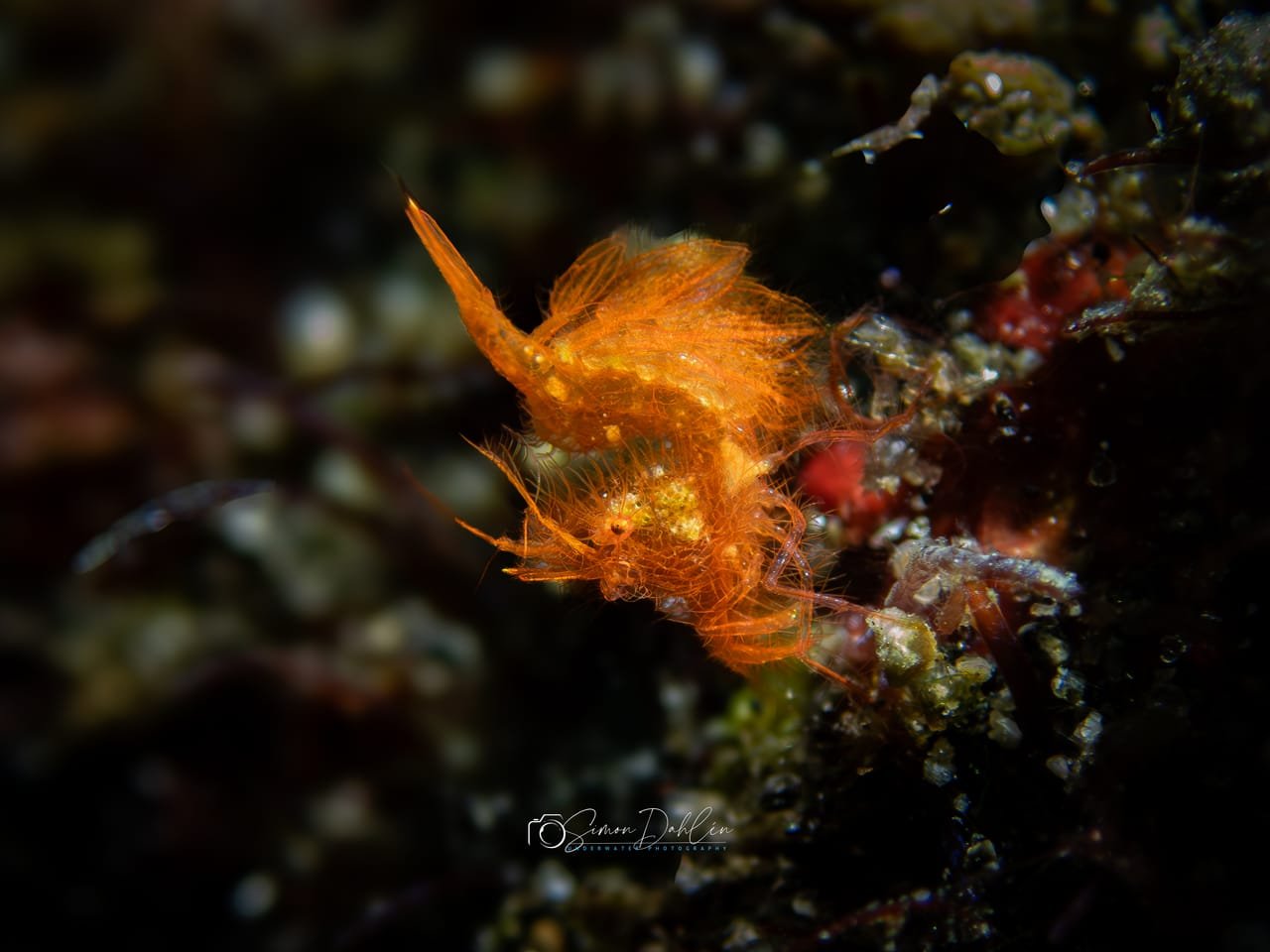
Hairy Shrimp — Phycocaris simulator

Hairy Shrimp

Phycocaris simulator

A few millimetres long and almost invisible — looks like a tuft of algae. Lives on red and green algae patches in the muck.

Year-round
Ocellate Tozeuma Shrimp — Tozeuma armatum

Ocellate Tozeuma Shrimp

Tozeuma armatum

Slender, often green or yellow, with eye-like markings near the tail. Aligns itself along sea whips and gorgonians for camouflage.

Year-round
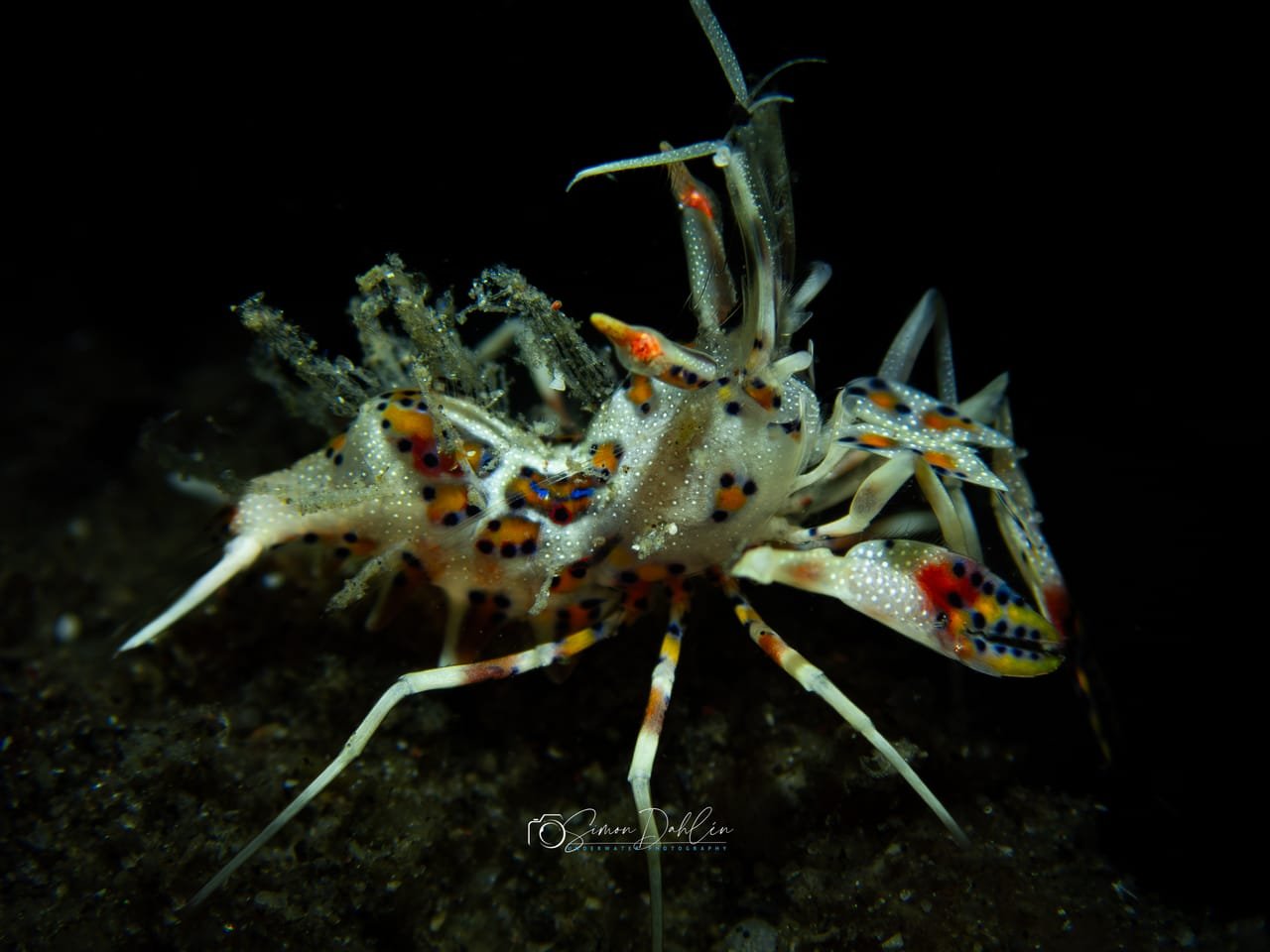
Spiny Tiger Shrimp — Phyllognathia ceratophthalmus

Spiny Tiger Shrimp

Phyllognathia ceratophthalmus

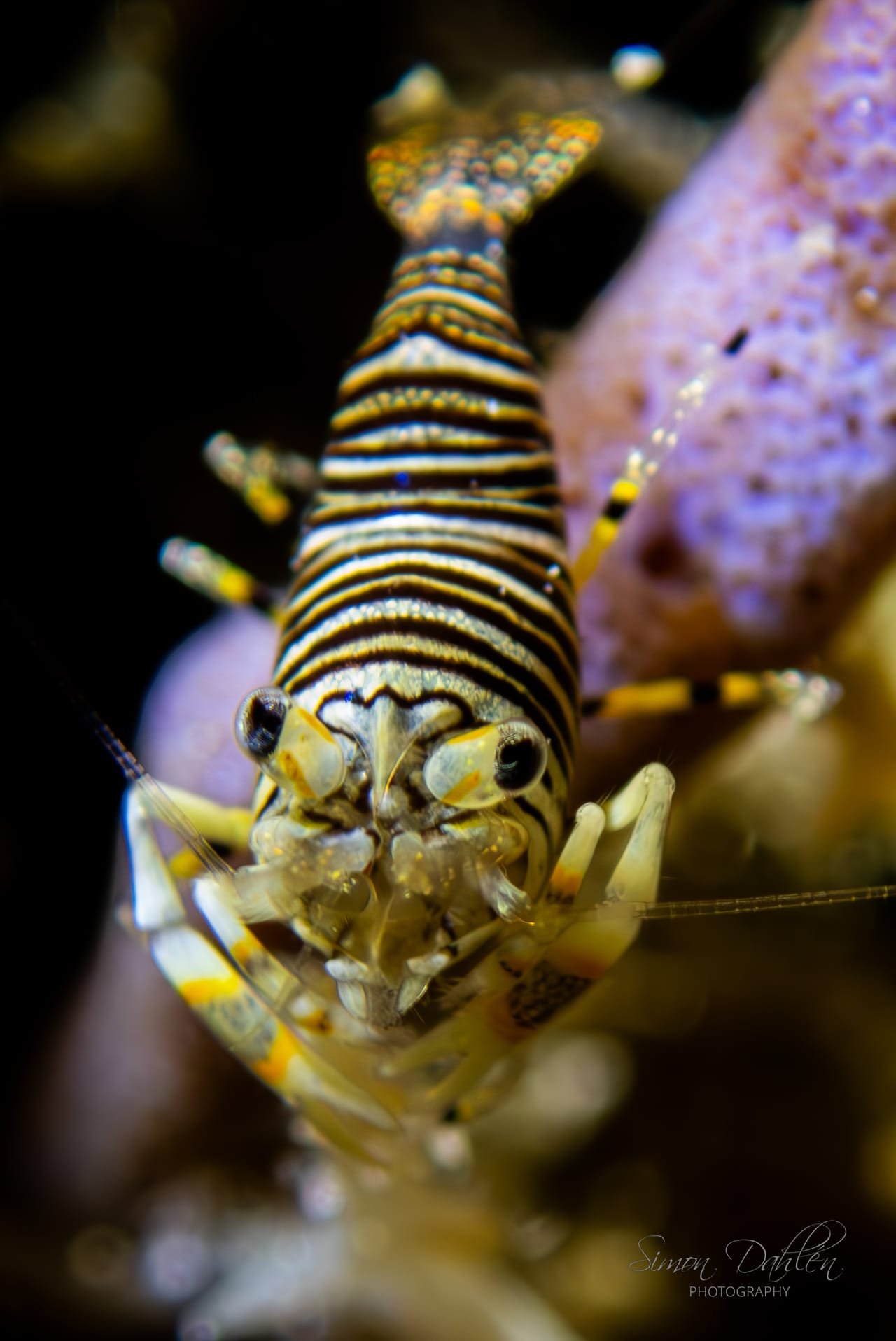
Under a centimetre long, with bold black, white, and orange stripes. Lives on or near specific sponges — hard to spot without a guide.

Year-round
Donald Duck Shrimp — Leander plumosus

Donald Duck Shrimp

Leander plumosus

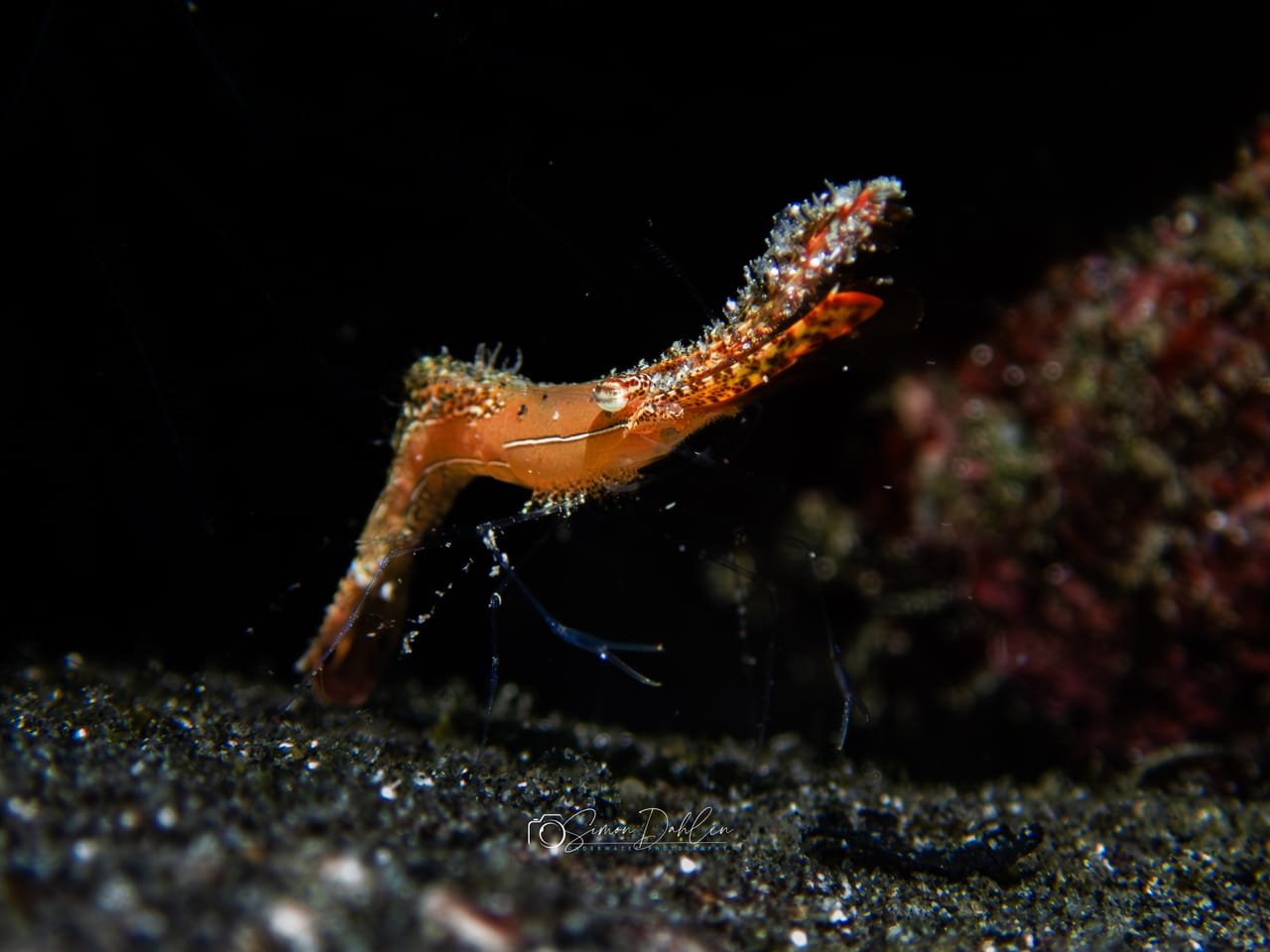
Named for its long upward-curving rostrum resembling a duck's bill. Transparent body with subtle markings, often found on sandy slopes.

Year-round
Bumblebee Shrimp — Gnathophyllum americanum

Bumblebee Shrimp

Gnathophyllum americanum

Tiny shrimp with bold black-and-yellow stripes — the colour pattern of a bumblebee. Lives in coral rubble and on sea cucumbers and starfish, feeding on tube feet.

Year-round
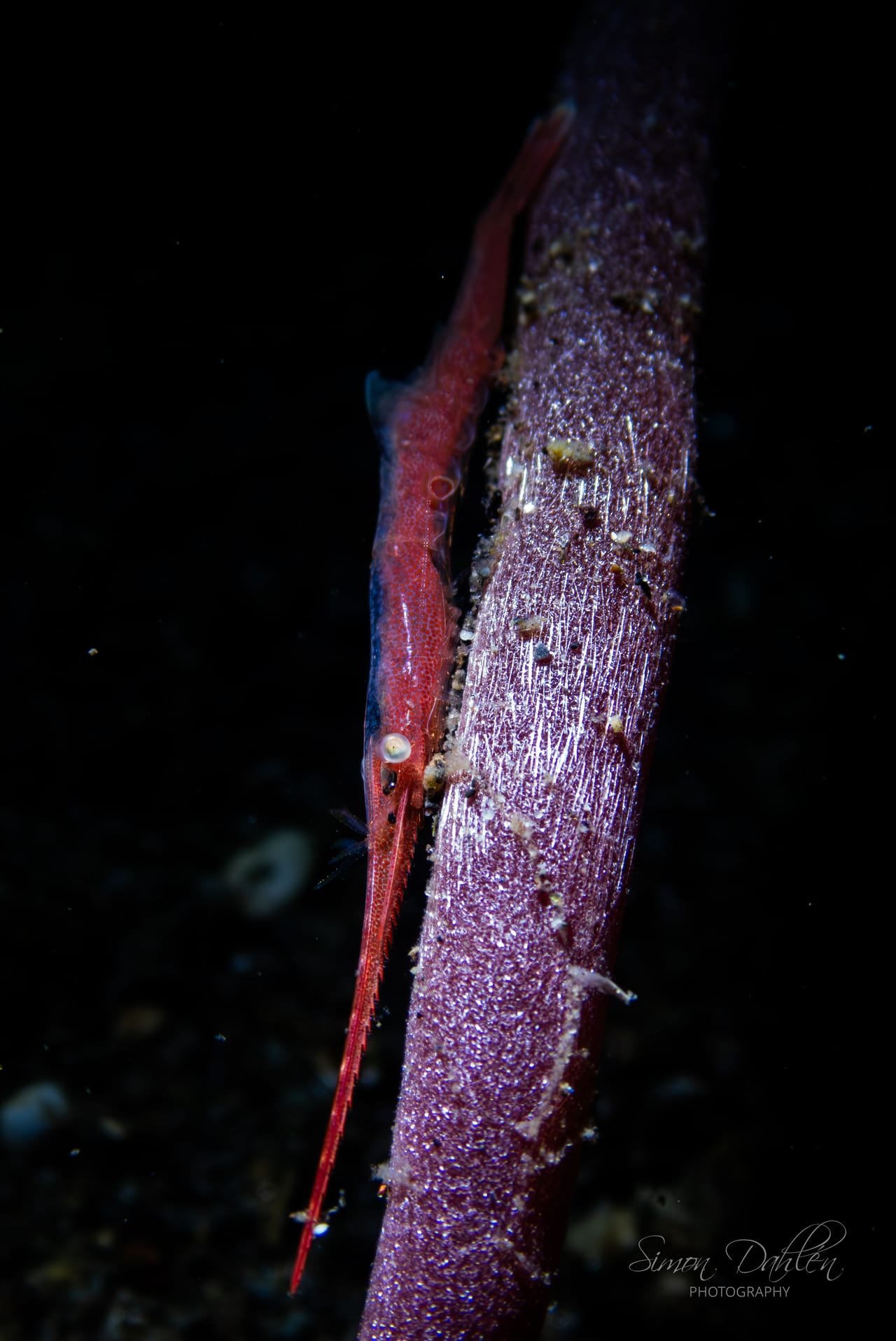
Anker's Whip Coral Shrimp — Pontonides ankeri

Anker's Whip Coral Shrimp

Pontonides ankeri

Tiny commensal shrimp — under a centimetre — found exclusively on whip corals (Cirrhipathes). Translucent with white and red markings, almost invisible against its host.

Year-round
Decorator Crab — Camposcia retusa

Decorator Crab

Camposcia retusa

Attaches sponges, algae, and hydroids to itself for camouflage. Walks unnoticed in plain sight.

Year-round

Nudibranchs & Sea Slugs

Alor's nudibranch diversity is genuinely world-class — different sites, different substrates, different finds. Keep a list across a week of diving and it gets long quickly. The species below are reliable starting points.

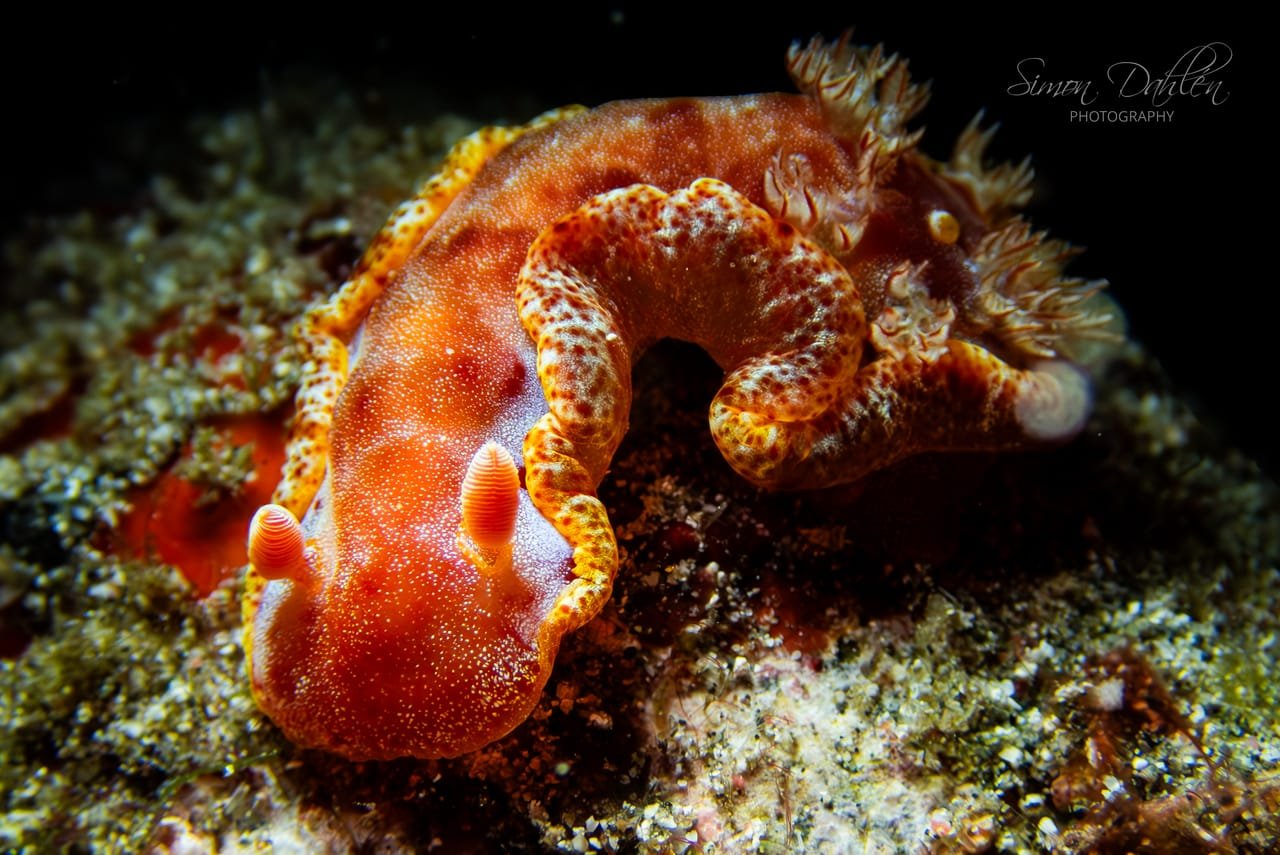
Spanish Dancer — Hexabranchus sanguineus

Spanish Dancer

Hexabranchus sanguineus

The largest nudibranch in the world — up to 60 cm, deep red, and one of the few that swims openly. Most often seen on night dives, flaring the wide skirt of its mantle as it moves.

Year-round · night
Where to dive for it
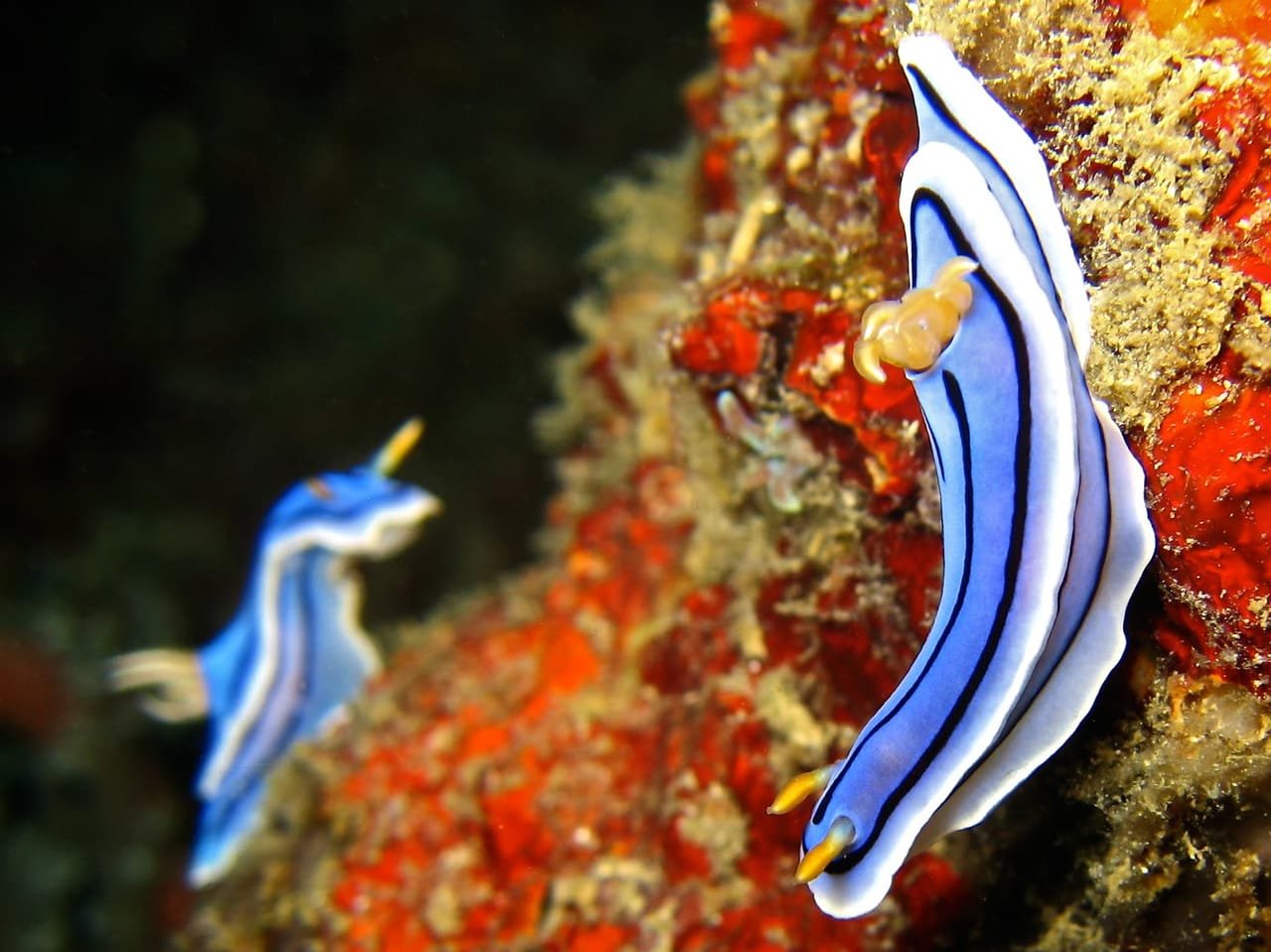
Chromodoris — Chromodoris spp.

Chromodoris

Chromodoris spp.

A genus of dozens of small, vividly patterned nudibranchs. Most reefs hold several species.

Year-round
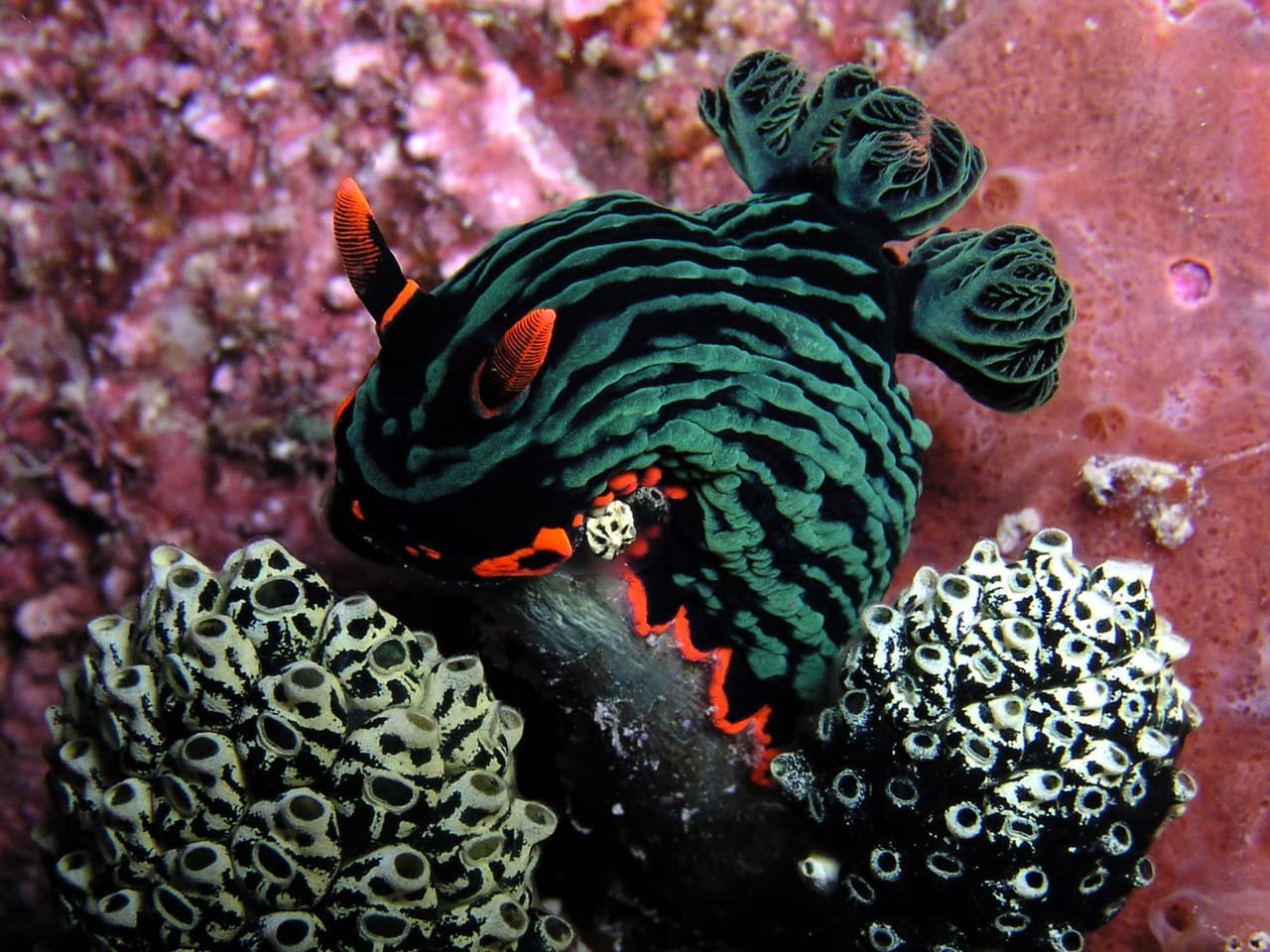
Nembrotha kubaryana — Nembrotha kubaryana

Nembrotha kubaryana

Nembrotha kubaryana

Black body, orange gills, lime-green stripes. Feeds on tunicates — easy to find where they are.
Year-round
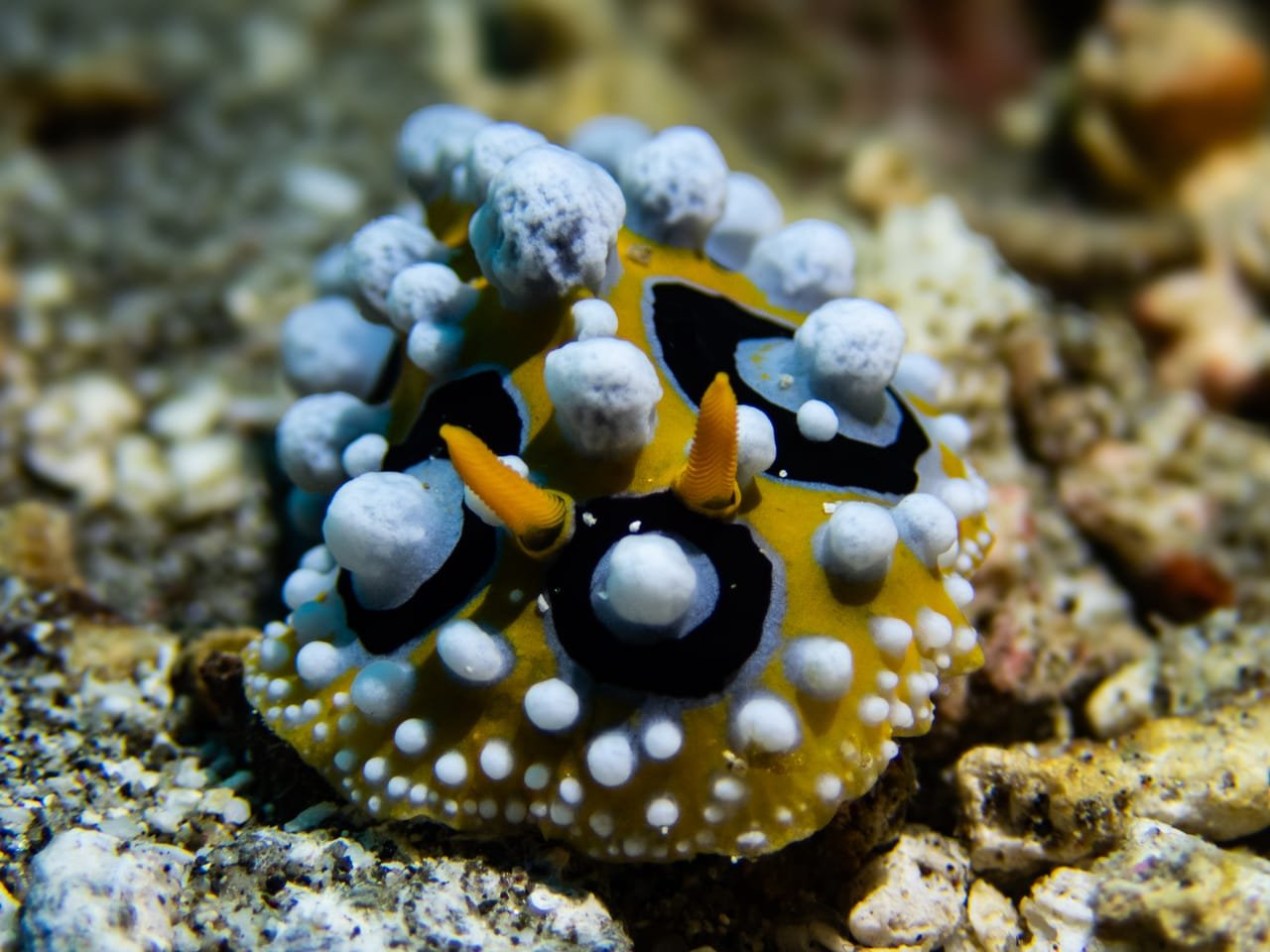
Phyllidia — Phyllidia spp.

Phyllidia

Phyllidia spp.

Hard-textured nudibranchs with pustular ridges — black, yellow, blue, white. Toxic, slow, photogenic. The ocellate Phyllidia ocellata pictured is one of several reliable species.
Year-round
Phyllodesmium longicirrum — Phyllodesmium longicirrum

Phyllodesmium longicirrum

Phyllodesmium longicirrum

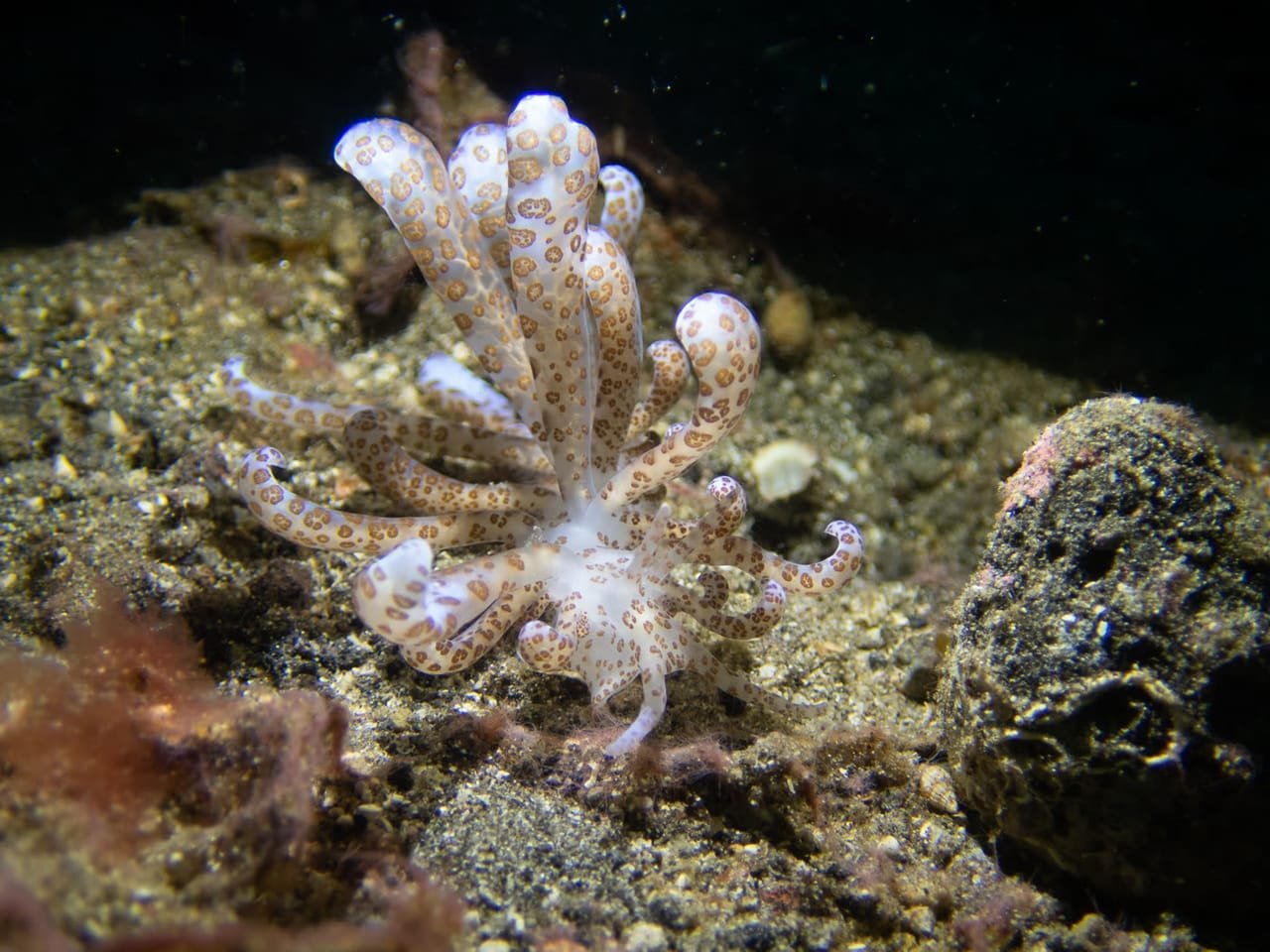
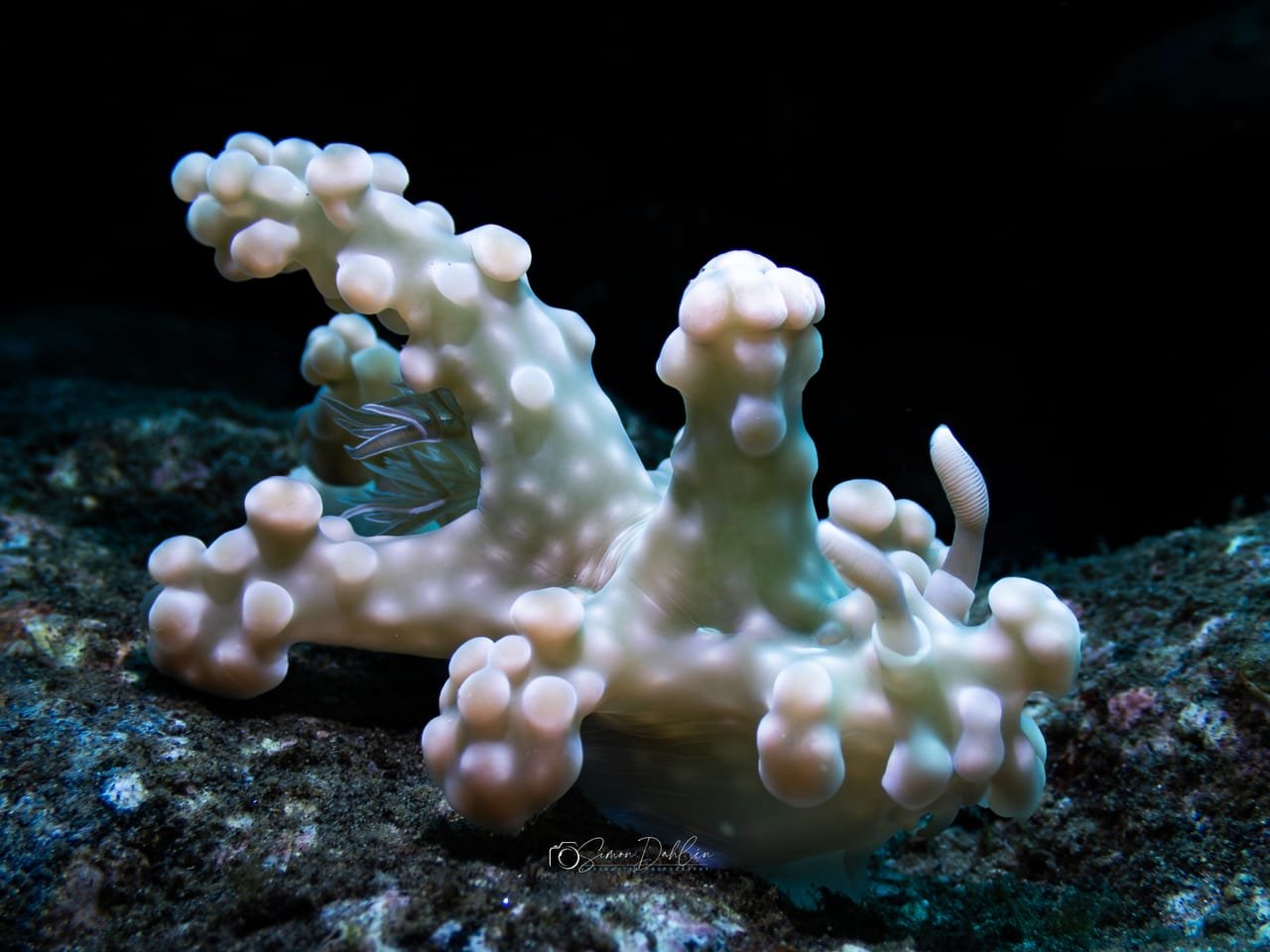
The largest member of the genus and one of the most striking — solar-powered, housing symbiotic algae in its cerata and living partly off sunlight. Cream body covered in brown leopard-print spots, with long radiating cerata that curl like a forest.

Year-round
Blue Dragon — Pteraeolidia ianthina

Blue Dragon

Pteraeolidia ianthina

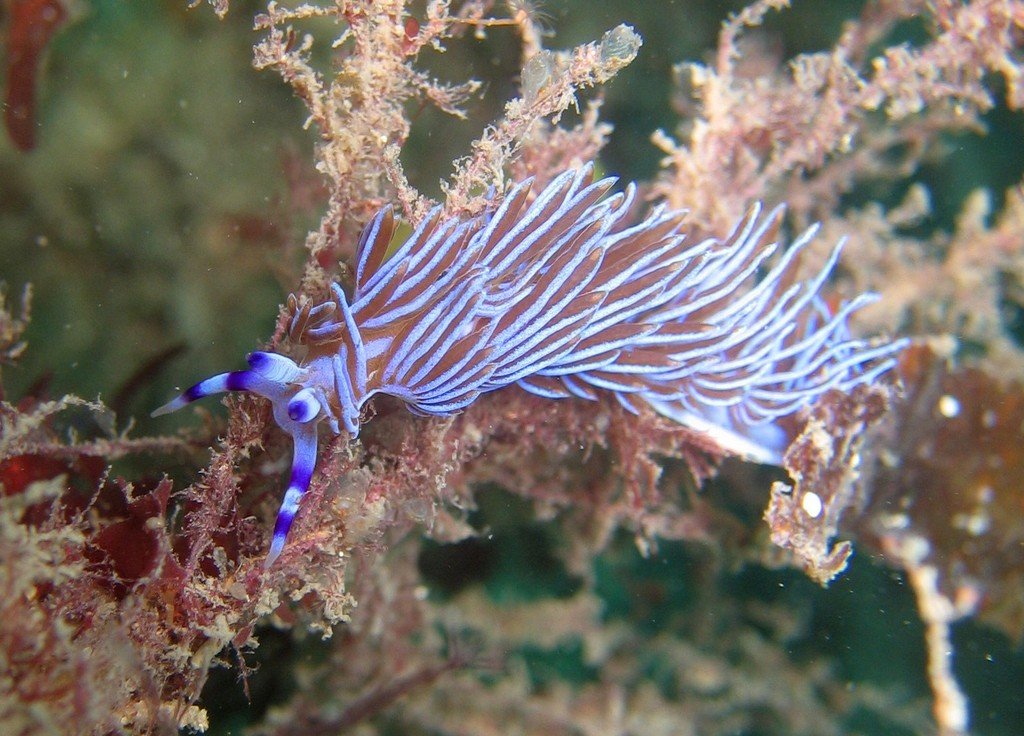
Long, blue, dragon-shaped — also solar-powered, also lives on hydroids it eats and inherits the stings of.

Year-round
Leaf Sheep — Costasiella kuroshimae

Leaf Sheep

Costasiella kuroshimae

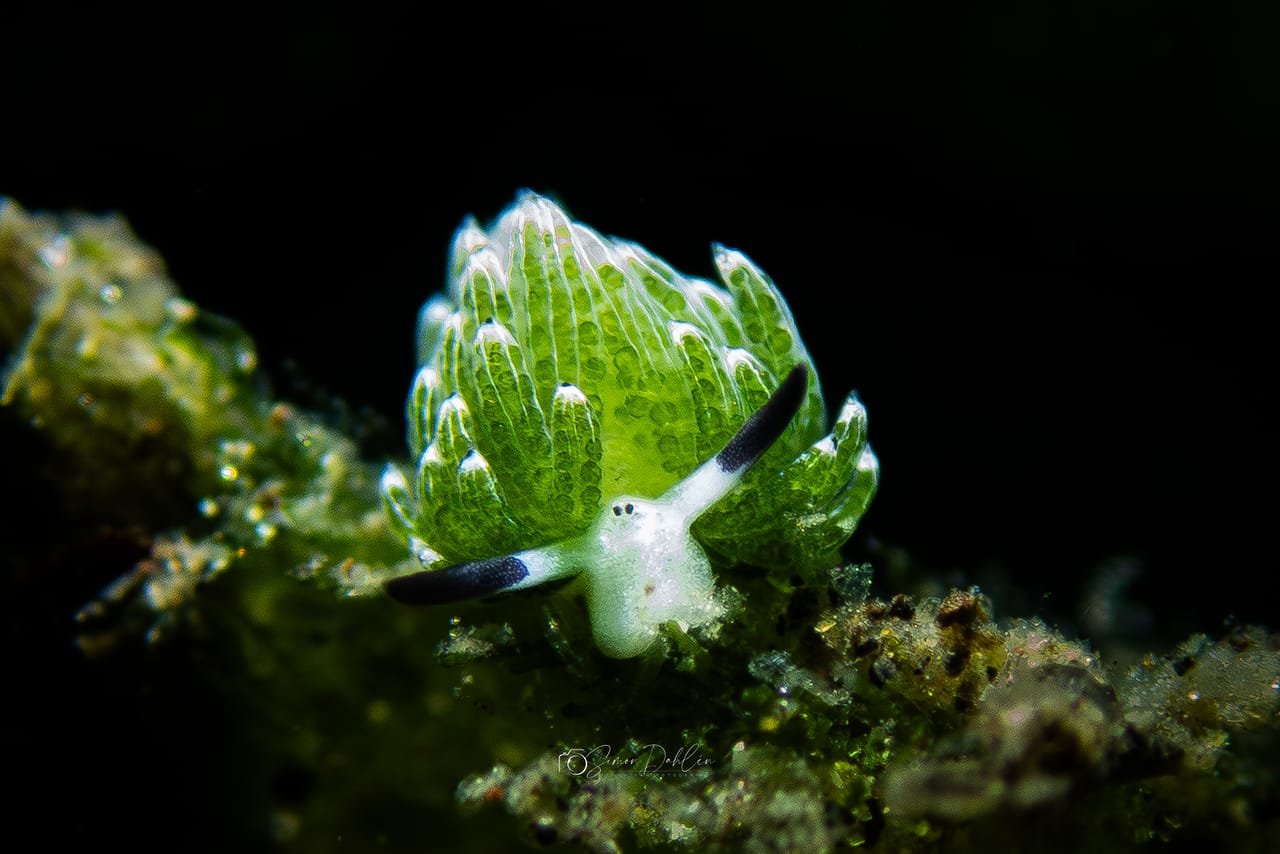
Tiny green sap-sucking slug, ~5 mm, with leaf-like cerata. Lives on a specific green algae. Also known as the "Shaun the Sheep" nudibranch.

Year-round
Elysia marginata — Elysia marginata

Elysia marginata

Elysia marginata

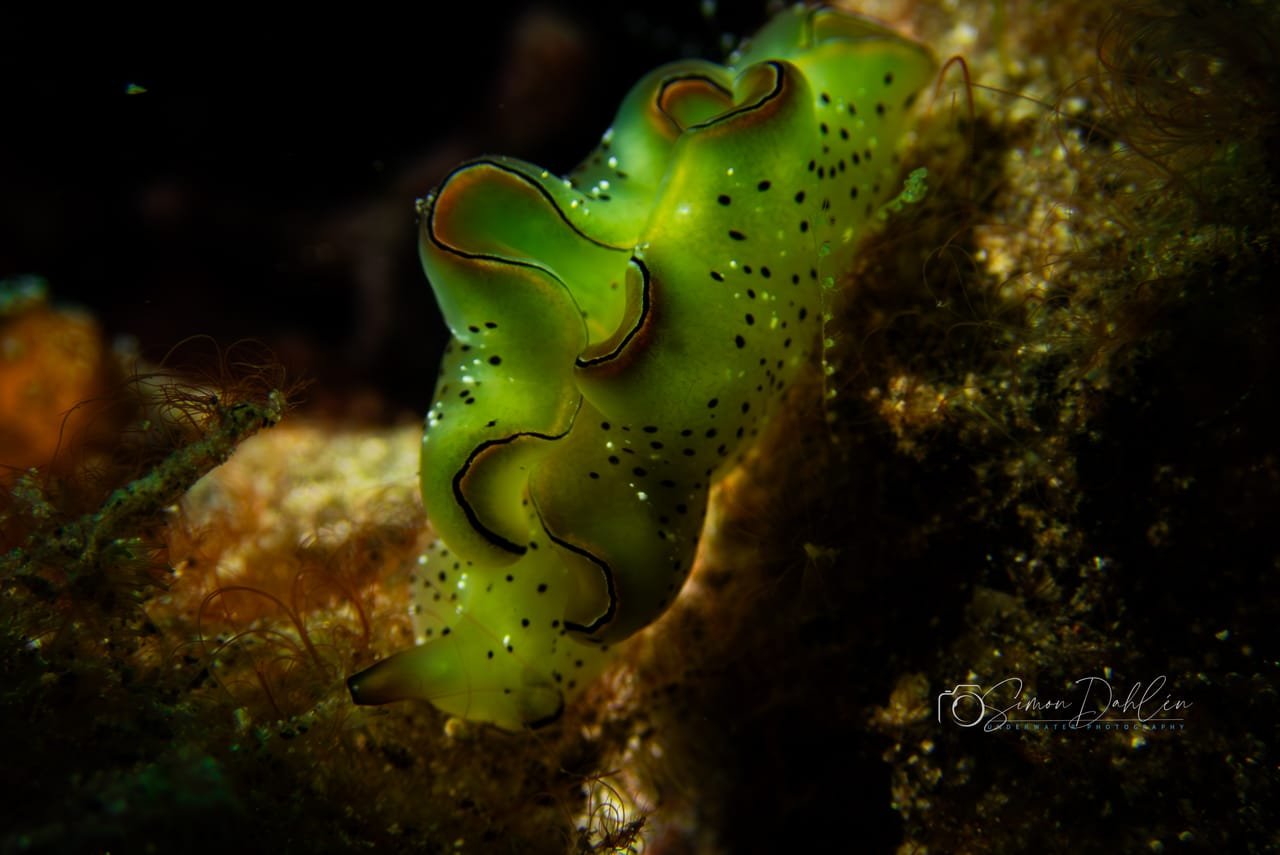
Sap-sucking sea slug — vivid green from the chloroplasts it steals from the algae it eats. Black-and-orange margin runs along the ruffled edges of its parapodia. Best known for its ability to autotomise and regrow its entire body.

Year-round
Headshield Slugs — Chelidonura spp.

Headshield Slugs

Chelidonura spp.

Sand-dwelling, with a flat plate on the head used to plough through the substrate. Iridescent blues and yellows.

Year-round
Miamira alleni — Miamira alleni

Miamira alleni

Miamira alleni

Pale cream body covered in pinkish-tipped tubercles, with long sensory rhinophores trailing back. A subtle, photogenic find on the rubble and reef edges — sponges are the host.

Year-round
Miamira sinuata — Miamira sinuata

Miamira sinuata

Miamira sinuata

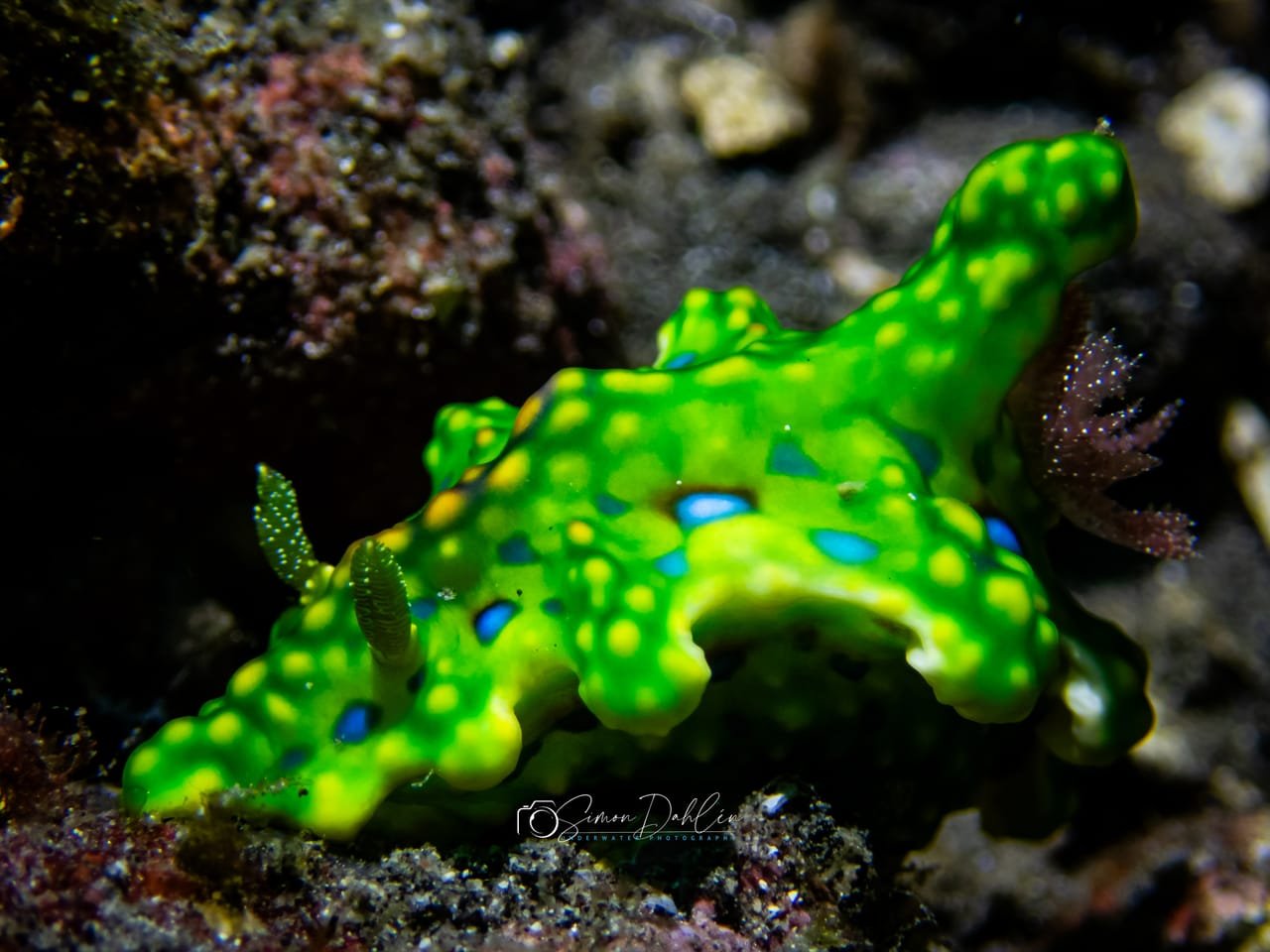
Brilliant lime-green body studded with iridescent blue spots ringed in yellow and orange — like a piece of reef carved out and put on the move. A favourite for macro photographers.

Year-round
Glossodoris — Glossodoris sp.

Glossodoris

Glossodoris sp.

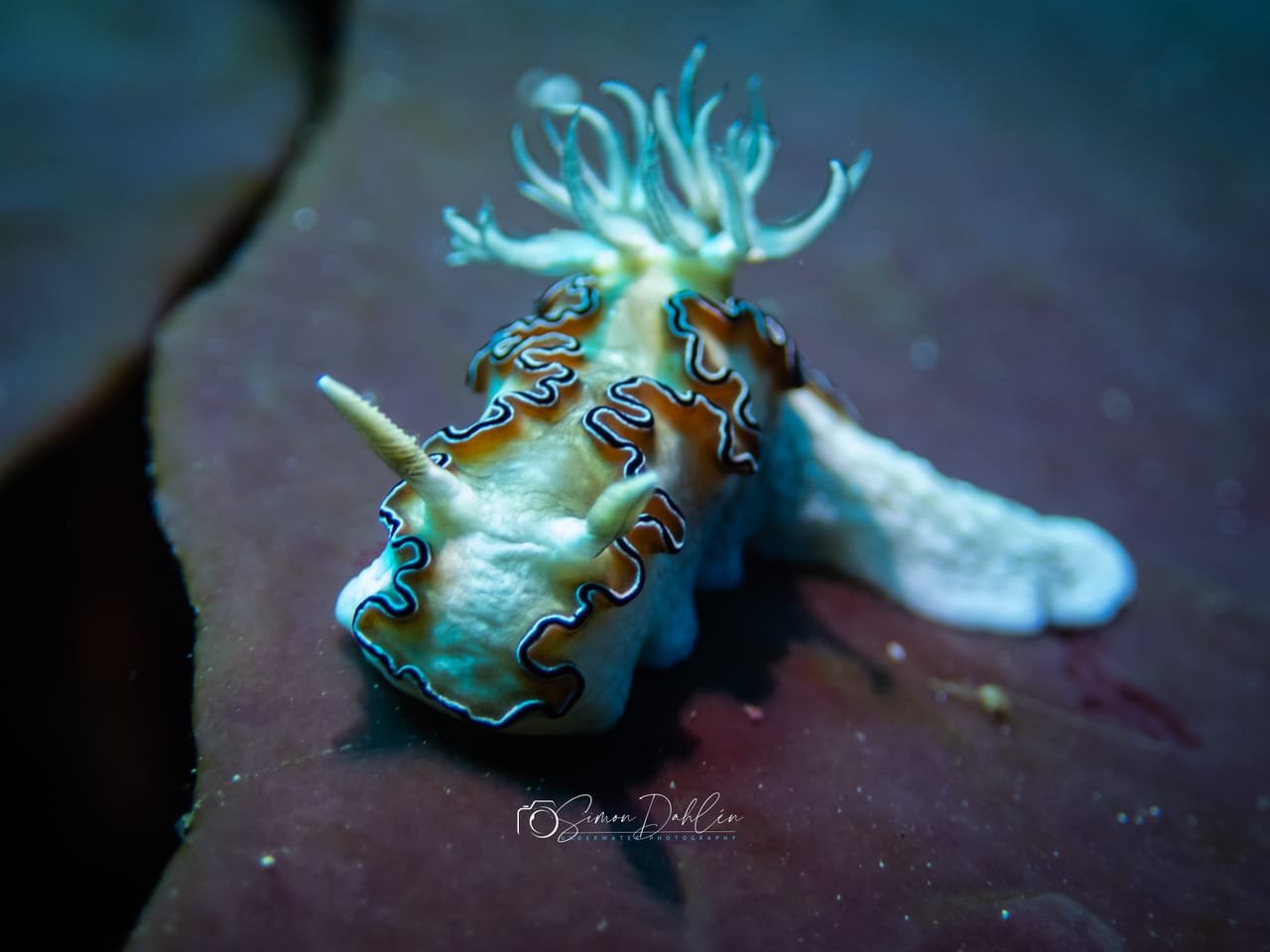
Striking white body with a ruffled purple-edged mantle. Lives on a specific coral that grows only in the strong currents of the southern strait — most often found at Apuri Bay and the deep walls and pinnacles further south.

Year-round
Batangas Halgerda — Halgerda batangas

Batangas Halgerda

Halgerda batangas

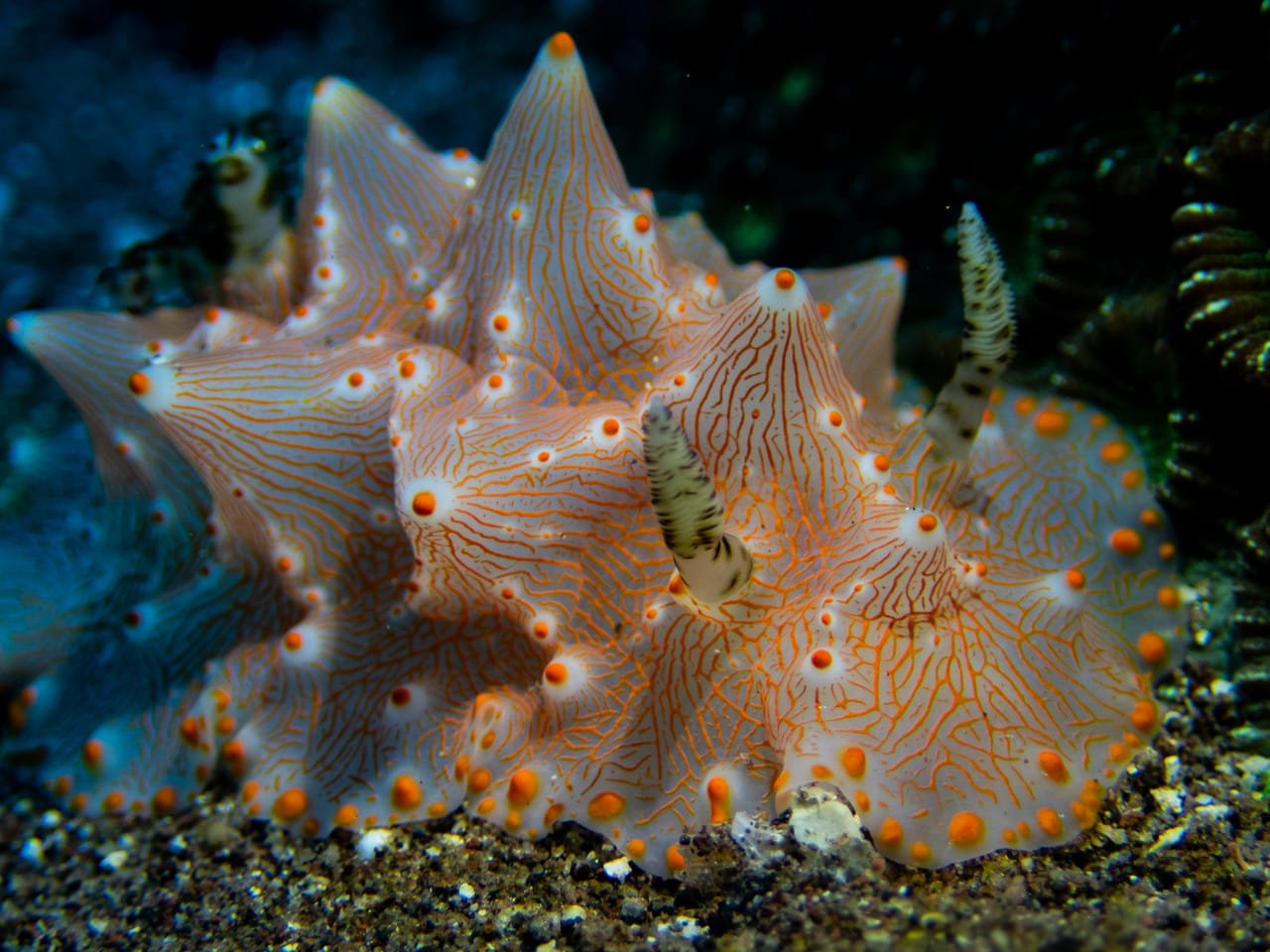
White body finely veined in bright orange, with raised tubercles tipped in orange. A striking find on tropical reefs, often near sponges.

Year-round
Goniobranchus hintuanensis — Goniobranchus hintuanensis

Goniobranchus hintuanensis

Goniobranchus hintuanensis

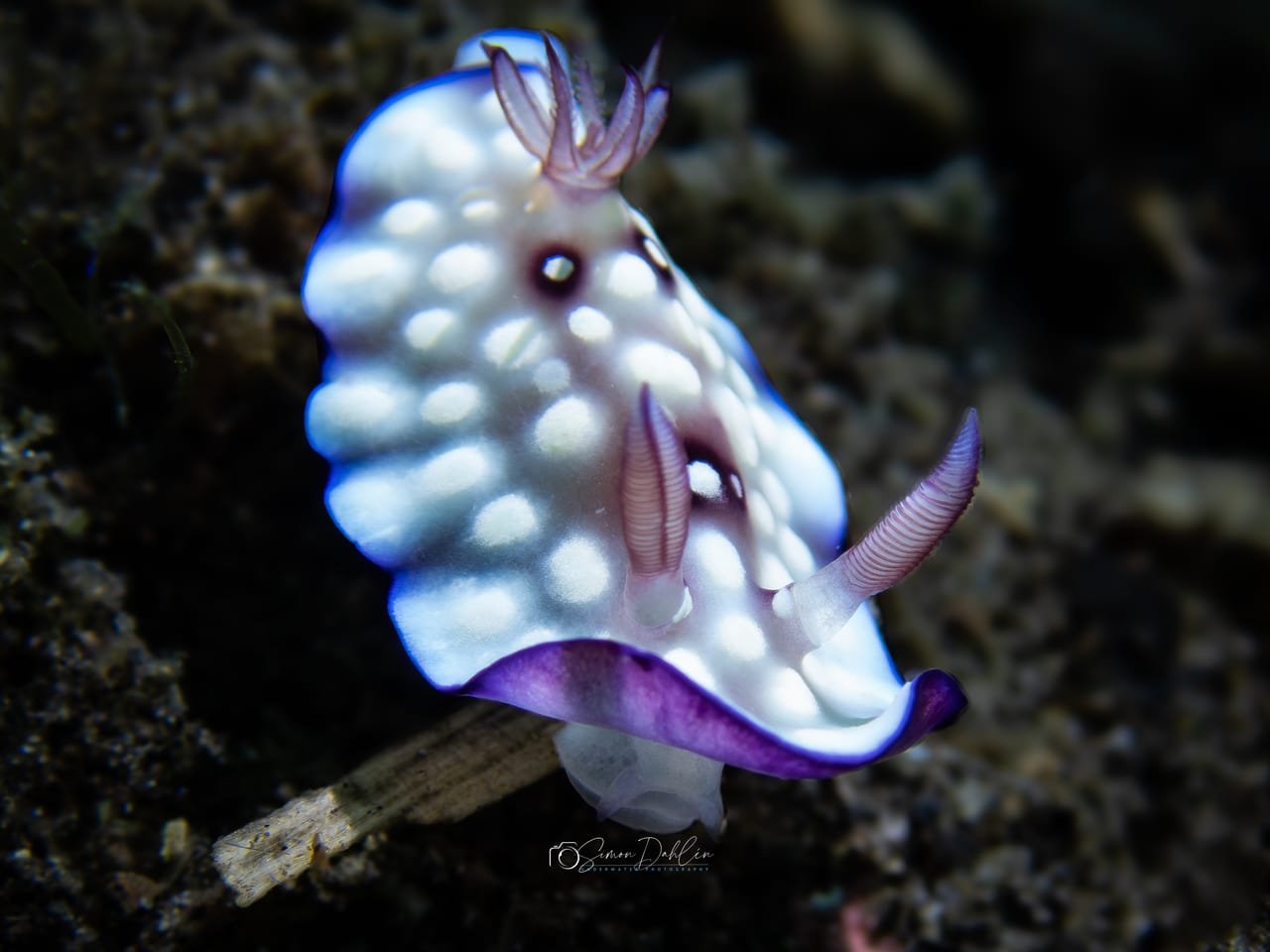
White body covered in raised pearl-like tubercles, with a vivid purple band running around the ruffled mantle skirt. Small but unmistakable when found.

Year-round
Jorunna rubescens — Jorunna rubescens

Jorunna rubescens

Jorunna rubescens

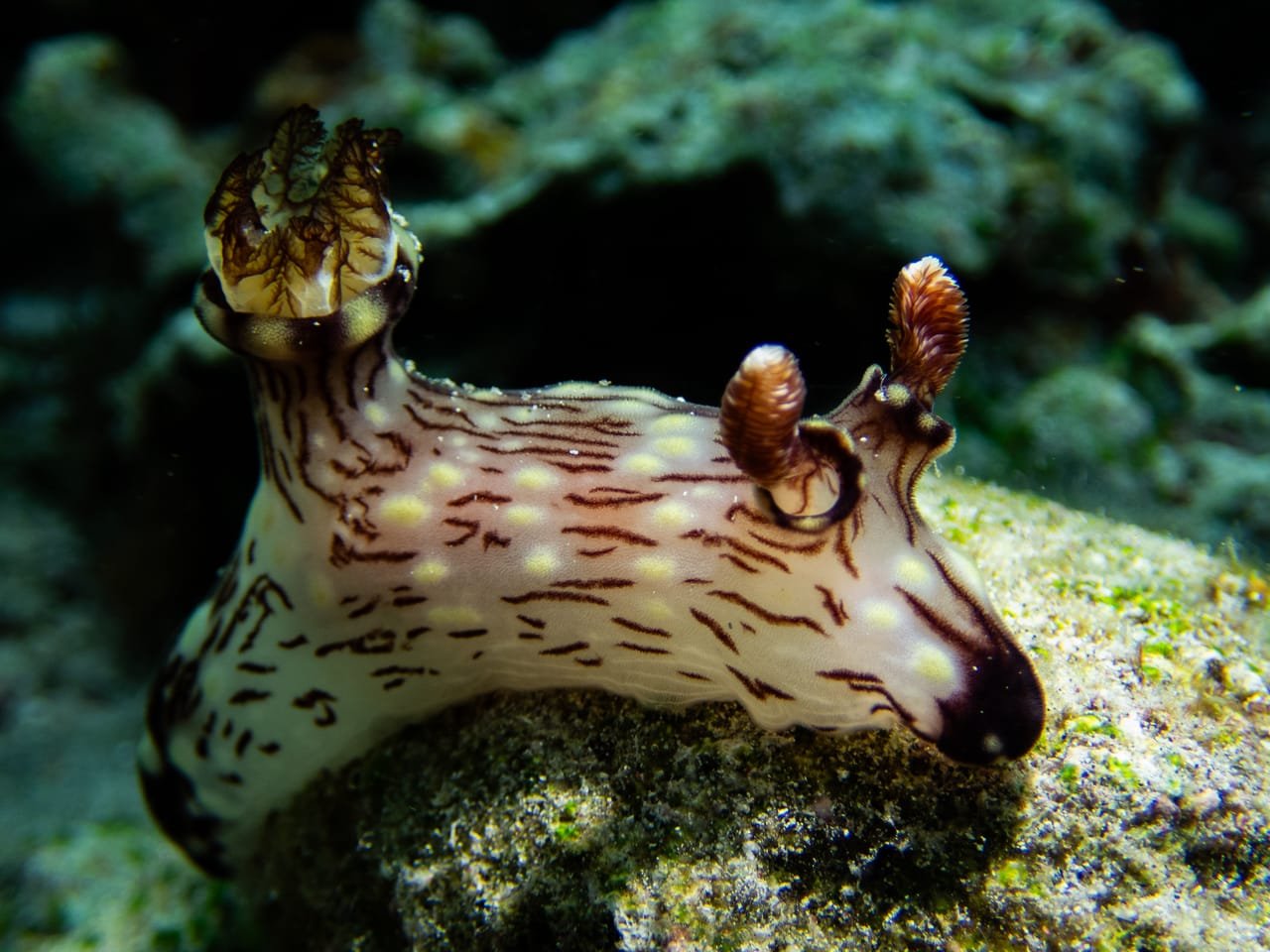
Pale cream body covered in fine dark-brown reticulated lines and scattered yellow spots. Striking feathery gills and rhinophores in deep chestnut tones — easily mistaken for several lookalikes until you see those plumes.

Year-round
Red-line Flabellina — Coryphellina rubrolineata

Red-line Flabellina

Coryphellina rubrolineata

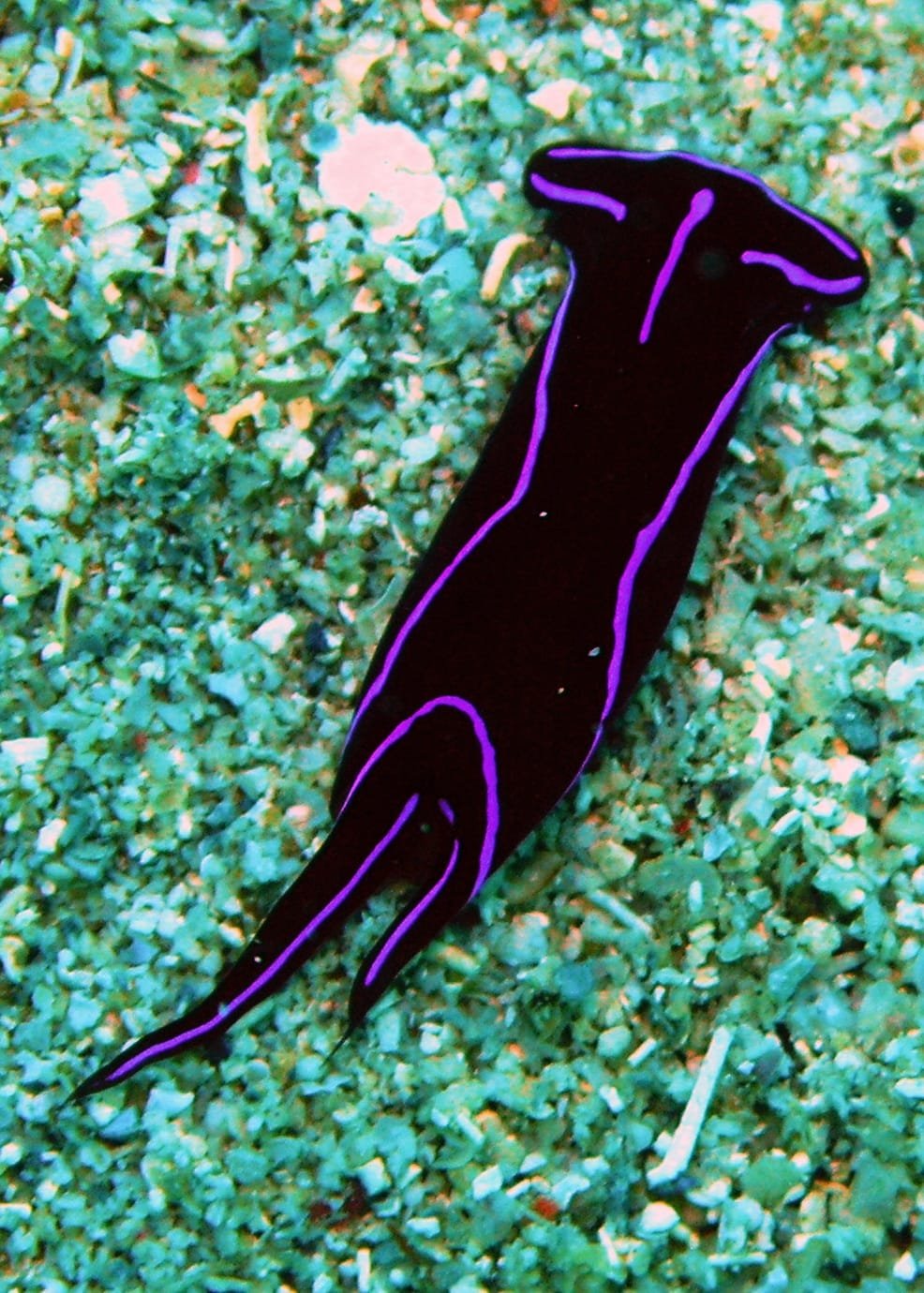
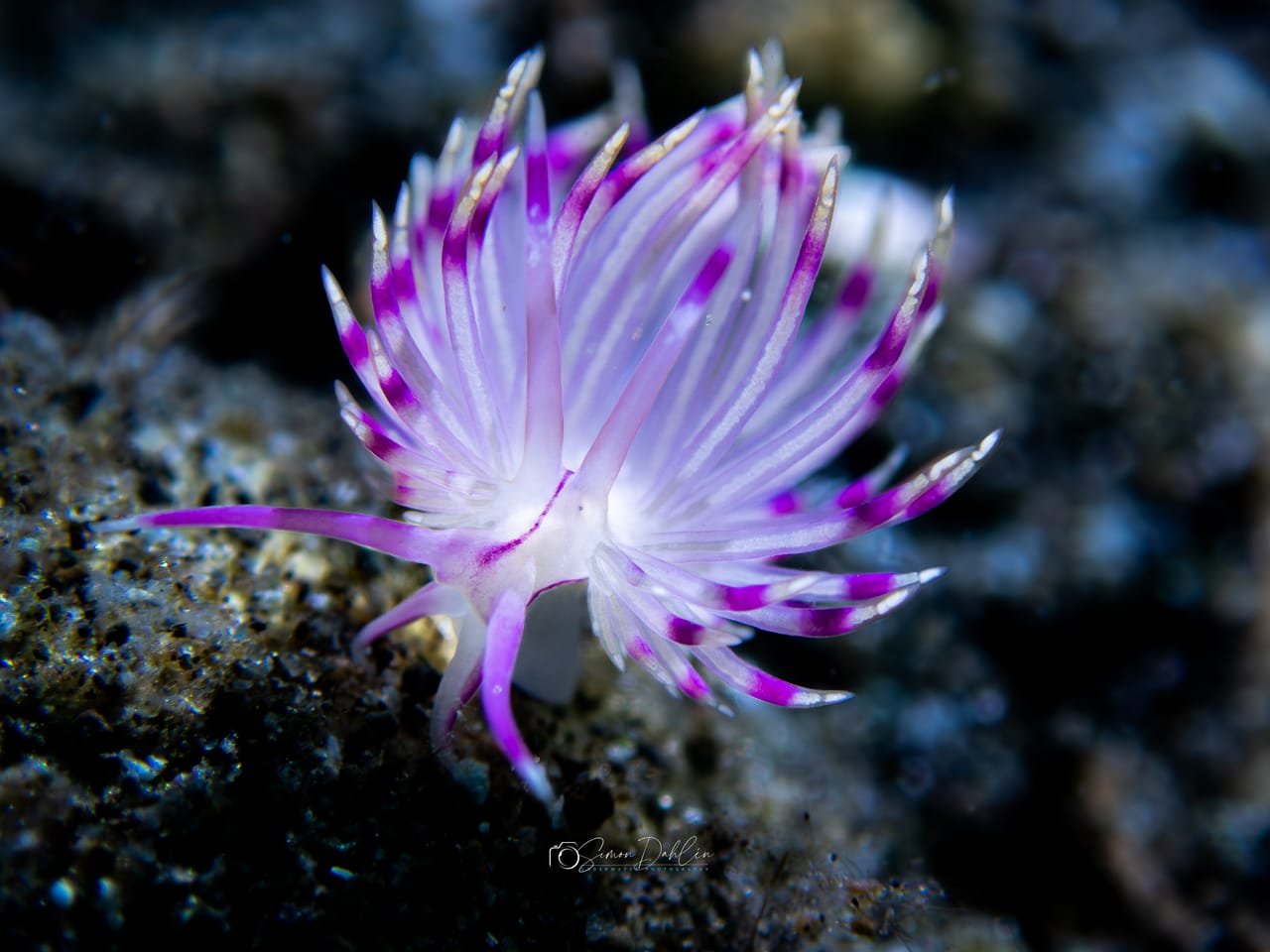
A vivid aeolid nudibranch — white body with electric-purple-tipped cerata radiating outward. Feeds on hydroids in shallow reef areas.

Year-round
Conservation

Diving with Light Hands in the Coral Triangle

The Coral Triangle holds three-quarters of all known coral species and over two thousand species of reef fish. Alor's reefs remain in good shape largely because the place is remote, the currents are demanding, and visitor numbers have stayed low. We'd like to keep it that way.

We dive with no gloves, no touching, neutral buoyancy, no flash on macro subjects without our guides' nod. We coordinate sites with the other operators on the island so reefs are never crowded. Plastic stays on the boat. Conservation isn't a marketing line here — it's the only way the diving survives at all.

Plan Your Dives

Time Your Visit to the Species You Want to See

Different windows favour different encounters. Blue whales in June or November. Hammerheads at full or new moon. Mola and threshers in the cold-water months. Macro at any time. Our team will help you plan a trip around the species you most want to see — and the conditions you're comfortable diving in.

Chat with us